Australia’s motor insurance market is absorbing a vehicle fleet transition it was not built to handle – and new consumer research puts numbers on how fast that gap is widening.
The third instalment of NRMA Insurance’s Changing Gears series, Closing the Confidence Gap, conducted by Ipsos across approximately 2,000 Australians, found national consideration of battery EVs (BEVs) rose from 20% to 31% between 2024 and 2026. Consideration of plug-in hybrid vehicles (PHEVs) climbed from 41% to 58% over the same period. Just 17% of respondents said they would not consider an EV.
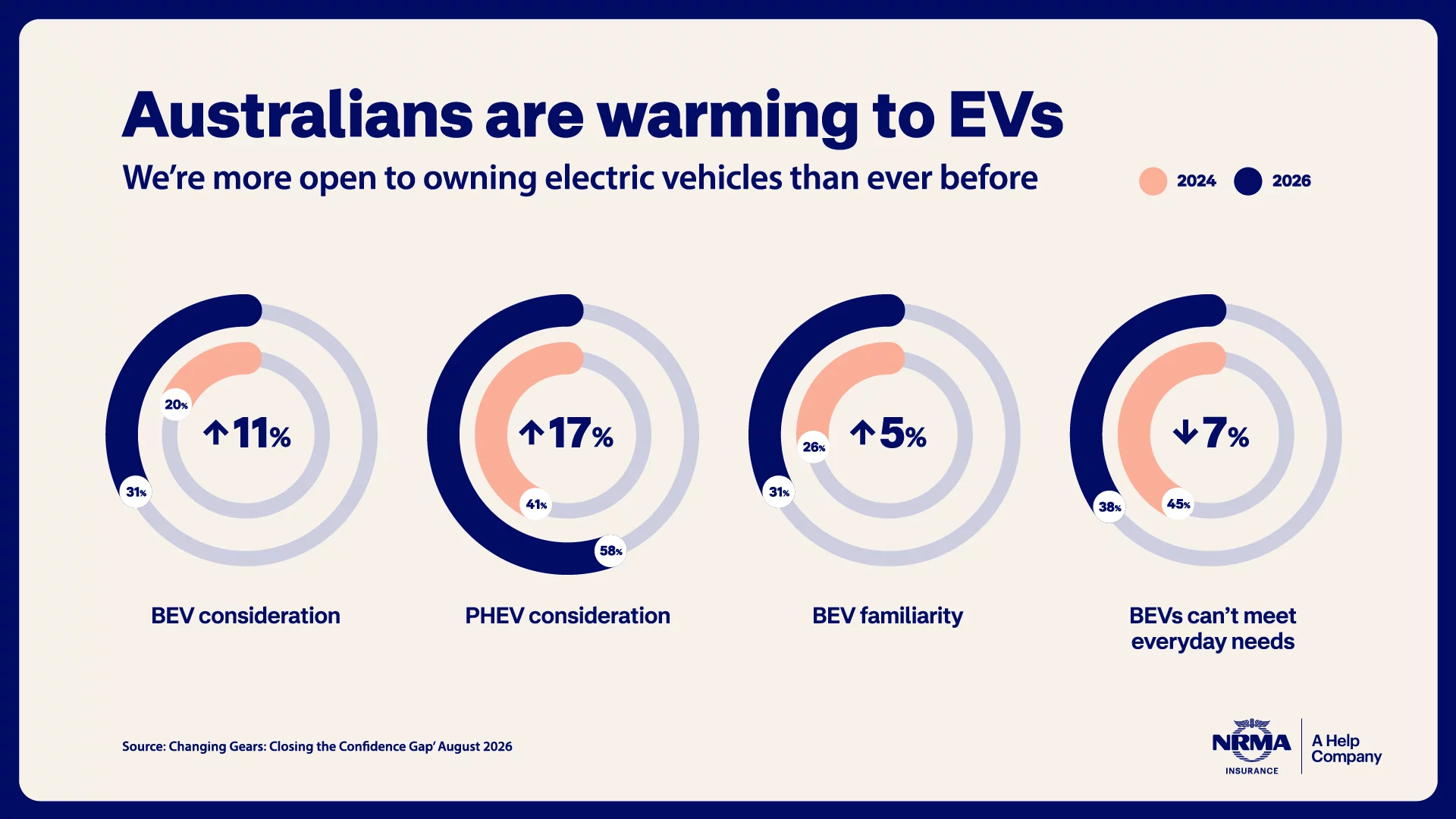
Those figures land against a broader market shift. In August 2026, battery EVs outsold every other fuel type in Australia for the first time, taking 25.6% of new car sales – ahead of petrol at 24.4% and diesel at 22.3%, according to the Electric Vehicle Council.
The report finds purchase intent is strongest among younger generations. Gen Z leads at 81% likely to buy a BEV in future, followed by millennials at 73%. By contrast, Gen X sits at 48% and Boomers at 20%.
The used EV market is central to that picture. More than half of all prospective EV buyers (54%) said they would consider buying second-hand. For younger Australians with tighter budgets, a used vehicle is often the only realistic route into ownership – yet the report notes that as of mid-2026, only two new battery EVs were available in Australia under $30,000.
Owner confidence in achieving a strong resale value has also fallen sharply – from 76% in 2024 to 56% in 2026 – a shift the report attributes to real depreciation movement rather than perception alone.
Eighty-two percent of respondents said they want a way to monitor and test EV battery health. That figure sits at the centre of both the used market problem and a product gap: no standard Australian motor insurance offering currently includes battery health monitoring.
ROLLiN’ executive manager Brendan Griffiths said the market’s immediate challenge is converting stated interest into actual purchases. “Australians are increasingly open to EVs, but they want confidence that ownership will be practical, affordable, and easy to fit into their everyday lives,” Griffiths said.
“For younger drivers, the issue isn’t willingness to make the switch. It’s access. Affordable vehicles, charging convenience, and a trusted second-hand market will be critical to the next wave of EV adoption,” he added.
Read next: Fuel volatility and model expansion are fuelling EV insurance demand – NRMA Insurance
The availability of qualified EV repairers is a concrete constraint on the market’s ability to absorb growing EV volume. The Changing Gears report noted that industry estimates from 2024, drawn from the Australian Automotive Service and Repair Authority’s 2022-23 annual report, put the share of EV-certified repairers in Australia at around 10%. The report flags expanded repair capability – including outside major cities – as one of its five priority recommendations, noting that more than 60% of current EV owners worry about local access to qualified mechanics.
That workforce gap carries direct pricing consequences. The Insurance Council of Australia (ICA) warned in a 2025 submission to a NSW parliamentary inquiry that proposals to introduce separate EV repair licensing classes risked pushing up repair costs and, by extension, insurance premiums, without a corresponding safety benefit.
Average comprehensive premiums for battery EVs rose 10.2% in the 12 months to March 2026, according to Compare the Market’s biannual EV insurance index, based on quoted premiums across 11 insurers and six underwriters. The average reached approximately $2,300 in March 2026, up from $2,071 a year earlier.
Brokers placing motor business are increasingly dealing with clients moving into manufacturers with limited Australian claims history and developing local repair networks.
Tom Hall, a specialist motor underwriter, put the data problem directly: “We don’t have any data on the new makes and models, so we don’t know how expensive they are to repair. That poses a challenge.”
Anthony Saunders, partnership director for EnviroSure at Gow-Gates Insurance Australasia, raised the question of long-term manufacturer viability: “There are about 16 electric car manufacturers in China alone and a number have already gone bust, so are we certain that when we need a repair they will still be around?”
ROLLiN’s own portfolio illustrates the brand spread already under way: Tesla accounts for 54% of its EV policyholders, followed by BYD at 16%, Zeekr at 8%, Geely at 3%, and Polestar at 2%. As entry-level pricing falls and model availability widens, that mix will shift further – taking underwriters into territory with less repair precedent and fewer established parts pathways.
Read next: EV appetite rises as confidence in resale value collapses
ROLLiN’s motor book reflects the pace of change. Its EV policies nearly doubled in the year to August 2026, reaching 10% of its total portfolio.
The repair workforce, claims data, and battery valuation frameworks are all developing – just not at the same pace as the fleet.