Zurich Australia has become the first insurer in the local market – and only the second globally – to build the use of Tesla's Full Self-Driving (Supervised) technology into how it prices car insurance, arguing its own underwriting data shows the system cuts down on crashes.
The change, folded into Zurich's existing InsureMyTesla product from this week, means owners of FSD-equipped Model 3 and Model Y vehicles will now be assessed as lower-risk policyholders. Zurich has stopped short of naming a figure for how much cheaper cover will be, saying the discount will sit alongside the usual pricing inputs – age, location, claims history – rather than replace them.
Alex Morgan, Zurich's head of general insurance, said the shift reflects what the insurer's underwriters have observed in early claims data: automated trips are, on average, turning up fewer collisions than human-driven ones. "Humans make mistakes. They get tired. They can be distracted," Morgan said, adding the technology is far from flawless but appears to outperform drivers on frequency of error over time.
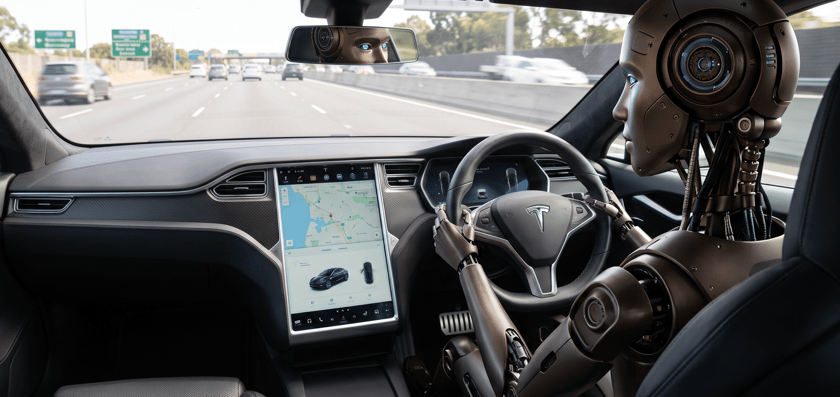
FSD (Supervised) has been available to owners of newer Model 3 and Y vehicles in Australia for about a year, at a cost of $149 a month. The system leans on eight external cameras for a 360-degree view of the road, feeding a vision-based neural network that handles steering, braking, lane changes and acceleration.
A separate cabin-facing camera checks that the supervising driver is watching the road and has their hands free to intervene – and the car will pull over and switch itself off if it's not satisfied they are. Because a human is still required to supervise, the system is classified as Level 2 driver assistance under Australian road rules, meaning legal responsibility for the vehicle stays with the person in the driver's seat.
Comprehensive motor premiums in Australia have climbed roughly 50% since 2019, and EVs have generally sat towards the more expensive end of that curve, a mix of higher parts and repair costs, thinner specialist repair networks, and less claims history for insurers to price against. Tesla says Australian drivers have now clocked more than 132 million kilometres using FSD, against roughly 264 billion kilometres driven by all vehicles nationally last year – still a small slice of the overall task, but enough for Zurich's underwriters to draw a preliminary view on risk.
Morgan was careful to frame the limits of what the discount covers. "It does not... do much to solve the problem of a tree branch falling on your roof in a storm, a shopping trolley being pushed into your passenger door, hail smashing your windscreen, or your vehicle being stolen," he said – pointing out that FSD addresses driver-error risk specifically, not the broader mix of perils motor policies are written for. Zurich has also said it won't be collecting individual driver or vehicle telemetry from Tesla; the discount is understood to be based on whether a car is fitted with the technology, not on how much a given driver actually uses it.
That's a different model to the one Tesla runs in its home market, where Tesla Insurance's own FSD discount scales with how many of a driver's monthly miles are actually completed under FSD, up to a maximum reduction on certain coverages. Other Australian insurers appear less ready to move.
Allianz has indicated existing Tesla customers with FSD subscriptions will simply continue to be covered under standard policy terms for now, rather than being offered a specific rating discount – a reminder that Zurich's approach, tied as it is to its exclusive Tesla-branded product, isn't yet an industry-wide position.
Not everyone is convinced the risk maths hold up as neatly as the announcement suggests. Angus McKerral, a road safety researcher at the University of Melbourne, warned that pricing a discount around an idealised version of driver supervision risks missing how people actually behave behind the wheel. His concern is that drivers "tend to blindly trust the system," swapping one kind of risk for another rather than eliminating it.
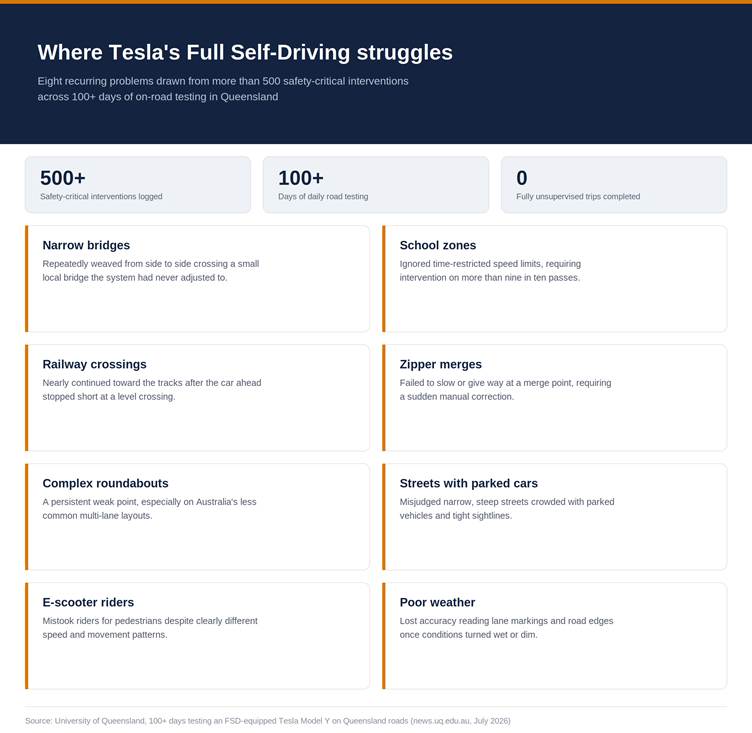
That scepticism has some data behind it. University of Queensland researchers spent more than 100 days testing an FSD-equipped Model Y on Queensland roads and logged upwards of 500 safety-critical interventions – moments where the driver had to take back control or the system misjudged something a competent human would have handled without thinking. Roundabouts, complex lane changes, school zones and less-common local road layouts featured heavily among the trouble spots.
In the US, regulators have gone further: the National Highway Traffic Safety Administration opened a formal safety investigation earlier this year into FSD software across nearly three million vehicles, after receiving dozens of reports of the system committing traffic violations without warning drivers.
None of that seems to have deterred Tesla from welcoming Zurich's move. Thom Drew, Tesla's country director for Australia and New Zealand, said it was "encouraging" to see an insurer "reflecting the reduced risk for Tesla owners" in its pricing.
For brokers and underwriters more broadly, the bigger story may be less about Tesla specifically and more about the principle Zurich has tested: that a manufacturer-fitted driver-assistance feature can become a standalone rating factor, sitting alongside age, location and driving record.
It's a similar direction to the one taken by telematics-based EV insurers such as KOBA, which already price car insurance around actual driving data rather than static demographics. Whether other mainstream insurers follow Zurich into ADAS-based pricing – for Tesla or any other brand – may hinge less on whether the technology works, and more on how comfortable insurers are relying on safety data supplied largely by the carmaker itself.