While US insurers have been cutting staff for most of the past year, Australia's finance and insurance workforce is holding its ground and quietly changing shape.
In the August 2026 quarter, 87.7 per cent of people working in Financial and Insurance Services were employees with paid leave entitlements, the Australian Bureau of Statistics' closest measure of permanent staff. That’s up from 83.7 per cent a year earlier and the highest August reading since the ABS began publishing this breakdown in 2014.
Across all industries, the share went the other way, slipping from 67.0 to 66.4 per cent.
The figures come from industry data the ABS now publishes inside its main labour force release, and the first edition came out on Thursday. Financial and Insurance Services is the ABS grouping that covers insurers, banks, superannuation funds and related services.
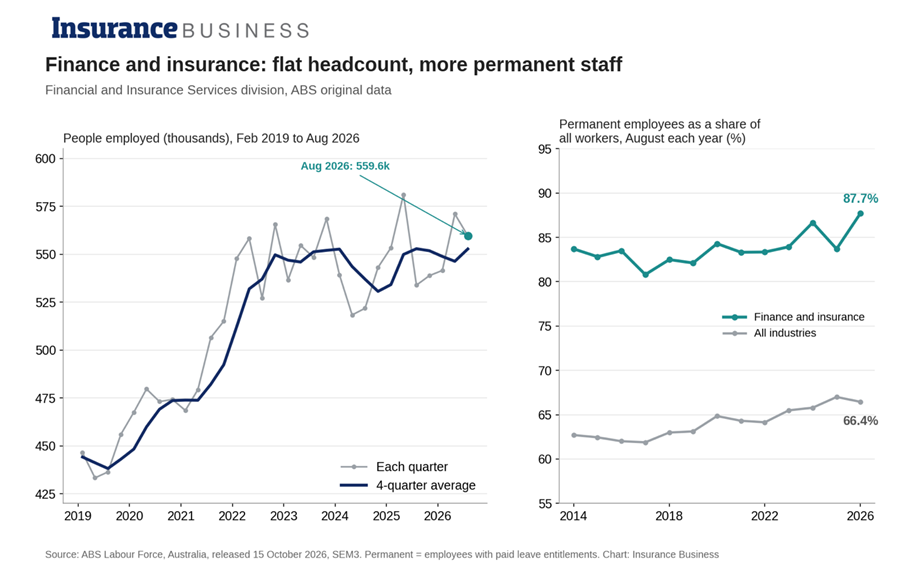
On the surface, the jobs number looks strong. About 559,600 people worked in the sector in the August quarter, up about 25,800, or 4.8 per cent, on a year earlier and the highest August figure since the series began in 1991. Employment across all industries grew 1.7 per cent.
That number needs a large asterisk. The industry figures come from a household survey, aren't seasonally adjusted, and swing a lot between quarters. Sector employment hit about 581,100 in May 2025, then dropped to 533,800 three months later, so much of this year's "growth" is a bounce back from a weak quarter.
Average the past four quarters and headcount is flat: about 552,700, against 552,900 a year earlier. The new monthly series shows a similar picture, with about 558,700 people employed in the sector in September.
Read next: US insurers have slashed jobs. Should Australia worry?
The shift in the type of work is clearer than the change in headcount.
Over the year to August, the number of permanent employees in the sector rose by nearly 10% 44,100 to 491,000. Employees without paid leave, mostly casuals, fell by about 5,900 to 20,500. Owner-managers, a group that includes independent contractors and people running their own small firms, fell by about 13,500 to 47,000, although that comparison flatters the trend: the August 2025 figure was unusually high, and 47,000 is close to where the group sat for much of the past decade.
All of the year's gain came from full-time roles, up about 33,700, while part-time jobs fell by about 7,900. Just 13 per cent of the sector now works part-time, against 31 per cent across the workforce. Total hours worked rose 8.8 per cent, and the average worker put in about 35.8 hours in the survey week, up from 34.5 a year earlier.
The ABS data doesn't say why. Several explanations fit: employers using permanent contracts to hold on to scarce staff, contract work being brought in-house, or consolidation reducing the number of small owner-operated firms. Each is worth testing with people in the industry.
Read next: Insurance broking confronts an ageing workforce and thin talent pipeline
A push to lock in staff would make sense given what insurers are telling researchers. Talent attraction and retention ranked as the third-biggest challenge for Australian insurers in 2026, up from seventh the year before, according to Gallagher Bassett research reported by Insurance Business. The Insurance Council of Australia has warned that about 30 per cent of the insurance workforce will be at or past retirement age by 2030.
Recruiters say the answer can't only be poaching. "The future workforce won't be built solely by competing for experienced talent," Ensure Recruitment managing director Paul Murphy said in Insurance Business's 2026 Top Insurance Employers coverage.
Not every employer is adding staff. Acenda was reported in March to be cutting at least 280 roles as it combines the former MLC Life and Resolution Life businesses, and Allianz has confirmed job cuts it attributes to AI. So far, though, those cuts haven't shown up as a fall in sector-wide headcount.
Read next: Disability hiring push meets insurance's talent crunch
A more permanent, full-time workforce brings stability and keeps knowledge in the business, which matters in an industry worried about retirements. It also means a larger fixed wage bill at a time when the economy is slowing. National unemployment rose to 4.7 per cent in September, and the Reserve Bank lifted the cash rate to 4.60 per cent on 29 September, its fourth increase this year.
There is a flexibility question too. If AI-driven restructuring of the kind under way at some overseas insurers reaches Australia, a workforce with fewer contractors and casuals is harder to resize quickly. A softer job market may also make some roles easier to fill than they were a year ago, though the specialist and senior skills insurers say they lack are unlikely to be among them.
The ABS doesn't separate insurance from banking and superannuation in this data, so the figures describe the whole division, not insurers alone. They are original rather than seasonally adjusted, so this article compares August with August only. The November quarter figures will show whether the shift to permanent full-time roles holds, and with industry data now arriving monthly, it will be easier to see whether overseas job cuts start to show up here.
Read next: Aon study flags Australia's AI workforce gap