Insurers say they can't find enough skilled people, or keep the ones they have. The latest official wage figures suggest pay isn't doing much to change that.
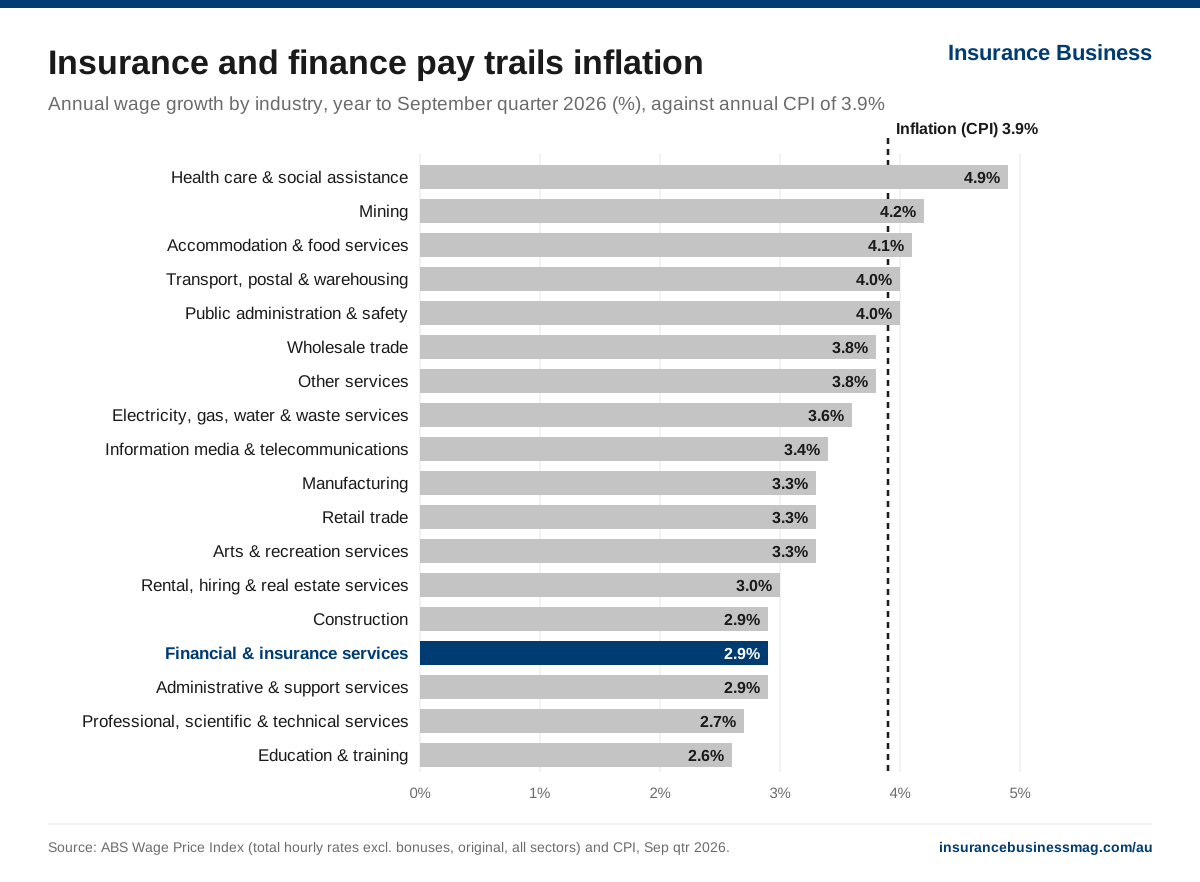
Wages in financial and insurance services rose 2.9% in the year to the September quarter, according to the Australian Bureau of Statistics' Wage Price Index, released on Wednesday. Consumer prices rose 3.9% over the same period on the ABS's quarterly measure, so the sector's workers went backwards by about a percentage point in real terms.
Across the economy, wages rose 3.5%. Of the 18 industries the ABS tracks, only education and training (2.6%) and professional, scientific and technical services (2.7%) recorded clearly slower annual growth. Construction and administrative and support services were level with finance and insurance at 2.9%. Over the September quarter alone, the sector's wages rose 0.7%.
It is still an improvement. A year ago, the ABS reported that financial and insurance services had the lowest annual wage growth of any industry, at 2.5%. By Insurance Business's calculations from the ABS data, the sector stayed at the bottom of the table for four consecutive quarters through 2025.
Read next: Financial services leads every Australian industry for workers walking out
The figures sit awkwardly beside what the industry says about its workforce.
Financial services recorded voluntary turnover of 15.6% in Aon's 2026 Salary Increase and Turnover Study, the highest of any industry surveyed. Gallagher Bassett's Carrier Perspective: 2026 Claims Insights found talent attraction and retention had become the third-biggest challenge for Australian insurers, up from seventh the year before.
The pipeline is thin, too. The Insurance Council of Australia's Insurance Industry Talent Roadmap estimates 30% of the insurance workforce will reach or pass retirement age by 2030. The National Insurance Brokers Association's Data to Direction report found brokers aged 18 to 29 make up just 11% of the general insurance broking workforce.
In most labour markets that combination would push wages up. So far, the ABS data shows only a modest lift.
Read next: Insurance and finance workers hit new record in ABS stats
The industries that did beat inflation were health care and social assistance (4.9%), mining (4.2%), accommodation and food services (4.1%), transport, postal and warehousing (4.0%) and public administration and safety (4.0%).
Much of that came from government decisions rather than market competition. The Fair Work Commission lifted modern award rates by 4.75% from 1 July, and state governments delivered large pay rises to nurses, midwives and police.
"The main driver of public sector wage growth was pay rises for state government front-line workers covered by enterprise agreements. This included groups like nurses, midwives and police officers," said Rachael McCririck, the ABS head of prices statistics.
Bonuses may widen the gap – maybe not…
The headline wage index excludes bonuses and commissions, which can make up a meaningful share of pay for broking and sales staff.
The ABS does not publish a bonus-inclusive figure by industry. Across the whole private sector, though, pay including bonuses and commissions rose only about 2.8% over the year, against 3.4% for base pay, according to the ABS original series. If that pattern holds in insurance, total remuneration in the sector may have grown even more slowly than the 2.9% headline.
Read next: The real reason your junior insurance hires are harder to find, and harder to train
With Aon projecting median salary increases of 3.6% for 2027, and most sectors including financial services clustered near that figure, there is little sign of a broad catch-up.
Aon's Yvette O'Reilly, associate partner and talent data solutions business leader for Pacific, said employers were concentrating what they have.
"We are seeing employers become increasingly targeted in how they allocate salary increases, prioritising critical roles, scarce skills, and talent segments that are most important to future business performance," she said.
For insurers and brokers, the hardest-to-fill roles are well known: Gallagher Bassett reports the greatest shortages in claims management, loss adjusting and specialised case management. Those are the roles where a below-inflation pay rise is most likely to send someone to a competitor.
Recruiters say pay alone won't fix the pipeline. "The future workforce won't be built solely by competing for experienced talent," Ensure Recruitment managing director Paul Murphy told Insurance Business earlier this year.
The ABS will publish December quarter wage figures in February.
The ABS's financial and insurance services category follows the standard Australian industry classification. It covers banks and other lenders; insurers and superannuation funds; and auxiliary services, which include insurance brokers, loss adjusters and agents. The figures therefore blend insurance pay with banking and super, and do not isolate insurers or brokers on their own.
Read next: The graduate hiring model that built insurance is breaking down