The Australian Securities and Investments Commission (ASIC) has concluded that a portion of superannuation trustees have yet to address basic shortcomings in how they process death benefit claims, despite having more than two years to act on concerns the regulator first raised in 2024. ASIC’s Report 831 – Delivering on death benefits: Have super trustees stepped up? – published June 10, 2026, draws on compulsory notices issued to 45 trustees and examines what steps, if any, they took between Nov. 20, 2024, and Nov. 20, 2025.
The review produced divergent results. On the one hand, internal complaints about delays in death benefit processing dropped 53% between early 2024 and late 2025. On the other hand, the total volume of death benefit claims rose 10% in the 12 months to October 2025, and ASIC expects that growth to accelerate given Australia’s demographic trajectory. “There are some promising findings in this report, including a 53% reduction in internal complaints about death benefit delays from early 2024 to late 2025. However, with claims volumes increasing by 10% in the 12 months to October 2025 and with that growth expected to continue in the context of Australia’s ageing population, it’s clear that more work needs to be done if all trustees are to meet member expectations,” said ASIC Commissioner Simone Constant.
Read next: The CIO who goes looking for problems is heading to InsuranceFest
The volume pressure is not new. ASIC identified a pattern of rising complaints as far back as May 2024, when it noted that death benefit delay complaints to the Australian Financial Complaints Authority (AFCA) had risen from 2.5% of all service-related AFCA complaints in 2021 to 8.5% in 2023 – a sevenfold increase in raw numbers over that period, according to AFCA external dispute resolution data accessed by ASIC in March 2024. Internal dispute resolution data that ASIC has collected from trustees since early 2023 reflected the same trend, with delay-related complaints spiking in the first quarter of 2023 (Q1 2023) and remaining elevated.
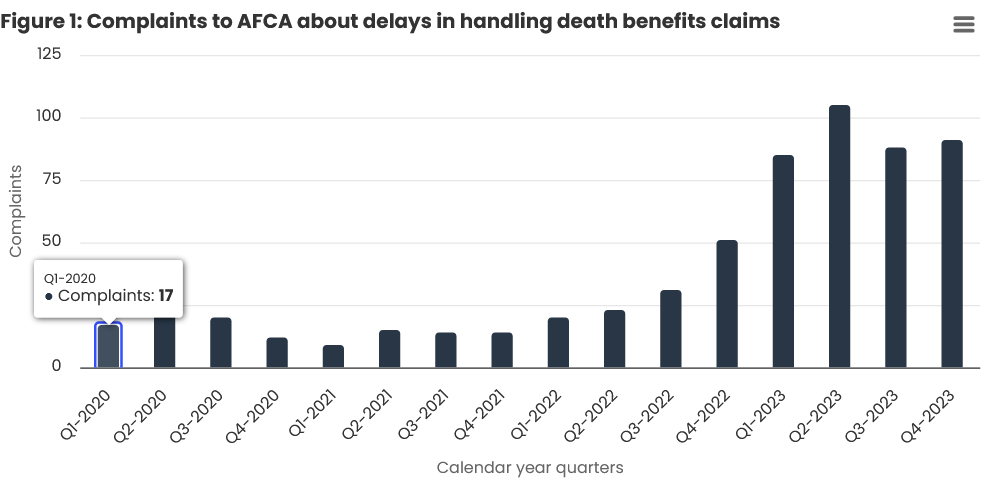
REP 831 outlines four areas where ASIC wants trustees to take action. The first is measurement: trustees are expected to track how long claims take from start to finish and set targets that reflect the experience of claimants, not just internal processing benchmarks. The second concerns low-value and low-risk claims. ASIC has taken issue with claims staking – a practice whereby claims are queued rather than processed according to their individual circumstances – and expects trustees to handle such claims within parameters they set for themselves.
Third, trustees are expected to communicate with members and claimants before a death occurs, not only after one. This includes providing clear guidance on how to lodge a valid binding death benefit nomination. ASIC identified language and communication barriers as a gap requiring specific attention. The fourth area involves First Nations members and claimants. ASIC found that identification requirements and certain administrative practices are producing outcomes for this group that fall below what the law requires. “We’re particularly concerned that some trustees have not actioned basic process improvements and continue exposing grieving beneficiaries to harm at times of heightened emotional and financial distress,” Constant said.
Alongside REP 831, ASIC is in the middle of a separate but related line of work examining whether trustees are drawing on complaints data to detect and address systemic service problems. Early results from a sample of 10 trustees are concerning: five had not identified a single systemic issue through complaints analysis during the review period, and at least one trustee had not conducted any such analysis at all. “A surge in complaints relating to death benefits was a catalyst for our review of claims handling. In the same way, trustees should use complaints data as an early warning system to detect and mitigate risks to members. Unfortunately, despite complaint numbers and trends rising overall between 2020 and 2026, early findings indicate that five of the 10 trustees we are reviewing have not identified a single systemic issue from analysis of their complaints data over our review period. At least one trustee failed to analyse their complaints data at all. This is baffling, and frankly, unacceptable,” Constant said. Full findings from this phase of ASIC’s multi-year member services review are expected to be released later in 2026.
The release of REP 831 follows a sequence of court outcomes that illustrate ASIC’s willingness to pursue trustees through litigation. The Federal Court ordered Cbus to pay a $23.5 million penalty in November 2025 after the regulator sued the fund over delays that affected more than 7,000 claimants seeking death benefit and total and permanent disability (TPD) payments. Civil penalty proceedings against AustralianSuper, filed in March 2025, remain on foot, with ASIC alleging the fund failed to process death benefit claims within a reasonable time. Earlier this month, the Federal Court ruled that Telstra Super – operating under the name Tetra Servicing Pty Ltd – had contravened its obligations by leaving roughly one-third of complaints received between Oct. 22, 2021, and Jan. 13, 2023, unanswered within the 45-day mandatory response window.
Constant said the regulator’s position on non-compliant trustees will not change. “Fund members have a right to expect claims will be handled efficiently, honestly, and fairly – this is an obligation for trustees under law. ASIC will consider the full range of regulatory tools at our disposal, including enforcement action, if trustees fail in this crucial obligation. We have done it before and if we need to, we will do it again. This is a mission critical area for trust Australians place in their superannuation system,” Constant said. The Commonwealth Government’s proposed mandatory member services standards, once enacted, would add a legislative layer to the obligations ASIC is already enforcing through existing law.