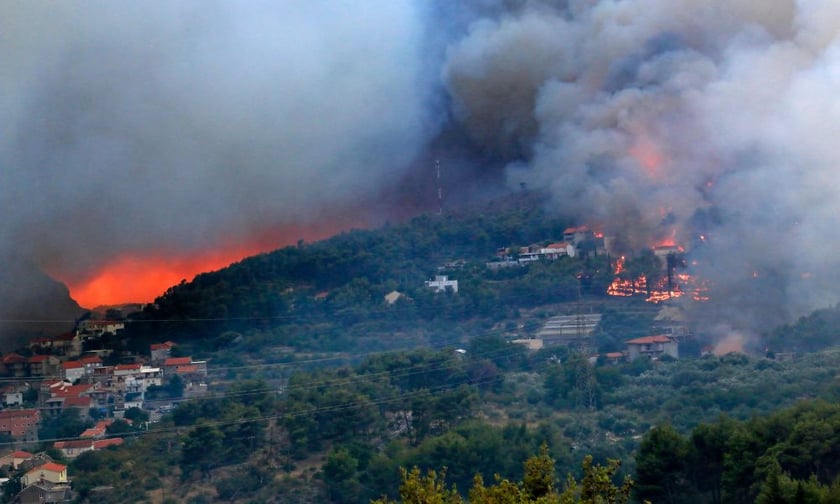
Spain declared its first-ever wildfire national emergency this week. France evacuated 40,000 people from Cap Ferat - a single peninsula. Both countries are having their second-worst fire season in decades, barely a year after Spain's actual worst one. None of that, on its own, is really the story for carriers. The story is what it might mean for an assumption the entire reinsurance industry still prices risk around.
Global reinsurance works, in large part, on a simple premise: catastrophe risk in different parts of the world doesn't move together. A bad wildfire season in California and a bad one in Spain are supposed to be statistically unrelated events, which is exactly why a reinsurer can hold both exposures and still sleep at night - losses in one region get offset by calm in another. It's the same logic that lets a single balance sheet absorb Australian bushfires, US hurricanes and European hailstorms without needing capital for each individually. Peer-reviewed climate research has described this explicitly: reinsurers built their diversification models on the US, Europe and Australia having a genuinely low correlation with each other on natural catastrophe losses.
That premise is exactly what's now being tested. A Moody's analysis found that more than 70% of global insured wildfire losses between 1980 and 2018 occurred in just three years - 2016 to 2018. Wildfire losses aren't just growing; they're clustering, in time and increasingly across regions that used to be treated as independent.
You don't have to take an academic's word for it. Swiss Re's Institute put global insured catastrophe losses at $107 billion in 2025, and wildfire came out as the fastest-growing peril category on the books, with insured losses climbing an estimated 12% a year. January's Los Angeles fires alone generated $40 billion in insured losses - the single largest wildfire loss event Swiss Re has ever recorded. Monica Ningen, the reinsurer's CEO for property and casualty reinsurance in the US, put it bluntly: wildfire and its fellow secondary perils "are no longer 'secondary' in any practical sense." Insurance Business covered that shift in detail back in May, reporting that wildfire and severe convective storms had displaced hurricanes as North America's dominant loss driver entirely.
Here's the part that should make carriers pay closer attention to Europe specifically, rather than less: as of Swiss Re's most recent report, wildfire has still not generated a single billion-dollar insured loss event anywhere on the European continent - despite Spain, Italy and Greece all suffering severe fire seasons. That's not because European wildfires are small. Munich Re put Spain's 2025 burn area at nearly 400,000 hectares, close to five times its 20-year average and a new national record. It's because so little of that damage is actually insured. Europe's wildfire exposure is currently absorbing the same physical intensification the US has seen, without yet carrying anything like the US's insurance penetration in wildland-urban interface zones.
That's exactly the setup that produced California's $40 billion single-event record: fire intensity meeting high-value, densely insured property in the wildland-urban interface. European insurance penetration for property catastrophe risk has been rising for years, and coastal and peri-urban development in fire-prone regions of Spain, Portugal and southern France isn't slowing down. If European wildfire losses start converting into insured losses at anything closer to US rates - even without the fires themselves getting any worse - the diversification benefit reinsurers have priced into decades of treaty structures starts looking a lot thinner.
Regulators have already flagged the mechanics of why this hits harder the further down the size chain you go. A report from the Bank for International Settlements' Financial Stability Institute, prepared with the insurance supervisors' body IAIS, noted that smaller and regional reinsurers achieving the same diversification as the largest global players is already difficult given fixed costs - and that if climate-driven losses become more correlated across the regions they do cover, "the limited diversification of smaller reinsurers may cause problems."
Swiss Re's own head of catastrophe perils, Balz Grollimund, has already modelled what a genuinely bad year - rather than a lucky one - would look like: a return to long-term trend would put 2026's global insured losses at $148 billion, and a full peak-loss scenario could reach $320 billion. Nobody's claiming this week's fires in Bordeaux and Ávila province are that scenario arriving. But they're a fairly clean example of the exact dynamic underwriters should be modelling for: a peril getting physically worse in a region that hasn't yet priced or insured its way up to match it. When it does, the diversification argument that's underpinned cat pricing for decades may not offer quite as much shelter as the models currently assume.