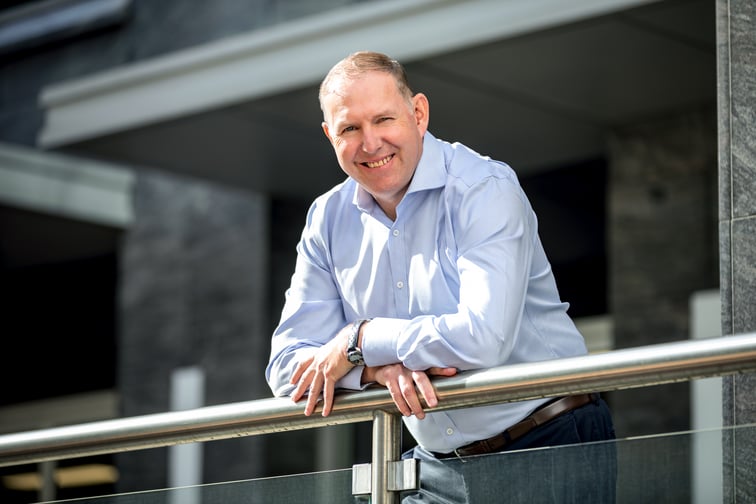
Weak credit risks in the Australian construction market are circulating among brokers who have little chance of placing them, according to Thane Duffin (pictured), CEO of Credeq Australia, who said the surety and guarantee business his underwriters are actually writing is coming from the stronger end of the credit spectrum.
The corollary is where the rest of the market ends up. Asked what is most consistently misunderstood about how surety and credit insurance are underwritten, Duffin said specialist brokers understand the product and the offering well and that the difficulty sits further out.
"I think less experienced brokers, often the really weak credit risks will fall on their plates, and then [they are] running around town trying to place something that's possibly much harder to place," he said. His recommendation was contact before the shopping starts. "Being able to speak to us early, I think would be my advice," Duffin said, describing the relationship between broker, underwriter and client as robust and noting that the broker usually introduces the underwriter into the client conversation.
That account sits somewhat at an angle to how the shift into insurance-backed guarantees is commonly framed. A Credeq press release of 28 August 2026 positioned rising demand against higher funding costs, tighter credit conditions and working capital pressure.
Asked when tighter credit began translating into submission flow at the underwriting desk, Duffin described a longer arc. Demand had already outstripped general growth, he said, as buyers weighed surety and insurance-backed guarantee products against banking products, and as companies looked to diversify funding portfolios rather than replace facilities they could no longer obtain.
He also described a different underwriting posture to a lender's. Banks are traditionally security-based lenders that look to what sits on the existing balance sheet, he said, which does not always support growth. "We would take a much more forward-looking view on a credit," Duffin said.
The scale of what is in play is set out plainly. Describing a typical civil construction client, Duffin said the business would fund plant purchases through hire-purchase arrangements and draw working capital from its bank, while carrying a large contingent exposure sitting outside both.
"Generally, 10 to 15 per cent of their turnover would be sitting supporting guarantees and contingent liabilities," he said, calling that disproportionate to the asset-backed funding the same company holds.
Larger clients typically retain strong relationships with their primary funders, he said, and use insurance capacity to gain additional headroom while keeping lending lines open for capital equipment. The same reasoning applies outside construction: Duffin pointed to lease bonds, where tenants historically secured leases with cash-backed guarantees, as a case where an insurance guarantee taking a risk position on the company had proved the smarter choice.
Risk selection is the part of this that has been tested. Construction insolvencies reached 3,475 in 2025-26, against 1,515 in 2018-19, according to the Australian Industry Group (Ai Group) reported by Insurance Business, with business collapses across the economy running 75 per cent above pre-pandemic levels. The source for those statistics is the Australian Securities and Investments Commission (ASIC).
Duffin said his portfolio had not tracked that experience and described why the exposure behaves differently to most insurance books. "It's not a frequency of loss type product," he said. The business operates in a volatile portfolio exposed to fewer and larger losses rather than a constant run of small ones, which means a single contractor failure can matter more than a bad year of attritional claims.
On that measure he said the book had held. The business had recorded strong returns in a market that had absorbed some very large losses, he said, pointing to several very large construction insolvencies over the past couple of years.
"I think we've been pretty fortunate in our selection of our risks," Duffin said, adding that the business has stayed clear of some of the bigger exposures. He also said the business invests more than most in its underwriting team.
What that performance has not yet faced is a broad credit downturn rather than a sector-specific one. On structure, Credeq Australia operates as an agent across several carriers rather than carrying risk itself. Commercial bonds, including lease bonds, petroleum bonds and the Deposit Power deposit bond business, are underwritten by HDI Global Specialty SE. Construction warranty insurance is written on the Assetinsure licence. Duffin said the agency mandates are substantial, that the same underwriters have worked on the portfolios for a long period and that Credeq Australia has a team of more than 100 underwriters and specialists.