Aon’s sale of One Underwriting Australia to AUB Group, which operates across Australia and New Zealand, is a modest deal on its own. One Underwriting has more than 30 years in the market and works with more than 250 brokers, writing lines from classic cars and pubs to commercial drones and fine art. Neither side disclosed a price and the sale still needs regulatory approval.
Alongside this year's other deals, it points to a bigger shift. Underwriting agencies handle about a fifth of Australia's general insurance premium and their ownership is concentrating quickly. The buyers are increasingly groups that specialise in owning agencies.
Aon is the seller this time. It said the sale followed a regular review of its portfolio, and that One Underwriting would grow faster under an owner focused on agency businesses. The agency has belonged to Aon since it launched in January 2016, replacing the broker's earlier underwriting business, Freeman McMurrick.
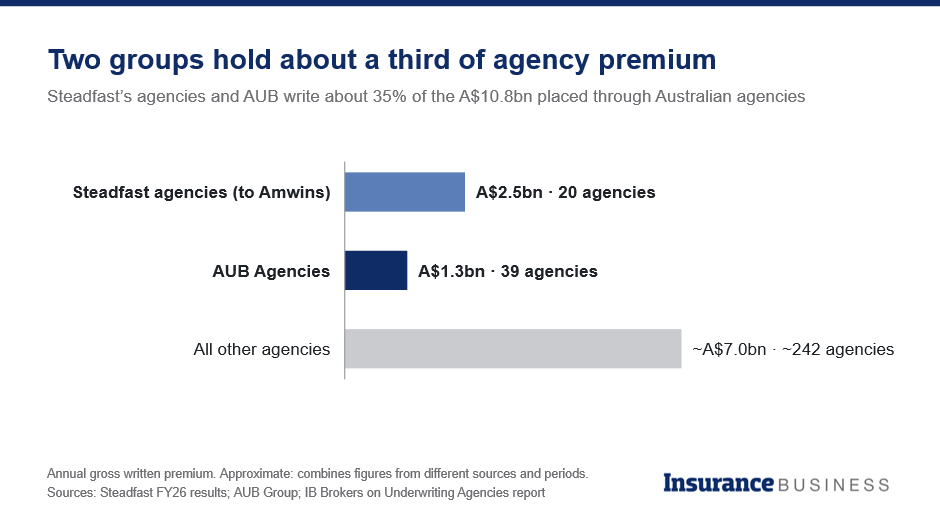
Steadfast's agencies are changing hands as well. Under the A$7.7 billion takeover of Steadfast by Amwins, Dragoneer and KKR, US wholesaler Amwins will take over Steadfast Underwriting Agencies once the scheme is implemented, which is targeted for December. That business wrote A$2.5 billion in premium in FY26 across 20 specialist agencies, according to Steadfast's results.
AUB is the buyer. Its Australian agencies division writes about A$1.3 billion in premium across 39 specialist agencies, according to the group's website. One Underwriting will join it under Agencies CEO Denis Morrissey, the founder of 360 Underwriting Solutions, who told insuranceNEWS.com.au the business is “highly complementary” to AUB's existing commercial products.
Together, Steadfast's agencies and AUB account for roughly a third of the premium written by Australia's 301 underwriting agencies. Those agencies wrote about A$10.8 billion in total, according to IB's Brokers on Underwriting Agencies report. The figures come from different sources and periods, so the share is approximate.
Michael Brown, CEO of Encept in New Zealand, said the pattern was a familiar one from elsewhere in the distribution chain.
“I think it's another sign of the value the market sees in specialist underwriting businesses," he said. "It's not that different from the consolidation we've seen among brokers: scale brings advantages, but the key is preserving the specialist focus and responsiveness that made these businesses successful."
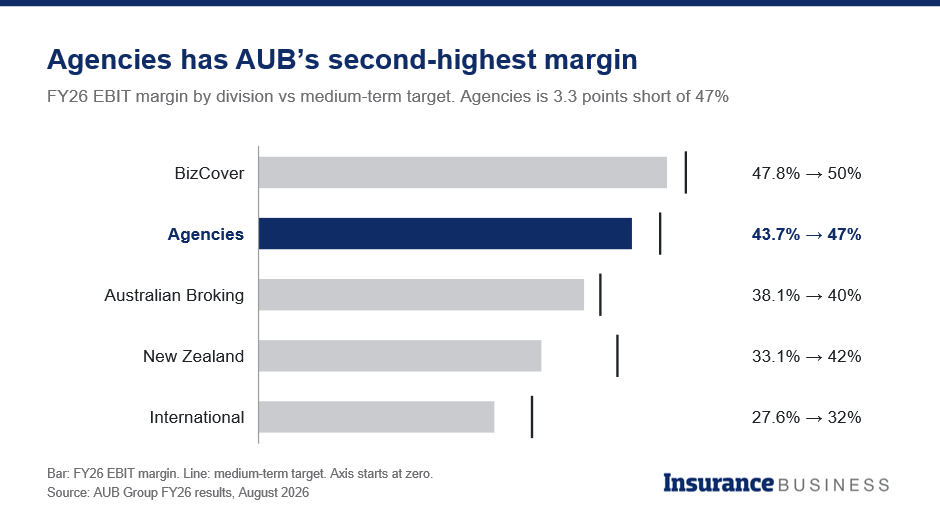
For buyers, the attraction is margin. AUB's agencies division earned an EBIT margin of 43.7% in FY26, ahead of its Australian broking business, and the group has set a 47% target for the division. Underlying pre-tax profit rose 8.4% to A$78.0 million, held back by weakness in strata, according to AUB's FY26 results. Adding commercial specialty lines such as One Underwriting's is one way to lift that margin without relying on strata.
The ownership list was already long. Jaydon Burke-Douglas, CEO of Antipodean Underwriting in Australia, pointed to Howden's ownership of DUAL, Steadfast's of ProRisk, the Envest Group's of London Australia Underwriting and AUB's 70% equity stake in Pacific Indemnity Underwriting Solutions. He said the Australian underwriting agencies market had grown more than 470% since the 2014-15 financial year, making it the fastest growing sector of the insurance market and that a race to own successful businesses was no shock.
“I can understand why established underwriting agencies are attractive to larger groups," he said. "They bring specialist underwriting expertise, established broker relationships and access to niche markets that can be difficult to replicate."
Insurers and wholesalers have their own reasons to buy rather than build. Jamie Richards, head of M&A at Ripe, told Insurance Business last week that in specialty lines it is easier to buy an agency with some scale and maturity than to grow one in-house. A new portfolio has no data to give it an underwriting edge, and a renewal book cannot be built overnight.
Brokers, meanwhile, are relying on agencies more. In IB's latest Brokers on Underwriting Agencies survey, 59.7% of brokers said agencies underwrite more than 30% of their book, up from 46.8% a year earlier. Nearly all said they would keep placing business with agencies even in a softer market. The more of a broker's book an agency holds, the more its ownership matters to that broker.
Read next: Revealed: top underwriting agencies in Australia for 2025
For the brokers who place with One Underwriting, the immediate questions are practical: whether its capacity arrangements, underwriting team and brand stay as they are. So far AUB and Aon have said only that they will work together on a smooth transition for customers, staff and other stakeholders.
There is a competitive question too. AUB holds equity in 45 partner brokers. Brokers outside that network who placed with an Aon-owned agency will now be placing with one owned by a rival broking group. Steadfast's agencies are heading the other way, from a broker network to a wholesaler.
Burke-Douglas said scale could deliver real benefits through investment in technology, operational efficiency and product development, but that the test was whether those benefits reached brokers and their clients.
“Consolidation can create stronger businesses, lower overheads and economies of scale, but bigger doesn't automatically mean better," he said. "Ultimately, brokers want competitive products, fast decisions, consistency and people who understand their clients' businesses."
Consolidation can also create choice. Richards said experienced underwriters often leave agencies once they are absorbed into larger groups and start new ones, many of which are bought in turn. He described consolidation and new MGA formation as two halves of the same cycle.
Some owners are opting out of the roll-up model altogether. Brisbane's High Street Underwriting Agency now sits under a new parent, 11th Avenue, which takes minority or strategic stakes in agencies and leaves underwriting decisions with each brand. Founder Alan Whittle said the group had no wish to fold agencies into something “bigger, more corporate, or less approachable”.
“The more the market consolidates, the stronger the case for a place in the market for independent underwriting agencies that can combine specialist expertise with modern technology and a genuinely broker-focused approach,” Burke-Douglas said.
Antipodean is 100% Australian owned and independent, with a shareholder register made up of employees, managers and retail investors. Burke-Douglas said he wished those consolidating well, but wanted brokers to know independent alternatives were available.
Read next: High Street's restructure bets against the agency roll-up model
Questions to ask an agency after a change of owner
Read next: Steadfast lifts profit as broker network heads for new ownership