Queensland’s government and its insurers agree on one thing: the state’s flood maps are a mess. Where they part ways is what should happen on the land those maps cover.
The Insurance Council of Australia (ICA) has used its submission to the State Planning Policy review to warn that homes built in harm’s way won’t fix the housing shortage, and could slow it down. Public feedback on the draft policy closed at 11.59pm on Monday.
The government has framed the rewrite around housing supply. When the Deputy Premier and planning minister, Jarrod Bleijie, opened consultation in August, the government said it wanted a “commonsense” approach to natural hazards. That would mean managing risk through how development is designed and assessed, rather than keeping it out of hazard zones altogether.
The ICA isn’t calling for a blanket ban. It backs simpler rules and consistent statewide flood mapping. But it wants hazards at the centre of planning decisions, and it wants the state to spell out exactly how much risk it is prepared to accept.
“We support the Government’s push to simplify planning and bring more consistency to flood mapping, but that can’t come at the cost of the protections that keep people and homes safe,” said Kylie Macfarlane, the ICA’s deputy chief executive.
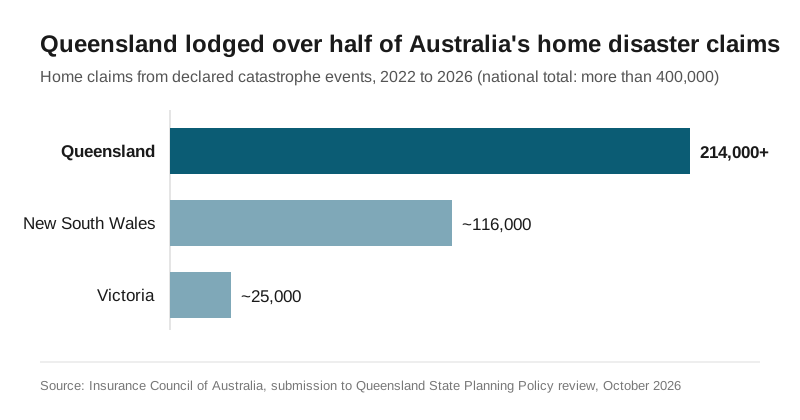
The industry’s case is built on its claims book. Between 2022 and 2026, insurers handled more than 400,000 claims nationally for homes damaged in declared catastrophes, at an insured cost of $11.3bn. Queensland accounted for more than 214,000 of them. NSW had about 116,000 and Victoria about 25,000.
Read next: Insurers ramp up Queensland, NT flood support as claims mount
Each of those claims is getting dearer to settle. The ICA’s latest catastrophe resilience report found a standard home in Queensland now costs around 45% more to build than in 2021. Roof tiles alone rose 77% over five years. The same report counted seven declared events in 2025-26, with insured losses of almost $4bn.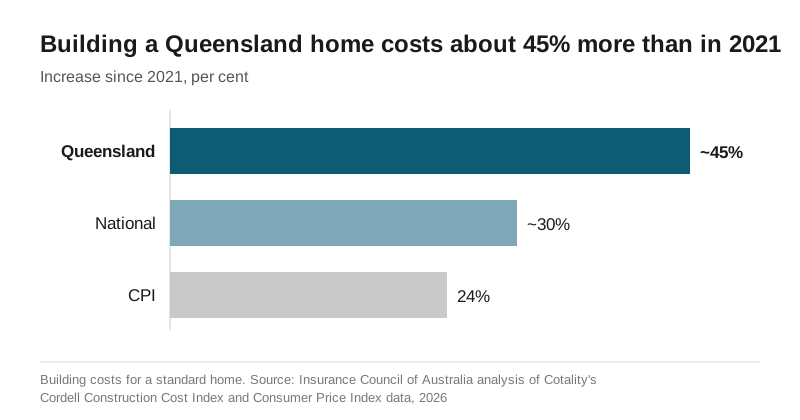
Insurers say this is where planning and housing supply collide. A rebuild in Bundaberg or Townsville uses the same roofers, plasterers and materials as a new estate on the Sunshine Coast.
“Every home damaged by extreme weather competes for the same tradespeople and materials needed to build new ones, so getting location right helps housing supply as well as safety,” Macfarlane said.
Read next: ICA seeks collaboration with Crisafulli government on climate resilience
Flood mapping is where the two sides come closest. Bleijie said in August that the state’s current mapping methodology was “causing more confusion than clarity”. The government has acknowledged that the same catchment can end up with different flood maps, which affects landholders’ property rights and their premiums.
Some data is already flowing. Results from seven new flood studies were handed to the ICA in March for the National Flood Information Database, through a working group led by the Queensland Reconstruction Authority. The ICA wants that to become the norm, with up-to-date maps shared with homeowners, councils and insurers alike.
The sharper disagreement is over levels of risk tolerance. The ICA wants the policy to define what counts as an acceptable or tolerable level of risk, so councils and developers aren’t left to interpret it case by case. NSW has already moved in that direction. Its proposed climate change and natural hazards planning policy went on exhibition earlier this year with a separate guideline on tolerable risk.
The ICA’s other asks:
The industry has company on the broad point. The Property Council’s Queensland executive director, Jess Caire, strongly welcomed keeping natural hazards as a state interest when the draft was released. The Planning Institute of Australia took the same view, describing Queensland as “Australia’s most disaster-exposed state”. The Local Government Association of Queensland said councils had been asking for more state help with hazard planning and mapping.
Read next: ICA urges Queensland to cut insurance stamp duty as premiums soar
.Before the 2024 state election, the ICA estimated that at least 310,000 Queensland properties carried a significant annual flood risk. Last year it told the Queensland Productivity Commission that new development should be steered toward low and zero-risk land.
Bundaberg shows what’s at stake. Floods there in March produced more than 2,000 claims, and a 1.7km levee for the city’s east, first proposed in 2014, still hasn’t been built.
INSERT CHART qld-home-claims-by-state
For brokers fielding questions from clients about premiums, the ICA’s message is that location decisions made now will show up in pricing for decades.
“Reducing risk is what brings premiums down over time, and good land-use planning is one of the strongest tools governments have to do that,” Macfarlane said.
The department will now work through submissions before the policy is finalised.