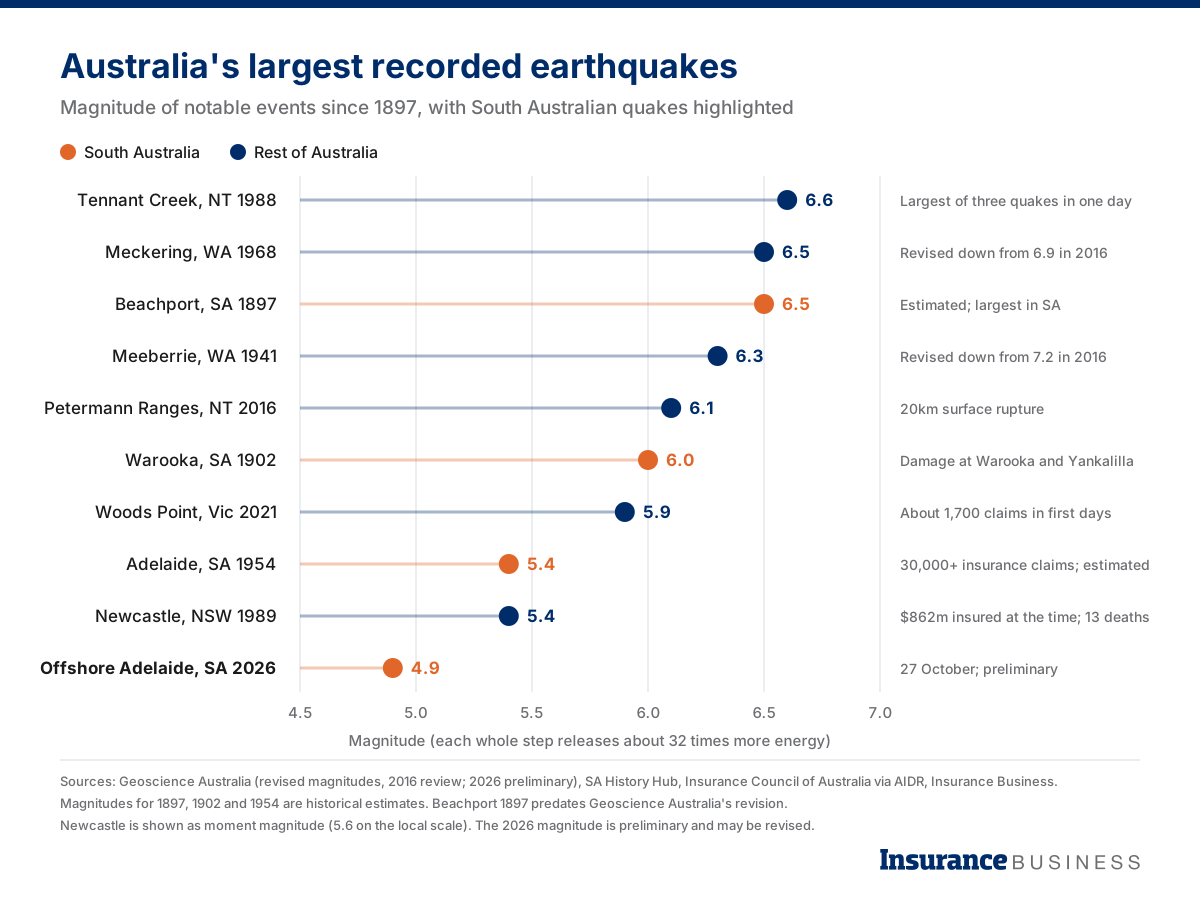
Adelaide got an early and unwelcome alarm this morning, when a magnitude 4.9 earthquake struck beneath the Southern Ocean and rattled homes from the northern suburbs to the Limestone Coast.
Geoscience Australia recorded the quake at 7.48am local time, about 10km deep and roughly 100km offshore, between Kangaroo Island and the state's south-east coast. Around 700 people lodged felt reports within the hour, from Gawler down to Beachport and inland to Naracoorte.
For most, it meant a few seconds of rattling windows and wobbling furniture. One Reynella resident had just climbed back into bed with a coffee when the bed shifted and the coffee went over. At Cape Jaffa, a local assumed a heavy truck was passing. No damage had been reported at the time of writing.
Senior seismologist Jonathan Bathgate called it "a significant earthquake", given how far the shaking carried. He warned aftershocks were possible but ruled out any tsunami threat.
Read next: Insurers watch for claims after twin earthquakes hit cities
An offshore 4.9 won't move anyone's loss ratio but it will jog unpleasant memories.
The 1954 Adelaide earthquake, estimated at about magnitude 5.4, caused light damage across the city and severe damage around Darlington. It generated more than 30,000 insurance claims worth around £3 million, according to state history records, and stood as the country's most destructive quake until Newcastle in 1989.
When insurers commissioned probable maximum loss studies for the major cities after Newcastle, the Adelaide work recommended a repeat of 1954 as the minimum prudent scenario. That benchmark may be generous. A 2022 review by Geoscience Australia researchers suggested the 1954 event was perhaps larger than previously thought, and questioned whether its epicentre really sat near Darlington.
The south-east has its own record. The 1897 Beachport earthquake, magnitude 6.5 and the largest documented in South Australia, damaged buildings in Kingston, Robe and Beachport and injured around 50 people. Several towns that felt Tuesday's tremor sit inside that footprint.
Read next: New quake risk map reveals seismic hotspots in Australia
Earthquake damage is generally covered under standard Australian home and contents policies, so the peril sits on almost every residential book. Moody's analysts have argued that with the cyclone reinsurance pool absorbing much of the cyclone risk, earthquake is now the bigger worry for nationwide portfolios.
Newcastle remains the reference point. The Insurance Council of Australia put insured losses at $862 million at the time, and its normalised analysis ranks the quake as the third costliest insured catastrophe in Australian history.
Smaller events show how claims usually arrive. After the magnitude 5.9 Victorian quake in 2021, insurers received about 1,700 claims in the first days, mostly for cracked plaster, render and fallen masonry.
Those figures look modest beside the ICA's 2025–26 tally of 147,552 catastrophe claims and $3.98 billion in insured losses, driven largely by storms, hail and fire. That gap is why earthquake is easy to forget, and why it hurts when it finally turns up.
Read next: Insurance Council reveals number of Victoria earthquake claims
For brokers with South Australian clients, Tuesday is a reason to pick up the phone. Commercial schedules are worth checking for earthquake deductibles, sub-limits and how aftershocks are grouped into a single event. Owners of older unreinforced masonry buildings can look at the retrofitting guidance published with the latest national hazard assessment, and householders can be pointed to the Insurance Council's post-earthquake checklist.
Wordings are under scrutiny elsewhere too. After last year's magnitude 8.8 Kamchatka quake, Aon's reinsurance team said insurers would revisit earthquake and tsunami sub-limits and exclusions, including actions of the sea and contingent business interruption.
None of this means Adelaide is getting shakier. Geoscience Australia attributes the country's quakes to stress inside a continent drifting north at about 7cm a year, and records around 100 of magnitude 3 or more annually. Most go unnoticed. Tuesday's didn't, and the industry would do well to remember how it felt.
Read next: Russia's giant earthquake and tsunami and its impact on Australia insurance