Australian insurers are assessing potential exposure after European rail pass provider Eurail BV confirmed that customer information taken in a 2024 cyber incident is now circulating on criminal platforms, including the dark web and Telegram. The Netherlands-headquartered company – which sells multi-country rail passes used by Australian travellers in Europe – first notified customers in early January that an “unauthorised person gained access to part of our customer database.”
The compromised data included phone numbers, passport numbers, email, and residential addresses, full names, and dates of birth. “This means that someone outside Eurail has been able to access certain customer details. Preventing and mitigating negative consequences for you is our highest priority. Criminals may attempt to misuse your data. Therefore, we advise you to remain extra vigilant for unexpected or suspicious phone calls, emails, or text messages asking you for personal information,” the company said in its initial notification, as reported by 9News.
In a follow-up update sent nearly four months later, Eurail advised customers that information taken in the incident had been offered for sale on the dark web and that a sample of the data had been posted on Telegram. The firm said it was continuing its investigation with external cybersecurity and legal advisers and working to secure its systems. Eurail has recommended standard breach-response steps such as changing passwords used for email, social media, and banking and monitoring for unusual transactions or sign-in activity.
Read next: Cyber visibility high, recovery plans missing across Australia
The incident is relevant for Australian insurers and intermediaries given Eurail’s Australian customer base. In 2024, the company identified Australia as its second-largest market after the US, reporting that 57,000 Australian travellers used its passes that year and travelled an average of 1,652 kilometres by rail. “Aussies are hugely important travellers for Eurail, with some interesting findings reflected in 2024 full year data. For starters, despite cost-of-living concerns at home, Australian Youth travellers (those aged 12-27) dominated, representing 43% of all Australian passholders last year,” said Jody Bauer, senior research analyst at Eurail, as reported by 9News.
Bauer also pointed to a change in age profile over time: “The share of Australian Youth travellers has jumped from just 32% pre-COVID (2019) to 43% last year (2024).” This concentration of younger travellers in the customer mix may affect student, youth, and backpacker travel products, as well as credit card and embedded travel covers that are frequently used by this segment. The exposure of passport numbers and contact details may lead to increased demand for assistance services and questions about coverage for identity compromise and document replacement.
Australian travellers whose passport details have been exposed in a data breach have several options under guidance from the Department of Foreign Affairs and Trade (DFAT), with potential implications for claims and policy wordings. DFAT advises that a passport remains valid for travel even if its number appears in a breached dataset, and travellers can continue to use it. Where a passport has more than two years before expiry, the holder can apply for a replacement and, in some circumstances, may be eligible for a reduced fee. If less than two years remain, a standard renewal application and fee apply.
Travellers may also ask the Australian Passport Office to cancel a passport immediately. DFAT has stated that overseas travel remains possible following a data breach because physical presentation of the passport is required to prove identity at the border. These options may influence decisions where policies provide cover for replacement of travel documents, additional expenses arising from document issues, or support services for customers managing potential misuse of their credentials.
Read next: Australia logs 1.1 million leaked accounts, ranks 15th worldwide
The Eurail incident sits within a wider pattern of account compromise affecting Australian users. In its latest quarterly breach analysis, VPN provider Surfshark estimates that 1.1 million Australian accounts were exposed in the first quarter of 2026, placing Australia 15th globally by breach volume for the period. Worldwide, Surfshark reports 210.3 million breached accounts between January and March 2026, with the US representing 29% of incidents. France ranked second, followed by India, Brazil, and the UK. According to the firm, the global Q1 2026 breach volume was three times higher than in the first quarter of 2025 and 22% higher than in the fourth quarter of 2025.
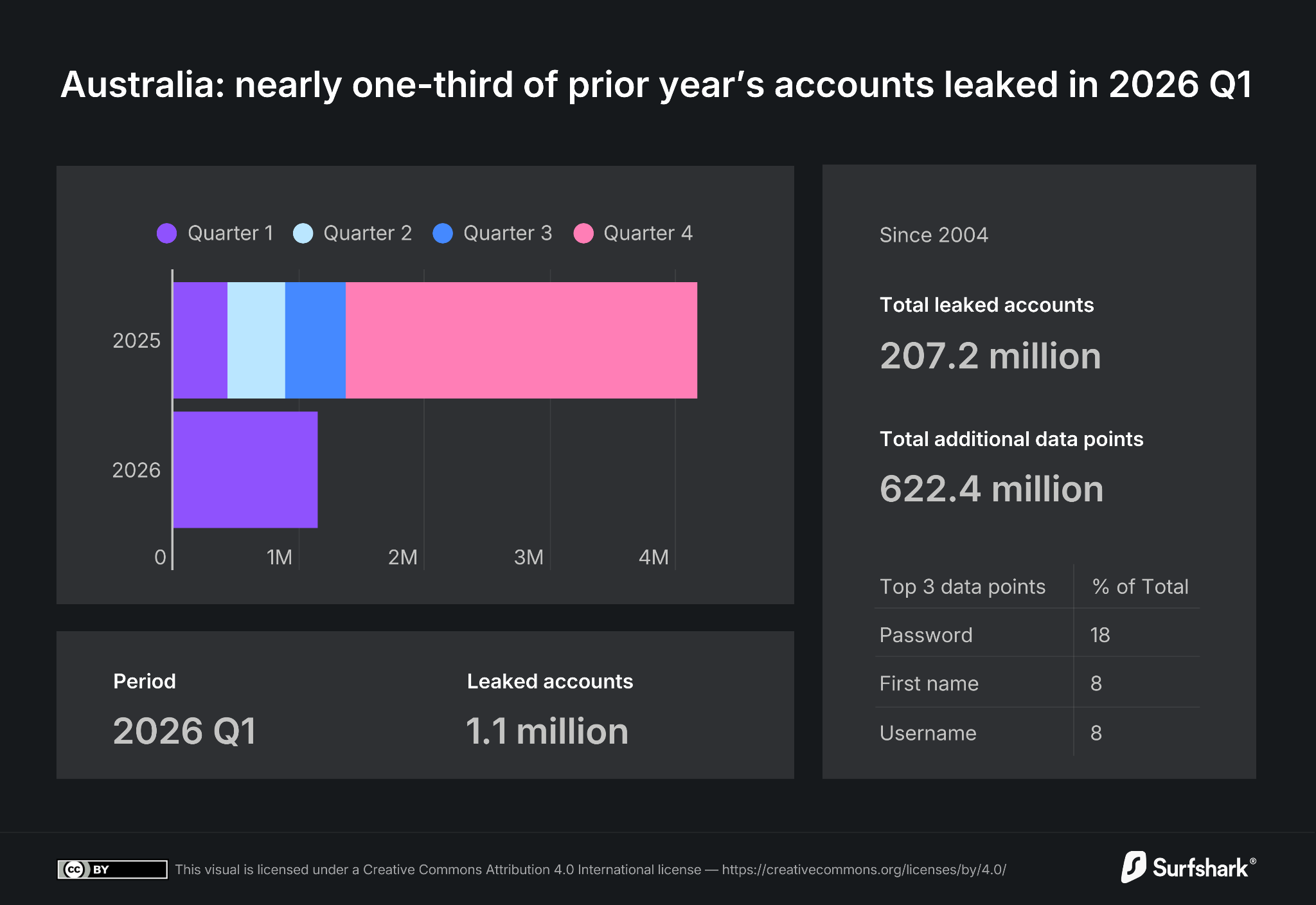
For Australia, Surfshark estimates a cumulative total of 207.2 million accounts linked to local users have been leaked. Each compromised email address is typically associated with around three additional data fields. Since 2004, the company estimates that 622.4 million Australian personal records have been exposed, including 110.2 million passwords and 52.6 million first names. The reported data categories extend into information used in financial and insurance transactions: 314,100 Social Security Numbers and 88,500 payment card numbers, along with 20.3 million phone numbers and 20.7 million physical addresses. These data types align with details collected for policy issuance, customer onboarding, and claims management, raising the likelihood that compromised information can be reused across multiple services.
The combination of the Eurail breach and broader account leakage trends points to several operational and risk considerations. In travel and assistance products, insurers may receive more inquiries about coverage for passport replacement, trip disruption linked to suspected identity misuse, and access to assistance or identity support services when customers are notified of inclusion in a breach. In cyber and privacy insurance, the ongoing rise in breached accounts and exposed credentials provides context for reviewing attachment points, limits, retentions, and sublimits for privacy events, notification costs, and identity monitoring in commercial policies.
For claims and underwriting functions, the availability of stolen data on the dark web and messaging platforms may prompt further tightening of verification controls, particularly for remote onboarding and fast-track digital claims where in-person checks are not used. Intermediaries may also use incidents such as the Eurail breach, together with national leak statistics, to reinforce basic cyber hygiene messages for personal and commercial clients, including multifactor authentication, password updates, and monitoring of financial and online accounts. As Australian travellers consider DFAT’s passport options and organisations respond to persistent data compromise, the intersection of travel, identity, and cyber risk is likely to remain a practical focus for insurers, underwriters, and risk managers in the Australian market.