Saudi Arabia's General Authority of Civil Aviation (GACA) said one person died and eight were hurt at King Khalid International Airport in Riyadh, while two died and 28 were injured at Abha International Airport in the kingdom's south-west. The attacks came on Tuesday and Wednesday, but the authority didn't say which airport was hit first.
The man killed in Riyadh was Sudanese. The two people killed in Abha were women, one Moroccan and one Algerian. GACA reported physical damage at both sites and said it was checking the facilities were safe for passengers and operations.
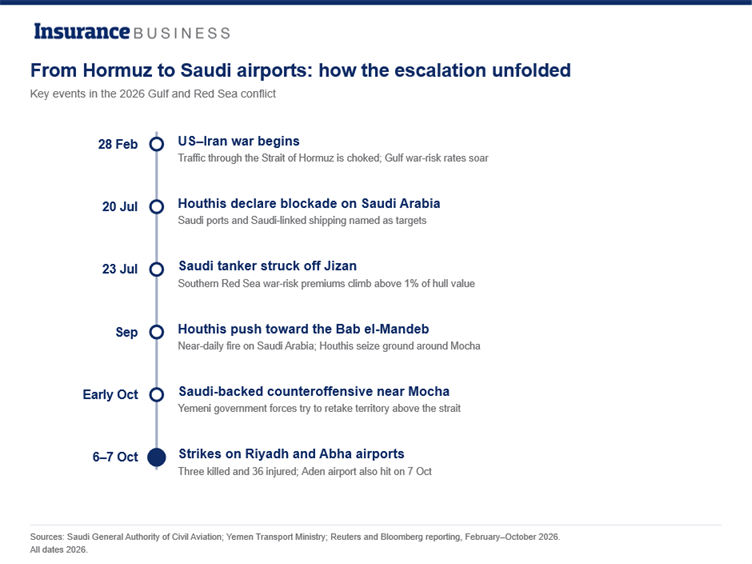
The Houthis have claimed both strikes. Their military spokesperson, Yahya Saree, said the group sent several drones at the Riyadh airport.
On Wednesday, Yemen's Transport Ministry said Houthi ballistic missiles and explosive drones also struck Aden's international airport, the main international airport for areas outside Houthi control. One missile came down near the runway shortly before a flight from Cairo was due to land. Separately, the Saudi-led coalition said it had shot down a ballistic missile north of Riyadh.
The airport attacks follow a counteroffensive launched this week by Yemeni government troops, with Saudi-led air cover, to win back ground around the Red Sea town of Mocha and the hills above the Bab el-Mandeb. The Houthis took that territory in September, after they began firing on Saudi Arabia almost daily.
The Bab el-Mandeb joins the Red Sea to the Gulf of Aden. It has become a far more valuable route for oil since the US–Iran war, which began on 28 February, throttled traffic through the Strait of Hormuz. Saudi Aramco has leaned harder on its Red Sea terminal at Yanbu as a result.
Read next: Australian claims feel the weight of Middle East fuel and freight shocks
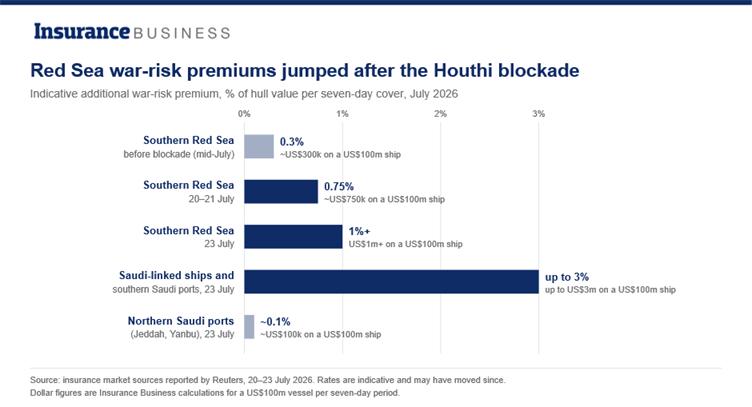
The Houthis declared a blockade on Saudi ports and Saudi-linked shipping in July, and the marine market moved fast. Within days, indicative war-risk premiums for voyages through the southern Red Sea rose from about 0.3% of hull value to more than 1%, according to market sources at the time. Some Saudi-linked ships, and voyages out of southern Saudi ports such as Jizan, were quoted at up to 3%. Ships using Jeddah and Yanbu, further north, were quoted at about 0.1%.
On a US$100 million tanker, that spread runs from roughly US$100,000 to US$3 million for a single seven-day period of cover. Brokers will be watching whether this week's fighting around Mocha shifts those numbers again.
The pressure isn't new. Insurance Business reported in July that the conflict had already tied marine war-risk repricing to rising trade credit risk. Lloyd's has since put its losses from the conflict at £1.4bn, a number its chief financial officer said rests mainly on exposure estimates and IBNR reserves rather than hard claims data.
Attacks on passenger airports put aviation war cover in the frame. Most airline hull all-risks policies exclude war, so airlines, airport operators and aircraft lessors buy that protection separately.
Law firm Kennedys said earlier this year that premiums for aviation risks were already climbing, with lower-risk carriers facing rises of 10% or more and airlines on Middle East routes seeing much steeper increases. The firm also said Australian insurers writing international airline, airport and leasing business carry exposure to the region despite the distance, a point Insurance Business explored in its coverage of aviation war-risk pressures for Australia.
Read next: Specialty insurers absorb Middle East war losses, report says
Direct shipping exposure for Australia is still limited, because iron ore, coal and LNG bound for Asia don't need either strait. The costs arrive the long way round, through fuel, freight, longer routings and claims inflation in local repair and building work.
Travel is the more immediate line. Smartraveller rates Saudi Arabia at Level 3, "reconsider your need to travel", while Yemen sits at Level 4, "do not travel". Insurance Business has reported that the move to Level 3 triggered known-event exclusions on many policies bought after the warning was issued, and standard travel policies exclude losses caused directly by war.
Read next: The heat on red meat: What the Hormuz crisis means for ANZ frozen meat exporters
The fighting has revived a Yemeni civil war that dates back to the Houthi takeover of Sanaa in 2014 and the Saudi-led intervention that followed. The International Organization for Migration said on Wednesday that more than 200,000 people had been displaced since the latest round began. "People are running for their lives and finding nowhere safe to go," said IOM Director General Amy Pope.
Riyadh is looking for help. Turkey is sending mainly defensive and technical support, according to two officials, and Syria is considering military help, according to a US official and a Syrian military official. The US official said Riyadh had asked Damascus to deploy forces.
For underwriters, the 2023–25 Red Sea campaign showed how quickly a Houthi threat can turn into a claim. The group has hit Saudi airports, refineries and pipelines before. This week, airports were back on the list.