Southern Cross Travel Insurance (SCTI) reports that serious injuries, winter sports accidents, and sudden illness accounted for many of its highest medical and evacuation claims for New Zealand travellers between January and March 2026, with fractures, infections, gastrointestinal illness, and acute cardiac events among the main drivers of large offshore payouts.
SCTI data for the first quarter of 2026 show that its largest overseas claims most often involved fractures and dislocations, infections, gastrointestinal illness, and acute medical emergencies. The claims related to trips across Asia, Europe, the Americas, and other regions. SCTI chief customer officer Jess Strange (pictured) said the recent claims experience shows how quickly medical costs can escalate when care is required offshore. “Clearly our customers were determined to have a good time, but things definitely did not go according to plan – thank goodness they didn’t decide to leave their health and wellbeing to chance and travel without travel insurance,” Strange said.
According to SCTI, fractures and dislocations were the most common high-cost claim type, with an average claim of about $24,000 and the highest claim of $72,000. These injuries were frequently associated with skiing, falls, and vehicle incidents, particularly in Japan and Austria during the Northern Hemisphere ski season. In one example in Japan, a traveller who fractured and dislocated an ankle required hospital treatment, diagnostic imaging, surgery, and recovery support. SCTI paid more than $70,000 in medical and assistance costs.
Snow sports incidents formed a notable subset of the claims portfolio. “If we spotlight skiing-related injuries, these included broken limbs, ligament tears, concussions, and spinal fractures, with Japan and Austria the most common locations. One example was a skier who suffered a serious knee ligament injury after a fall on the slopes who required urgent assessment, specialist treatment, and extended accommodation while unable to fly. That claim came in at $16,000,” Strange said.
Read next: Southern Cross Travel Insurance appoints chief digital officer
SCTI’s data also indicate that non-accidental health issues can lead to substantial costs once hospital admission or travel disruption is involved. Strange said infections and respiratory illnesses – including pneumonia, cellulitis, and ear and sinus infections – were among the higher-cost categories. “Looking at our highest value claims for infections and respiratory illness including pneumonia, cellulitis, ear, and sinus infections, these came in on average at $13,500, mainly because they often required hospital admission or ICU care in countries such as India, Brazil, and the US,” Strange said. In one South American case, a traveller developed severe pneumonia caused by H1N1 influenza and was admitted to intensive care for respiratory support. SCTI covered hospital and medical costs exceeding $40,000.
Gastrointestinal illness remained a frequent cause of claims, particularly where severe diarrhoea and dehydration resulted in hospital treatment or itinerary changes. SCTI’s largest gastro-related claims averaged around $11,000, driven by inpatient care and rebooked travel. These claims were more common in parts of Asia and among travellers on cruises or in transit. In one transit incident, a child became acutely unwell with gastroenteritis, requiring the family to leave their flight and delay their journey home. “When one of our younger travellers falls ill, it’s often very concerning for parents and caregivers. SCTI covered medical treatment, accommodation, and rebooked flights,” Strange said.
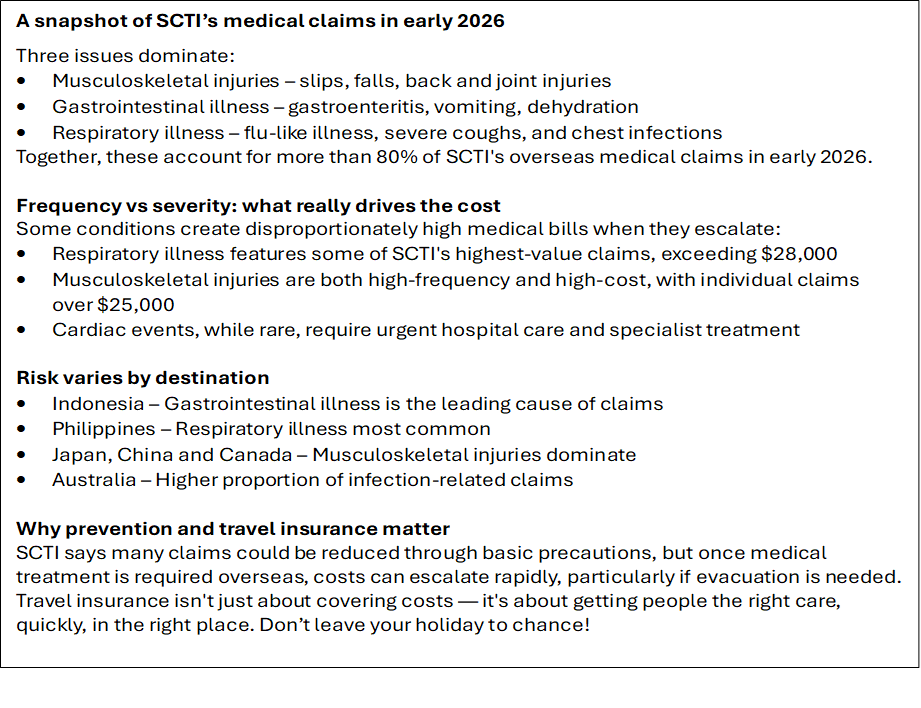 Cardiac and other acute medical events – such as heart attacks, syncope, and hypoxia – sat among the most expensive claims, with an average cost of about $28,000. In one case, a customer experienced multiple heart attacks overseas and required emergency care, monitoring, and recovery support, resulting in total expenses of nearly $50,000. Gastroenteritis claim statistics show Indonesia recorded the highest claim volume, with 552 claims and total payments of about $351,000, averaging roughly $636 per claim. Thailand, Australia, China, the Philippines, the US, Fiji, Japan, and India also recorded significant claim volumes. There were 81 gastro claims relating to New Zealand, generally tied to illness occurring before departure that disrupted planned journeys, with an average claim of about $2,366.
Summarising the pattern, Strange said: “Our data highlights how quickly a holiday can turn serious and expensive when travellers face unexpected illness or injury overseas, even during normal activities; skiing, walking, travelling between destinations, or becoming suddenly unwell with no warning. The costs can escalate rapidly once hospital care or travel disruption is involved. Don’t leave your holiday to chance people!”
Read next: Insurance moves: Southern Cross Travel Insurance, Fidelity Life
Alongside SCTI’s short-term claims experience, Southern Cross Health Insurance has released findings from its inaugural Feel Good Index, a survey of New Zealanders’ perceptions of their current and future health. The survey points to a gap between life expectancy and “healthspan,” or years lived in good health. “The average lifespan, or how long we live for in New Zealand, is 82 but the actual healthspan – or how many of those years we live in good health – is 70. That’s a significant period of time we lose to poor health,” said Southern Cross Health Society chief executive Nick Astwick.
Respondents reported greater confidence about their financial futures than about sustaining good health. Of those surveyed, 81% said they felt confident about managing their finances for the future, compared with 72% who expressed confidence in their ability to stay healthy and improve their long-term health. Among respondents aged 60 and over, 64% said they were confident they could improve their long-term health. Overall, 69% of respondents said they felt good about their current health and wellbeing, and 70% said they felt positive about their future health. However, 84% were unaware of how long the average New Zealander spends in poor health at the end of life.
After the concept of healthspan was explained, 75% of respondents said they wanted more information on how to improve their future health, while 79% agreed they know what they should be doing to stay healthier for longer. Two-thirds (67%) said they were investing in their health and fitness to stay independent as they age, rising from 56% among those under 30 to 76% among those aged 60 and over. On average, respondents said they would like to live to age 89, above the current national life expectancy of 82. Astwick said many respondents still saw barriers to improving long-term health. “While it’s encouraging that six in 10 New Zealanders feel their current lifestyle is setting them up to be healthy and pain free, that still leaves a significant proportion who don’t,” he said. Cost and affordability (32%), motivation or willpower (19%), and lack of time (10%) were cited as the main obstacles.
Astwick said the findings inform how insurers position their role with members. “At Southern Cross, we see our role expanding beyond providing our members with access to healthcare when they need it. We’re also investing in and incentivising healthy behaviours as we deliver on our ambition to be the health partner of choice for more New Zealanders. Over time, the Feel Good Index will provide a useful measure of how we’re feeling as a nation and it’s my hope through conversation and action, we can claim back our healthy years,” he said. The combination of SCTI’s early‑2026 travel claims report and the Feel Good Index data illustrates exposure to both acute, high-cost medical events overseas and longer periods of morbidity later in life. The Feel Good Index was conducted by Talbot Mills Research via an online survey of 1,016 nationally representative respondents aged 18 and over, with fieldwork completed between March 12 and 23, 2026.