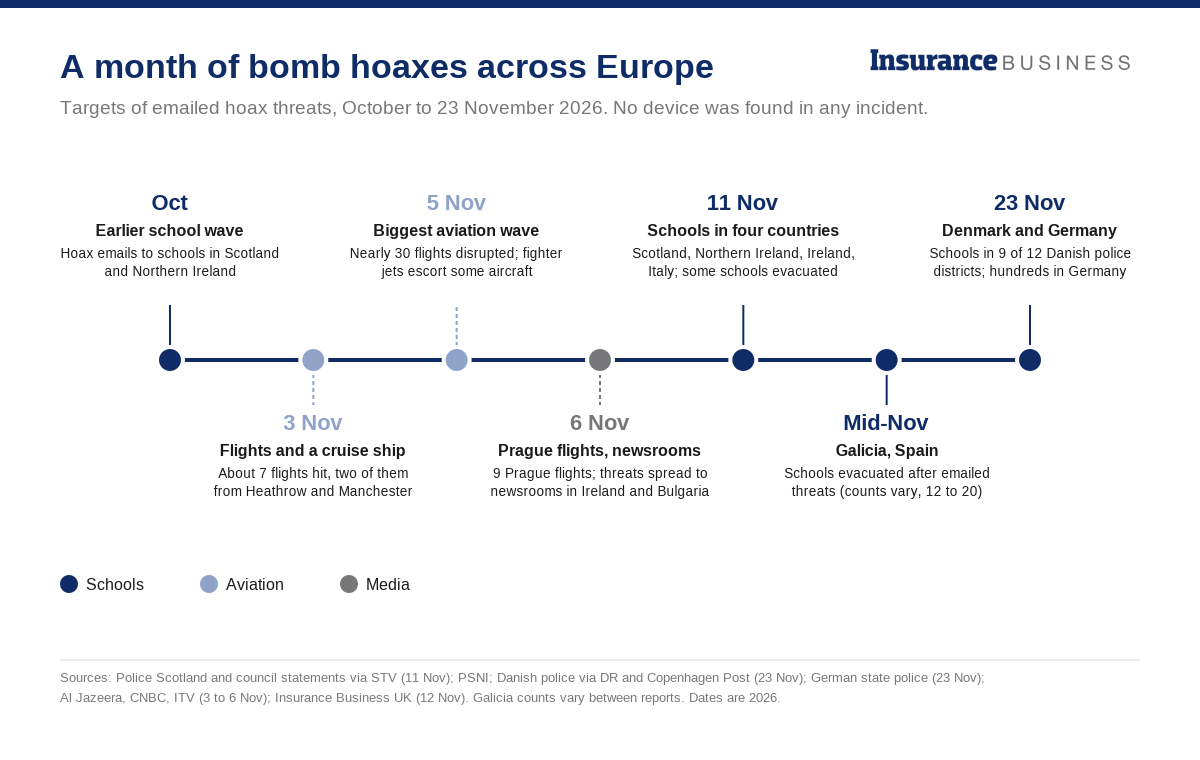
Schools across Denmark opened their inboxes this morning to an email claiming a bomb had been planted on site, the same stunt pulled on schools in Scotland, Northern Ireland, Ireland and Italy less than a fortnight earlier. By mid-morning, police in at least nine of Denmark's 12 districts were dealing with reports, and one Jutland force said it had received hundreds of them.
The official line was keep calm and carry on. Danish police said they did not regard the threats as credible, saw no reason to evacuate and asked schools that had only received the email not to file a separate report. Schools were told to call in only if staff spotted a suspicious object or person.
Germany was also hit this morning. Police in Baden-Württemberg said the same message had gone to more than 450 schools across the state, while forces in Thuringia and Lower Saxony reported their own cases. Thuringian officers advised against evacuating, though a handful of schools sent pupils home anyway and patrols were sent to check on them.
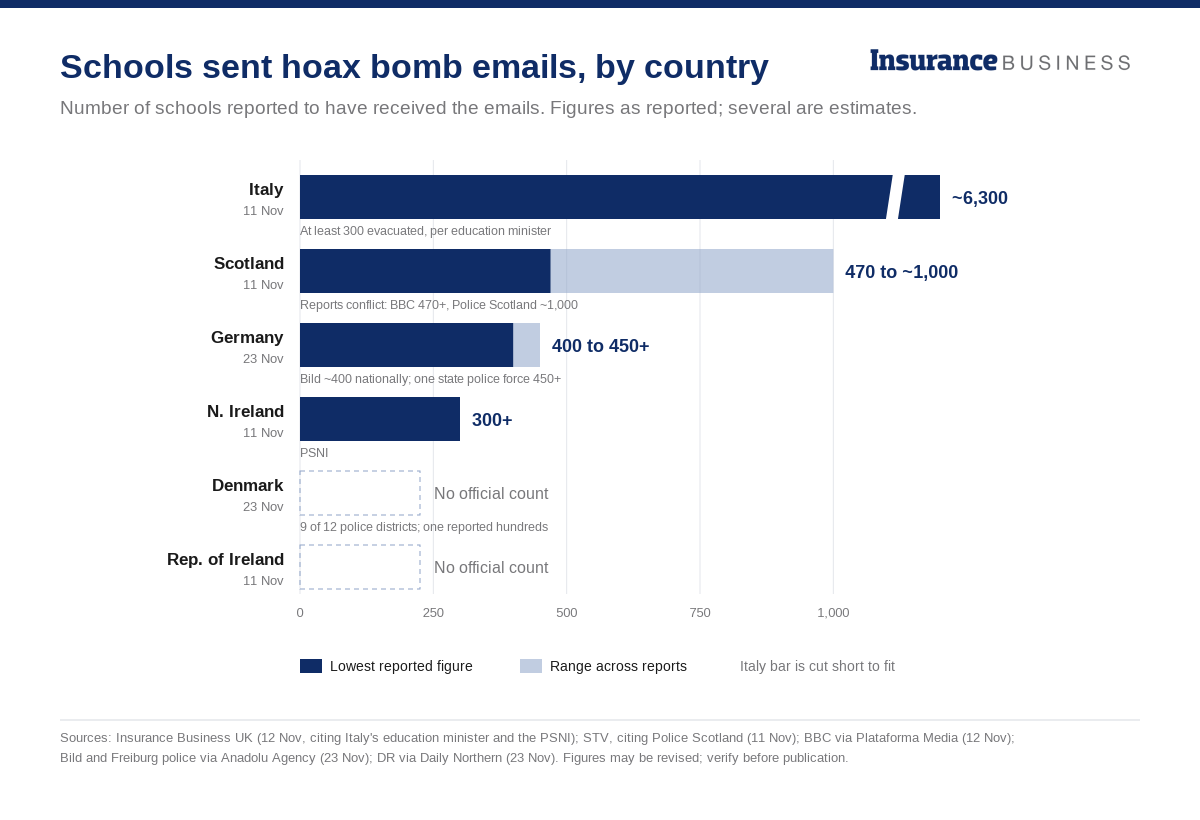
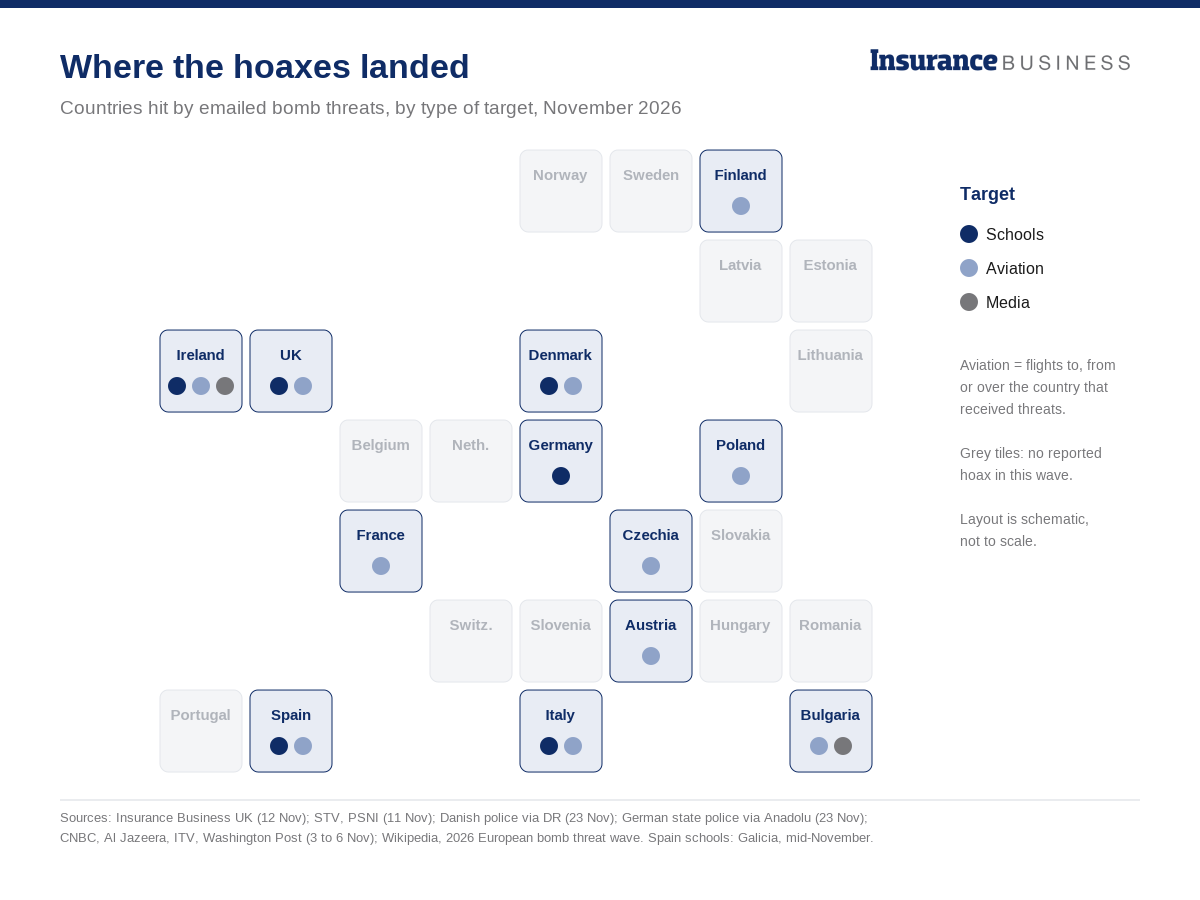
On November 11, schools across Scotland, Northern Ireland, the Republic of Ireland and Italy received a near-identical hoax. Police Scotland said the messages had been sent to distribution lists across the UK, assessed immediately and treated as hoaxes, with its Cyber and Fraud Unit trying to trace the sender. In Northern Ireland, the PSNI said more than 300 schools had reported the email and that it came from outside the UK. Several Scottish councils, including Edinburgh, Fife, Perth and Kinross and Inverclyde, still saw some schools evacuate or lock down as a precaution. Scotland had already been targeted in a similar wave only weeks earlier.
Read next: Wave of UK, European school bomb threats expose cover gap
Schools are only part of the picture. In the first week of November, hoax threats hit dozens of flights across Europe, forcing diversions, searches and, in some cases, fighter jet escorts. Newsrooms in Ireland and Bulgaria were also targeted. No device has been found in any of the incidents, and no government has publicly named who is responsible.
Read next: Europe's wave of aviation bomb hoaxes puts war risk and terrorism cover in focus
In Denmark, Monday's advice was effectively to note the email and carry on. That reflects official thinking in the UK too: the government's guidance on bomb threats says most threats are hoaxes meant to cause alarm and disruption, and asks organisations to judge credibility before deciding whether to search, evacuate or stay put.
Each wave that turns out to be fake makes the next one easier to dismiss, and that creates its own problem for anyone responsible for a building full of children or members of the public. Over time, the bigger danger becomes underreacting rather than overreacting. If a genuine threat ever arrives in the same format, the person who decided to ignore it will want a documented, defensible process behind them.
A school or venue with a written bomb threat plan, clear lines on who makes the evacuation call and records of how each decision was reached is far better placed if something goes wrong. ProtectUK, the police-run counter-terrorism advice platform, sets out when evacuation, invacuation or lockdown makes sense, and the Department for Education has its own school and college security guidance.
Read next: 25 years after 9/11, terrorism cover still has blind spots
The insurance problem with an email hoax is that it causes cost without damage. Lost teaching time, staff overtime, parents leaving work early, extra security and cancelled events all add up, but standard commercial property and business interruption cover is built around physical loss.
As Insurance Business reported this month, Pool Re's non-damage business interruption cover can respond to denial of access, but only where the underlying policy includes it and HM Treasury certifies the incident as an act of terrorism. Pool Re's chief underwriting officer, Jonathan Gray, told IB that Treasury guidance means some hoaxes may now be capable of certification without property damage, but whether any of this autumn's incidents would qualify is untested. Northern Ireland sits outside the Pool Re scheme entirely.
Take-up is the other gap. Pool Re's guidance for small businesses puts the share of UK SMEs without terrorism cover at around 95%, although some insurers have started building it into standard SME policies this year.
Read next: Aviva embeds terrorism cover in SME policies as Pool Re scheme begins to take hold
Underwriters also have an accumulation problem to consider. A single email, sent to a mailing list, reached hundreds or thousands of schools in several countries within hours. If a future campaign does trigger a cover that responds, losses would land across a whole portfolio at once rather than one site at a time. And if a state actor is ever shown to be behind it, war and state-actor exclusions come into play.
Read next: Fairford arrests expose the war exclusion gap behind terrorism cover
For clients in education, hospitality, retail and events, brokers can start with three questions. Does the programme include non-damage business interruption, and what exactly triggers it? Is there any cover at all for a threat or hoax, as opposed to an attack, and at what sub-limit? And does the client have a bomb threat procedure that would stand up to scrutiny if staff got the call wrong?
Airlines are already counting the cost. Diversions and searches from this month's hoaxes have left carriers with bills that hull and liability policies were never designed to pick up.
Read next: Bomb hoaxes leave airlines with costs insurance won't cover
Danish and German police are investigating, as are forces in Scotland, Northern Ireland, Ireland and Italy. No arrests linked to the school emails had been publicly announced at the time of writing. Until that changes, schools across Europe should expect more emails, and most of the cost of each round is likely to be paid by schools themselves rather than their insurers.