The Fidelis Partnership has filed to list on the New York Stock Exchange. Its prospectus gives the clearest picture yet of how the Lloyd's heavyweight makes its money, and of who it still depends on.
TFP Group Limited, run by founder, chairman and group chief executive Richard Brindle, has applied to trade under the ticker "TFP". The registration statement filed with the SEC on Friday leaves the price range, share count and ownership table blank for now. Both the company and a group of existing shareholders will sell stock.
The company is incorporated in Bermuda, but its principal executive offices are at 22 Bishopsgate in the City of London. It employed 622 permanent staff at the end of June, based mainly in London, Dublin and Bermuda.
TFP calls itself the world's largest independent MGA, and it is keen to stress that it is not a carrier. It places risk on behalf of capacity providers rather than holding it, although it does put up a minority share of the capital behind its two Lloyd's syndicates. Placement commission made up 86% of revenue last year, profit commission 12%, and interest on premium it holds in trust the rest.
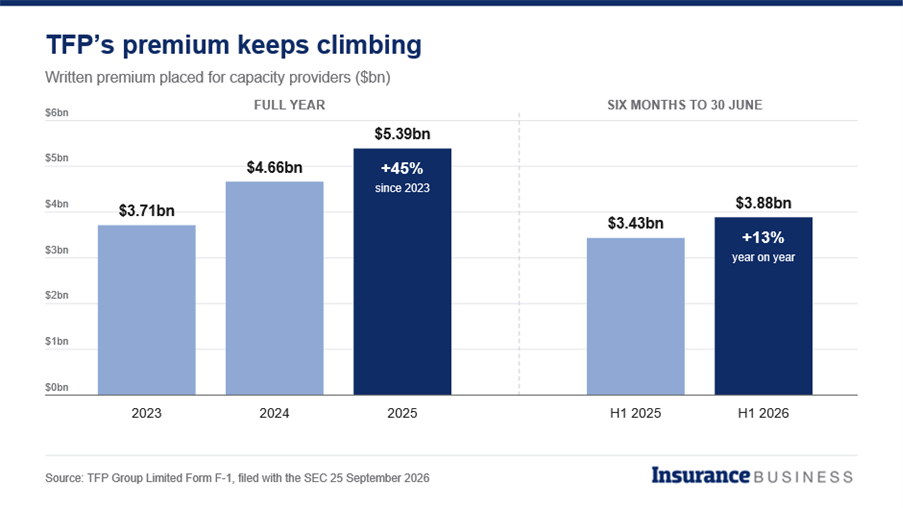
The scale is considerable. TFP wrote $5.39bn of premium for its capacity providers in 2025, up from $4.66bn, across more than 150 lines and over 140 countries. It says its Fidelis Underwriting arm led on 94% of the risks it wrote in the year to June.
Read next: Fidelis commits $1.6 billion in data center capacity through Lloyd's consortia
At first glance, the half-year numbers look impressive. Net income for the six months to June rose to $127.5m from $74.5m, and revenue climbed 11% to $407.5m.
Most of that profit leap didn't come from underwriting fees, though. TFP owns about 9.9% of Pelagos Insurance Capital, the listed carrier created alongside TFP when Fidelis Insurance was split in two in January 2023. TFP values that stake at its market price. In the first half, the holding produced a $39m gain, against a $17.5m loss a year earlier. That $56.5m swing accounts for roughly the whole improvement in net income.
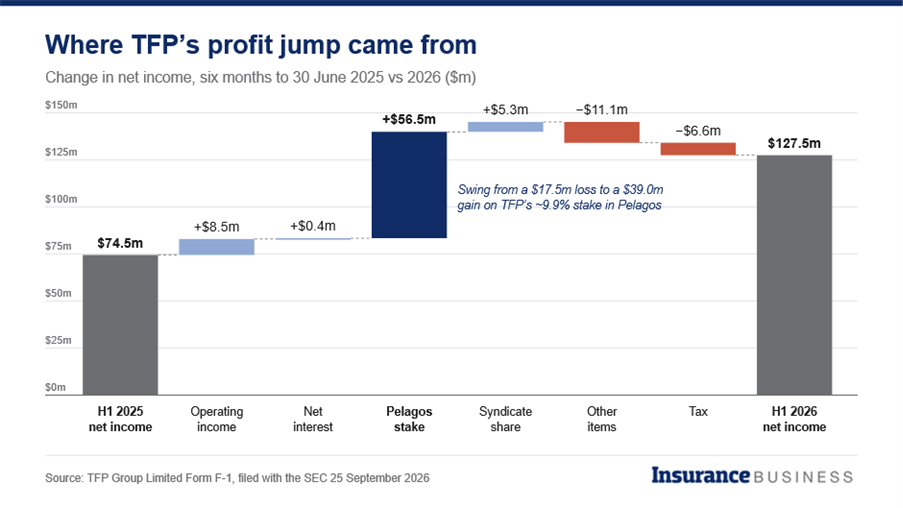
Strip that big swing out and the picture looks much steadier.
Operating income rose just 4.3% to $205.1m. Adjusted net income was broadly flat at $131m, compared with $129m. The adjusted EBITDA margin slipped from 64% to 60%. Total operating expenses rose nearly 20%, driven by more hiring and a weaker dollar against sterling and the euro, while revenue grew 11%. For the full year 2025, reported net income actually fell, to $140.6m from $152.7m.
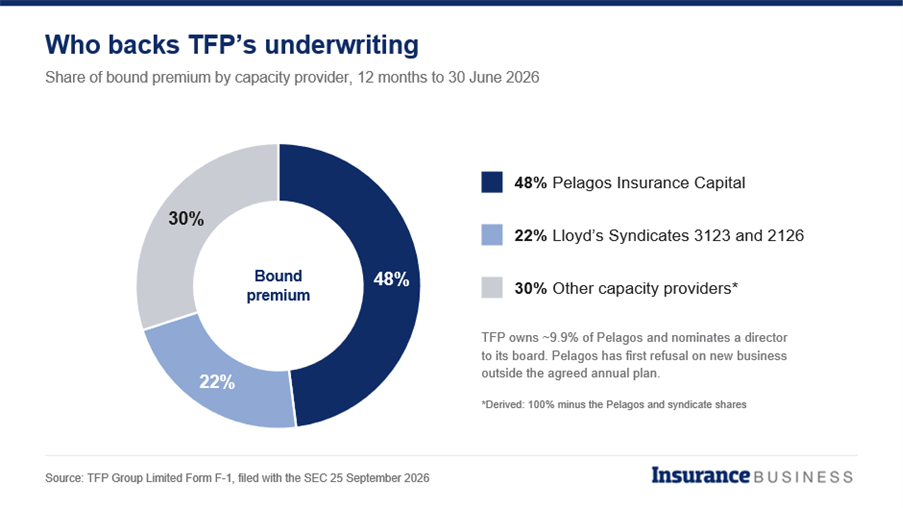
The prospectus also puts a number on how much TFP relies on its former sister company. Pelagos, formerly Fidelis Insurance Group and renamed in May, supported 48% of TFP's bound premium in the 12 months to June.
That relationship is governed by a framework agreement on a rolling ten-year term, with a minimum floor of capacity from 2027 onwards. The arrangement cuts both ways. Pelagos gets first refusal on any new business TFP originates outside the agreed annual plan. In return, TFP gets first offer on new business Pelagos wants placed. TFP also nominates a director to the Pelagos board.
Brindle called it a "cornerstone" relationship when TFP launched its Blackstone-backed syndicate in late 2025, before Fidelis Insurance Group renamed itself Pelagos. The F-1 uses the same word. It also makes clear that the relationship is a significant concentration: TFP warns that its business could suffer if a key capacity provider cut back or walked away.
Read next: Fidelis Partnership cuts borrowing cost by 225bps in $2bn debt move
TFP set up at the Lloyd's market just over two years ago. It wrote $196m of premium there in the rest of that year and $752m in 2025, and it has approved capacity for $1.3bn this year. The set-up costs were just $4.8m.
Its two syndicates now support 22% of bound premium. Syndicate 3123 is backed by Lloyd's Names, and 2126 is backed by funds managed by Blackstone. Together with Pelagos, they mean about 70% of TFP's bound premium sits on multi-year capacity arrangements, which the company presents as a selling point for investors.
Read next: Fidelis secures NAIC listing as syndicate 2126 joins US surplus lines fray
TFP will use its share of the proceeds to pay down part of the $2.04bn term loan it took out in August. Blackstone's ties run deep here too. As well as backing Syndicate 2126, it was the largest lender under the loan that facility replaced. TFP intends to start paying dividends in 2027.
As both a foreign private issuer and an emerging growth company, TFP will be exempt from some US disclosure and governance rules, including parts of the NYSE's corporate governance requirements.
TFP says it saw some rate softening across traditional specialty and reinsurance in 2025. It expects further downward pressure this year in property and cyber. It also lists the loss of Brindle as a key risk.
The market it is walking into is not generous either. Florida-based E&S homeowners insurer Orion180 priced its IPO this month at $12 a share, below its $15 to $17 range. Matt Kennedy, senior strategist at Renaissance Capital, has described a "valuation mismatch between issuers and buyers" this autumn.
The price range, when it arrives, will show whether investors pay up for the fee-based growth story or mark it down for the Pelagos concentration.
Read next: Orion180 IPO falls short of target valuation