Ask most commercial clients what needs insuring and they’ll point at what they own: the warehouse, the fleet, the machinery on the factory floor. According to Lloyd’s, that’s increasingly the wrong place to start.
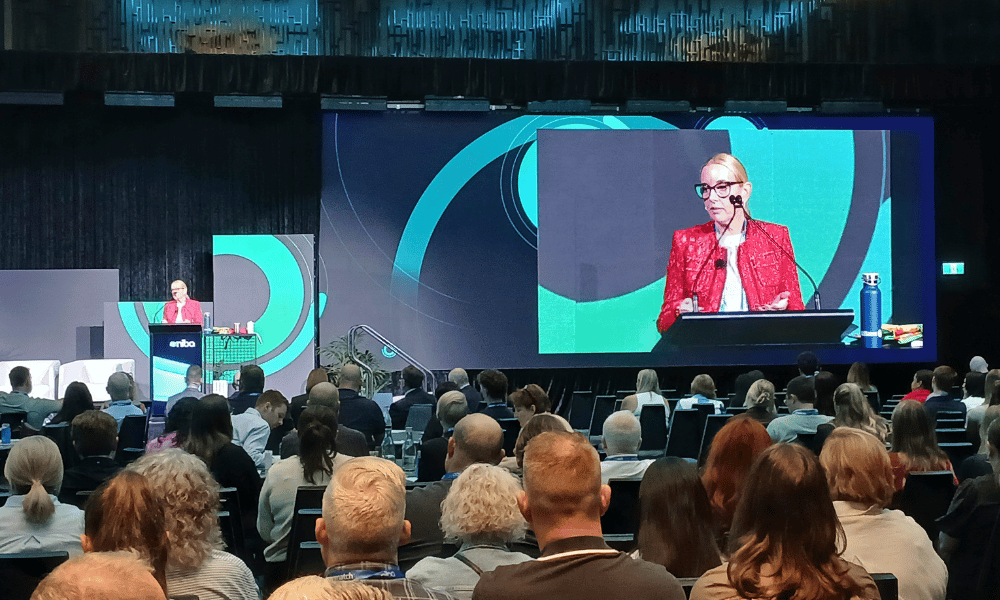
Giving the keynote on the final morning of the National Insurance Brokers Association (NIBA) convention on Australia’s Gold Coast, Emma Loynes, Lloyd’s chief executive for Asia Pacific, the Middle East and Africa, told a sold-out audience of more than 1,000 that risks now connect and compound. Brokers who can trace those connections, she argued, will matter more to clients than ever.
The audience was Australian, but the message will be familiar in Britain. Loynes spent more than two decades at RSA before joining Lloyd’s, and her argument fits a UK market still dealing with the fallout from Jaguar Land Rover.
In practice, she said, brokers need to ask a different question. Where a client’s assets sit matters less than what the business needs to keep trading, where the fragile points are, and what happens when one fails. For a manufacturer, that could be a specialist supplier abroad, a port, a haulier, an energy provider or a cloud platform. Smaller firms are often more exposed, not less. Loynes described the typical SME as running on “one supplier, one cloud platform, one key customer, and one premises”, where losing any one of them can stop the business almost immediately.
Her main example came from Australia. In January 2022, a one-in-200-year flood in South Australia badly damaged a 300km stretch of the Trans-Australian Railway, the east–west line that carries around 80% of the freight entering Western Australia from the rest of the country. The flooding was hundreds of kilometres from Perth, but supermarket shelves there emptied.
Government, rail operators, retailers and hauliers improvised. Special permits put 53.5-metre triple road trains on the highway, and a road–rail “land bridge” moved containers around the break. Main Roads Western Australia says road freight rose by half under those permits. Loynes’s point was that the exposure was never only the track - it sat with every business that relied on the route.
British brokers don’t need to look as far as the Nullarbor. When JLR’s factories went dark for five weeks from 1 September 2025, the damage spread well beyond the company. The independent Cyber Monitoring Centre later estimated the economic cost at around £1.9bn, affecting more than 5,000 UK organisations, the most damaging cyber incident on record in the UK. Insurance Business reported at the time that JLR had no cyber policy in place, and the government stepped in with a £1.5bn loan guarantee to keep the supply chain going.
The incident became a real-world test of contingent business interruption wordings and named-supplier schedules, which is the kind of dependency mapping Loynes is asking brokers to do before renewal rather than after a loss.
Read next: Did Jaguar Land Rover’s cyber insurance gap help pave the way to 4,000 job losses?
Digital dependencies are where clients are most likely to be caught out, Loynes said. Many know their buildings in detail but know little about the third-party platforms and data they rely on every day. She described AI as a real opportunity that also brings liability: it can scale fraud and error, blur who is accountable, and create exposures that are hard to see coming.
She also gave the protection gap a second meaning. Beyond the familiar gap between economic and insured losses, she pointed to the gap between how resilient a business thinks it is and how resilient it actually is.
Loynes was clear that technology won’t replace human advice. Used well, she said, it handles the routine and gives brokers more time for judgement. “A machine can identify a pattern, but only the broker can decide whether it matters for this business, in this market, in this moment,” she said.
The Australian profession at least isn’t fully ready. NIBA’s Ready or Reacting? report found 83% of brokers expect technology and automation to reshape broking by 2035, but only 61% feel prepared. NIBA was due to publish follow-up research on AI before the convention closed.
UK brokers also have a gap that needs work. BIBA and Markel opened applications this summer for a Broker AI Academy, one of the commitments in BIBA’s 2026 Manifesto. BIBA chief executive Graeme Trudgill said members had been asking how to take advantage of AI while managing its risks.
People are still the bigger worry, though. A survey at this year’s BIBA conference found talent attraction and retention ranked above AI as brokers’ top priority. Loynes made a similar point: alongside deep insurance experience, the profession needs people with skills in data, engineering, climate and finance.
Read next: Talent beats AI as brokers’ top priority, BIBA survey finds
Brokers can’t do this alone, Loynes said, and insurers have to keep their side of the bargain. For Lloyd’s, that means underwriting discipline. Rates may be easing in places, she noted, but claims keep getting more expensive. Lloyd’s risk-adjusted rates fell 6.7% in the first half of 2026, almost double the 3.5% decline a year earlier, while the underlying combined ratio worsened from 82.1% to 84.0%.
Price matters, Loynes said, but clear wordings, capacity that stays when conditions turn, and claims handling that works when needed matter just as much. For risks that don’t fit a standard product, she described Lloyd’s as a marketplace rather than a single balance sheet. It can bring specialist underwriters and capital together through open-market placements, binders, consortia, facilities, parametric covers or alternative capital. Facilities in particular are growing quickly: Lloyd’s CEO Patrick Tiernan has said cross-class facilities and structured solutions now account for around 3% of the portfolio, growing at roughly 56% a year.
Read next: Lloyd’s rates fell 6.7% in H1 - nearly twice the pace of last year. Brokers should be watching
Her outlook will make some brokers uneasy. Automated underwriting will keep commoditising routine placements, she predicted, and the annual renewal will increasingly give way to continuous, real-time evaluation. In London, algorithmic follow platforms such as Ki are already moving in that direction.
Her advice was not to fear the algorithm but to use it: let it handle volume and sharpen insight, so brokers can concentrate on judgement, advocacy and relationships built on trust. The future, she said, belongs to brokers who help clients “understand it, reduce it, manage it, and build resilience”, and who present risk management as protecting future revenue rather than as a yearly cost.
She closed with a four-part instruction: own the insight, master the technology, raise your advisory value, and be proud of the work.
Read next: Ki adds sixth Lloyd’s syndicate as brokers gain wider follow-capacity access