Somewhere in Europe, two lorryloads of very good Tuscan red are looking for a buyer. The owner of those bottles, the 640-year-old Marchesi Antinori dynasty, is looking for them too. Its insurer, by the sound of things, will be writing a cheque for only a fraction of what went missing.
Over the weekend of 2–3 October, a crew of masked men got into Antinori's storage site at Cortona, in the hills of eastern Tuscany. The alarm stayed quiet and the cameras were knocked out. Using the winery's own forklifts, they loaded around 30,000 bottles into two trucks and drove off. Nobody noticed until staff turned up for work on the Monday.
The haul is valued at about €5m (roughly £4.2m). It was no random sweep of the shelves. The thieves took the house's most coveted labels, including Tignanello, Solaia and Guado al Tasso, bottles that typically sell for somewhere between €120 and €500 apiece. Most were from the 2023 vintage and had been gathered in one place for a big export consignment due to leave the following week.
Around 10,000 of them were Solaia, a wine Italian reports say is made in runs of only 60,000 to 70,000 bottles a year. Losing that much of a single vintage is not something a producer can simply replace from the next shipment.
That timing is what makes this an insurance story rather than just a crime caper. According to the company, export runs like this happen only once or twice a year. For a few days, an unusually large slice of the year's most valuable stock sat in a single building, ready to go. It is the textbook accumulation risk, and it seems the policy wasn't sized for it.
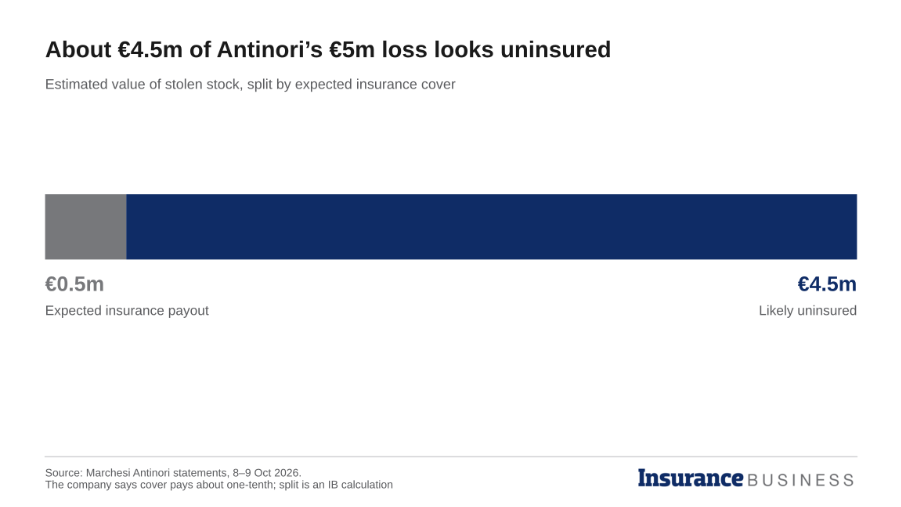
Antinori has said its cover was designed around smaller losses, the odd pallet or a few cases going astray in transit. Lorenzo Vivoli, who handles communications for the winery, has said the insurance is expected to pay out about one-tenth of the value lost. On a €5m loss, that leaves a gap in the region of €4.5m.
For UK brokers, that should sound uncomfortably familiar. Underinsurance has been a running theme on this side of the Channel for years, mostly through the lens of buildings. Research from RebuildCostASSESSMENT.com found that 70% of UK properties were insured below their true rebuild cost in 2025, with the average property covered for just 66% of what it would cost to replace.
Stock is arguably harder to get right than bricks and mortar. Values swing with seasons, shipping schedules and, in the case of fine wine, market appetite. A sum insured that is fine in March can be badly short in October if a client is building up inventory for a launch, a peak season or a once-a-year shipment.
Stock declaration clauses, seasonal increases and properly structured stock throughput cover exist for exactly this reason, but they only work if somebody asks the client when the stock peaks.
Read next: Why UK commercial buildings face a mounting underinsurance problem in 2026
The silent alarm has raised the obvious question. The winery has said it suspects someone with inside knowledge may have switched the system off, and that the gang's timing was almost too good. Carabinieri in Cortona are working through the CCTV footage. Italian reports say investigators are also looking at whether the job was stolen to order and whether the lorries have already crossed a border. At the time of writing, no arrests have been made.
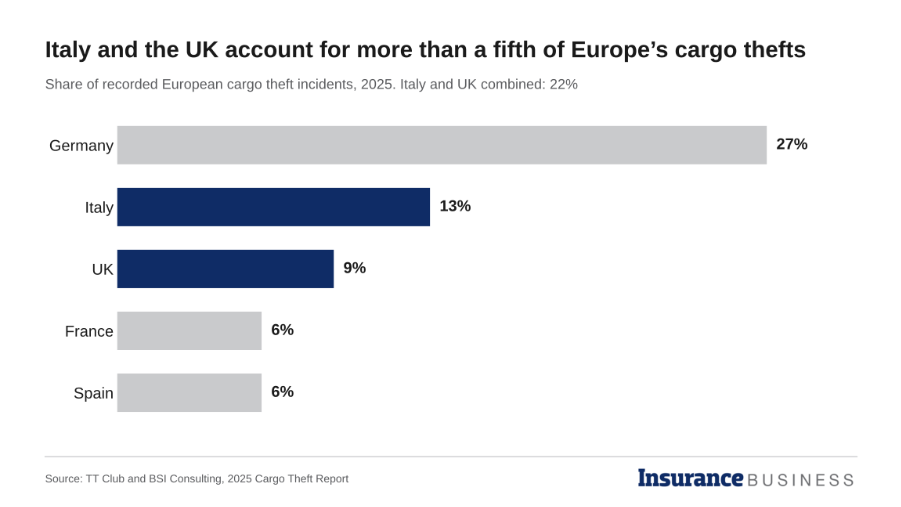
If that suspicion holds, it lines up with what the specialist market has been warning about. The 2025 Cargo Theft Reportfrom transport insurer TT Club and risk adviser BSI found that 22% of cargo thefts worldwide involved insider cooperation. Food and beverage topped the list of stolen goods. Warehouses accounted for a third of theft locations, and break-ins at storage sites were rising in Italy, which made up 13% of recorded European incidents. The UK accounted for 9%, with losses of about US$149m in 2024.
So whose policy picks up an inside job? That depends on wordings that clients rarely read until it's too late. Many theft sections require forcible and violent entry. Employee dishonesty usually sits under separate fidelity or crime and fraud cover, if it's bought at all.
Read next: Cargo insurers face rising losses as fraud reshapes global theft risk
Italy has been here before, and the insurance outcomes have varied wildly. In August 2012, a masked gang of about a dozen took nearly 29,000 bottles from the Cantele winery in Puglia, worth close to US$200,000. None of it was insured. The family later explained that mid-priced producers rarely insured bottled stock, on the basis that nobody would bother stealing it.
At the other end of the scale, a couple posing as hotel guests walked out of the two-Michelin-star Atrio restaurant in Cáceres, Spain, in 2021 with just 45 bottles. Those bottles were worth around €1.65m, including a single 1806 Château d'Yquem. The restaurant reached a confidential settlement with its insurer within months.
Forty-five bottles, properly scheduled, got paid. Thirty thousand bottles, insured as if they were a few lost cases, will not. The difference was never the size of the loss. It was whether anyone had imagined it.
Antinori isn't the only Italian producer to be targeted this year. Earlier in the summer, the Banfi group reported that about 3,000 bottles of its Alta Langa sparkling wine were taken from a warehouse in Piedmont.
In September, thieves spent just under three hours at the Conterno Fantino estate, also in Piedmont, and left with a similar number of Barolo bottles, again helped along by the site's own forklift. Antinori's chief executive, Renzo Cotarella, has said he thinks the same gang may be involved.
The pattern is a shift from the classic wine theft, where a thief lifts a handful of trophy bottles from a Michelin-starred restaurant's cellar. These jobs are about volume, planning and logistics: the kind of crime cargo underwriters see every week, aimed at a sector that has historically thought about breakage and spoilage far more than about organised gangs.
UK insurers shouldn't treat this as a Tuscan curiosity. On the August bank holiday Monday, thieves hitched two HGV trailers holding around 800 barrels of Guinness, worth about £115,000, at a depot in Runcorn. Cheshire Constabulary later found the trailers 30 miles away, empty. And on 2 October, the same weekend as the Cortona raid, Avon and Somerset Police began investigating the theft of a large amount of premium vodka from a lorry load near Radstock. Drinks are portable, valuable and easy to sell on, which is exactly why they top the stolen-goods tables.
There's also a practical twist. Antinori says every stolen bottle carries an anti-counterfeiting label that can be checked with a smartphone, so the wine itself is identifiable. The consignment, though, had no tracking device on board. The company has warned trade buyers around the world to be wary of any of its wines offered outside official channels. Shifting 30,000 bottles of instantly recognisable Super Tuscans quietly won't be easy, but trace-and-recover clauses only help if the goods can actually be traced.
Read next: Gallagher flags widening protection gap as UK supply chain shocks intensify
The estate, founded in 1385 and with exports to some 170 countries, will survive. Revenues ran to about €263m last year, so a €4.5m uninsured hole hurts without being fatal. Cotarella has spoken of staff in tears, and of the shock that something like this could happen to them at all.
Smaller producers, distributors and bonded warehouses holding high-value stock in the UK might not be so lucky. Three questions are worth putting to any client in that position before renewal:
As the old Insurance Business piece on avoiding 'pour' decisions with wine insurance put it, valuations need regular inventories to stay honest. That advice was written for private collectors. After Cortona, it applies just as much to the trade.