More than 50,000 people living in Europe's towns and cities died because of the heat this summer, and nearly two thirds of those deaths would not have happened in a climate untouched by fossil fuel burning.
That is the verdict of new modelling from researchers at Imperial College London and the London School of Hygiene & Tropical Medicine, released today in the journal Nature Health. It makes 2026 the deadliest European summer for heat in the researchers' records, which run back to 2000.
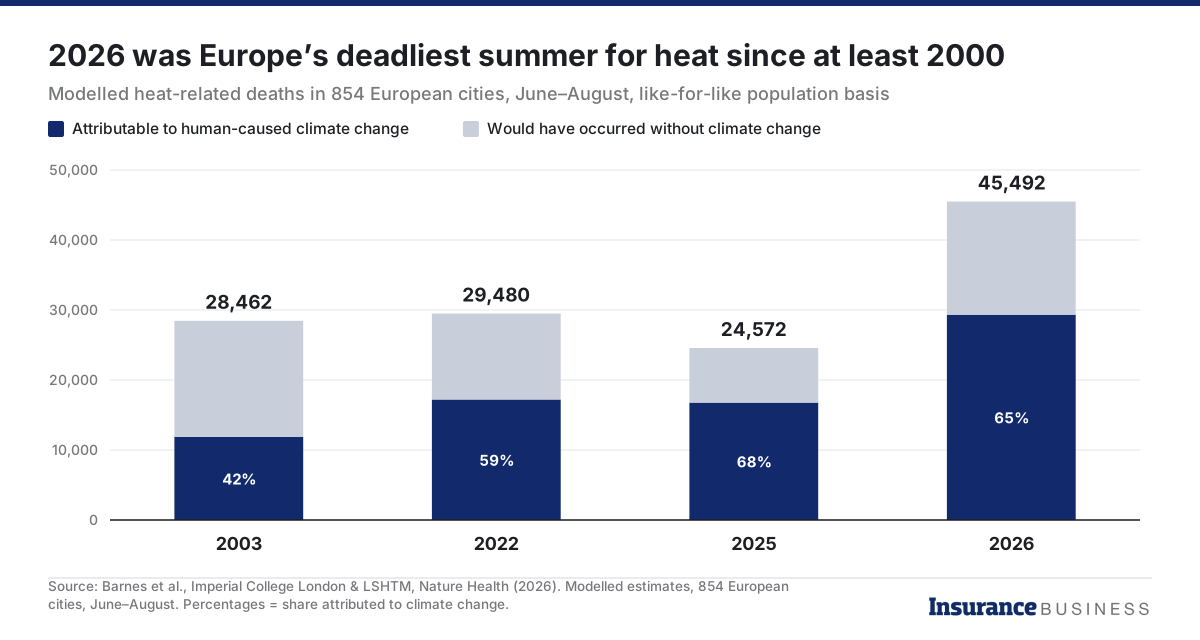
The team looked at 854 cities in 30 countries (the EU-27 plus the UK, Norway and Switzerland), together home to about 173 million people. It estimates 50,391 heat-related excess deaths between June and August, with 32,619 of them attributed to human-caused warming. Run on the same population assumptions used for earlier years, the 2026 toll comes out roughly 50% higher than 2003 and 2022, the two summers that until now set the benchmark.
"Until we kick the fossil fuel habit, we will continue to see increasingly hot and dangerous summers," said lead author Clair Barnes, a climate scientist at Imperial.
For an industry that has spent the summer tallying subsidence and wildfire claims, the numbers are a blunt reminder that the heaviest cost of extreme heat falls on people rather than property.
Read next: Fourth UK heatwave piles pressure on insurers facing record claims
The oldest paid the highest price
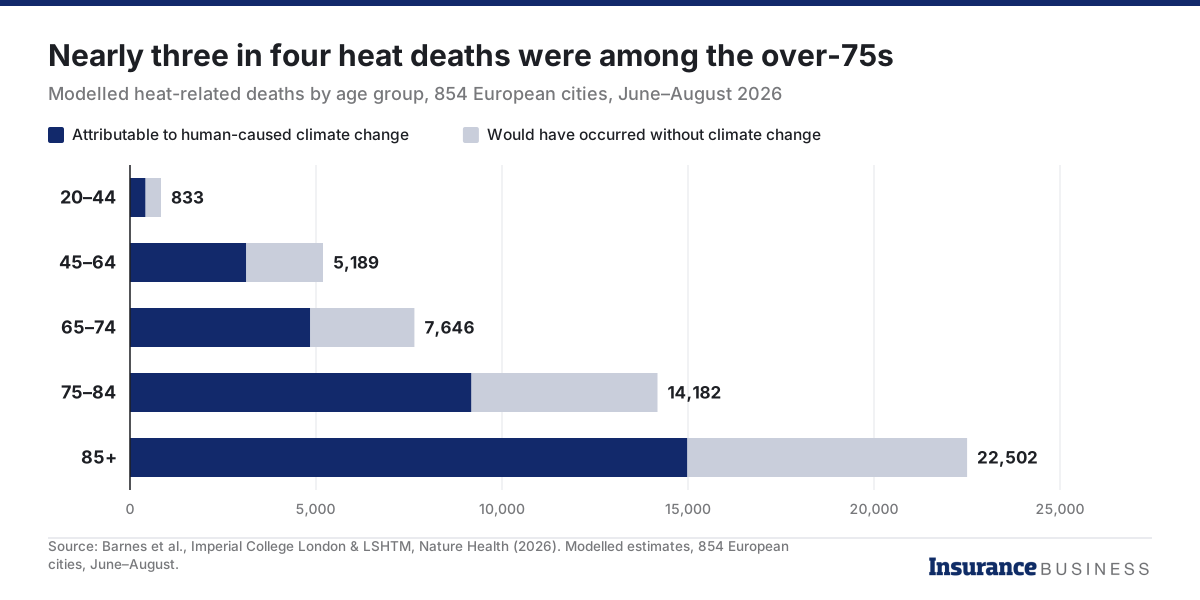
Age did most of the damage. People aged 85 and over account for 22,502 of the modelled deaths, about 45% of the total, and those aged 75 and over for nearly three-quarters. Working-age adults were not spared: the model puts around 6,000 deaths among 20 to 64-year-olds, including more than 800 aged 20 to 44.
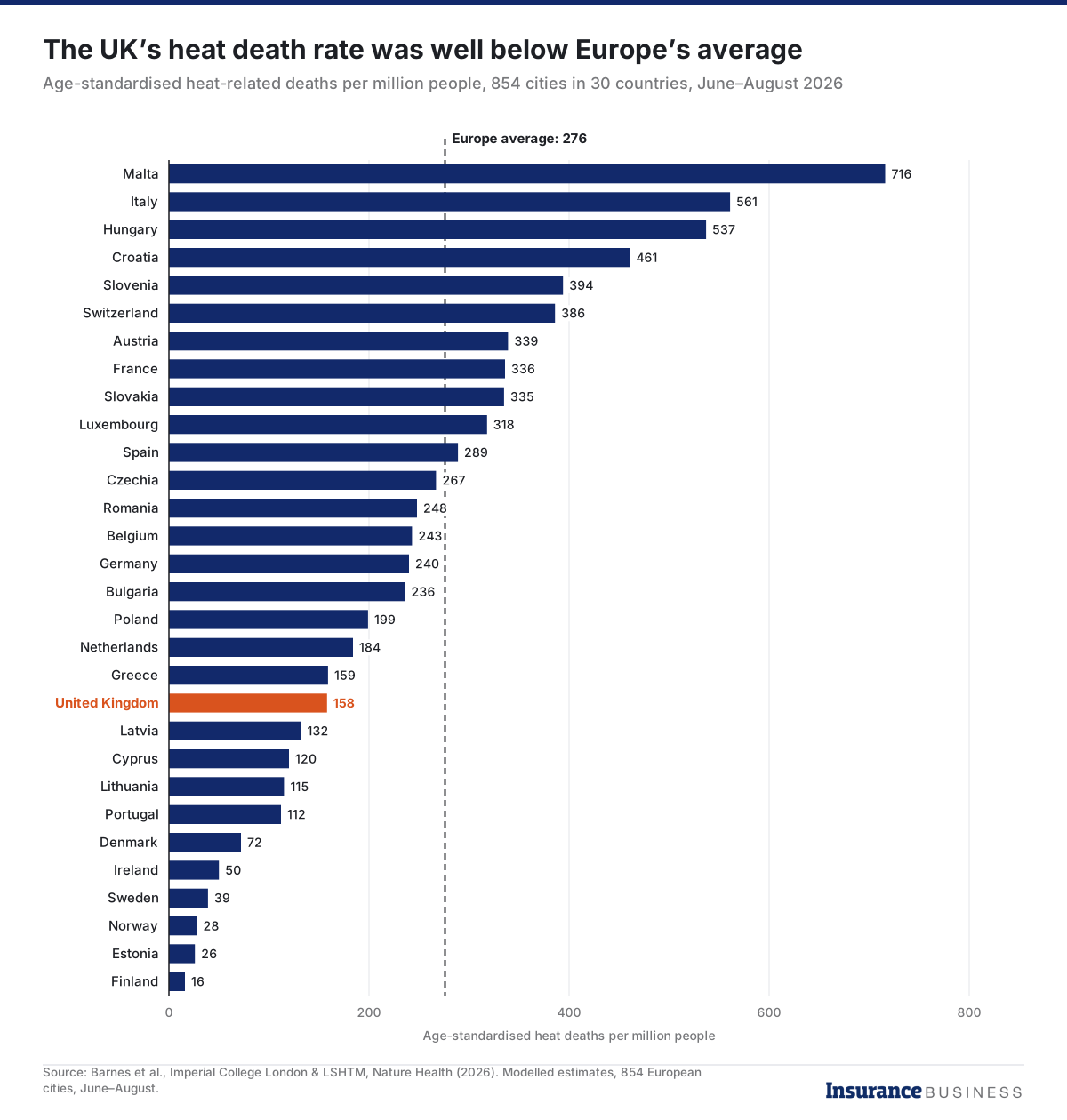
The UK fared better than much of the continent, but not by a comfortable margin. Across 135 UK cities the researchers estimate 4,354 heat deaths, of which 2,535 (59%) are linked to climate change. Adjusted for age, that is 158 deaths per million people, against a European average of 276. Malta (716 per million), Italy (561) and Hungary (537) had the highest rates, and Italy's 13,303 deaths were the largest national toll.
Official figures back up the sense of a record year. The UK Health Security Agency estimated 2,877 heat-associated deaths in England during the May and June heat episodes alone, 2,124 of them in the eight-day June heatwave, and expects 2026 to beat the 2022 record of 2,985 once the full summer is counted.
"Much of Western and Northern Europe, our infrastructure is just not designed to cope with the sort of temperatures that we are seeing now," Barnes said.
The heatwave that gripped western Europe from 17 June to 1 July did the most harm. City temperatures ran 5.3°C above the 1991–2020 average for the time of year, and the model attributes around 14,500 deaths to that fortnight, close to three in 10 of the summer total.
There is a counterintuitive twist. During that peak, the share of deaths blamed on climate change dropped to 57%, because temperatures that extreme would have been dangerous even in a pre-industrial climate. Cooler countries such as Finland and Estonia, where heat would barely have reached lethal levels without warming, saw about 80% of their much smaller tolls attributed to climate change.
The Copernicus Climate Change Service has confirmed western Europe had its warmest summer on record, 2.54°C above the 1991–2020 norm and well clear of 2003. Elsewhere, France's public health agency reported 5,764 excess deaths in its late-June heatwave and Germany's Robert Koch Institute put its April to early September total at around 16,000.
Read next: Heatwave deaths not yet enough to change life insurance assumptions
The protection market is large enough for this to matter. Insurers paid out £7.84bn in individual and group protection claims in 2025, according to the ABI and Group Risk Development, with £4.03bn of that in life claims. Heat deaths do not land evenly across that book, though.
Read next: UK protection payouts reach £7.84bn as musculoskeletal claims lead income protection
For actuaries, the key question is whether heat adds deaths over a full year or simply brings some forward. Many people who die in a heatwave are already very frail, so a spike can be followed by a dip, a pattern known as mortality displacement. Michael Anderson, editor of the Institute and Faculty of Actuaries' Longevity Bulletin, told Insurance Business earlier this year that it was "a little bit too soon to get a firm conclusion", not least because a mild flu season pushed first-half mortality in 2026 to record lows.
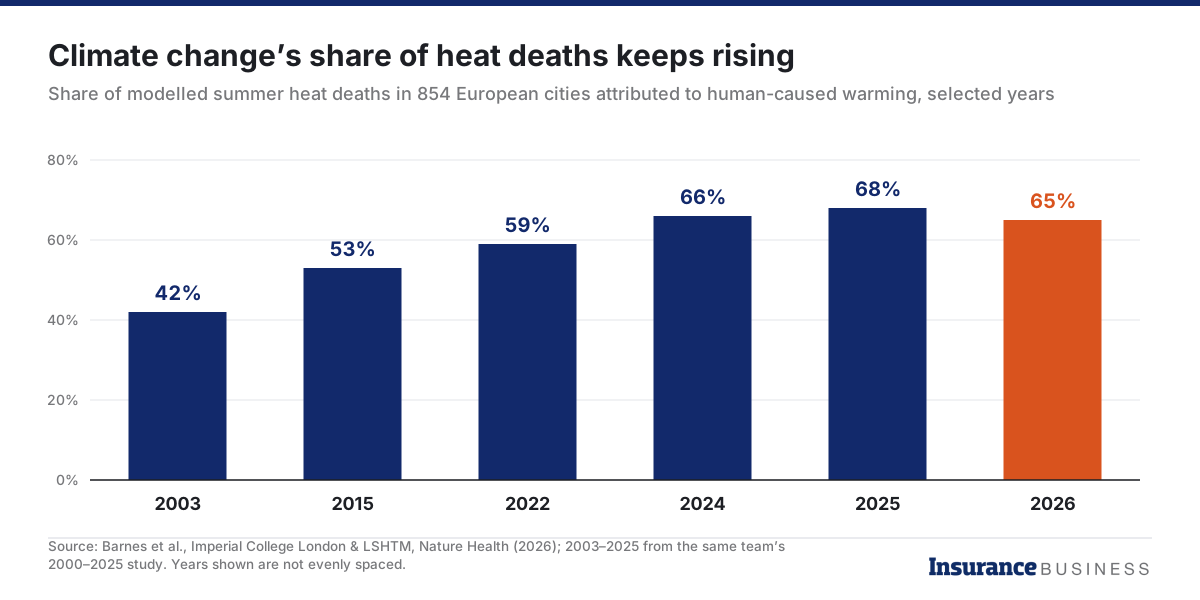
What the new study does show is that climate change's fingerprint on heat deaths is getting heavier. Using the same model, the researchers attribute 42% of 2003's heat deaths to human-caused warming, 59% of 2022's and 68% of 2025's. At 65% in 2026, two-thirds is becoming the norm.
Regulators have noticed. Last month EIOPA named extreme heat as the leading climate-related liability risk for life and health insurers and pension providers, flagging medical expense, income protection and workers' compensation as the most exposed lines. Rating agencies, for now, see the pressure as manageable, as S&P's recent analysis of European heat mortality showed.
Read next: European heatwave mortality is pressing on insurer financials – but ratings are not yet at risk
These are modelled estimates rather than counted deaths. The study covers urban populations only, which the authors put at about 40% of the 30 countries' population, so the true continental figure will be larger. The temperature–mortality relationships come from 2000–2019 data and do not capture humidity, warm nights or the fact that the worst heat arrived in June, before people had acclimatised. The authors say all three probably mean the June toll is understated.
They also note that, under current policies, a further 1.4°C of warming is projected by the end of the century. For underwriters, actuaries and brokers advising older clients on long-term protection, heat is starting to look less like a freak summer and more like a structural shift in risk.
Read next: UK heatwave signals a systemic risk shift, warns WTW climate expert