What happened: The Court of Appeal ruled that a housing provider's claim over passive fire safety defects in a block of flats should proceed to trial, rejecting the insurer's bid to have it thrown out early.
Who's involved: Vivid Housing Limited (housing provider and policyholder) and Allianz Global Corporate & Specialty SE (insurer)
What's at stake: The cost of repairing fire safety defects across a 72-flat residential block in Portsmouth - no figure is stated in the judgment
Why it matters: Latent defects insurers cannot easily dispose of passive fire defect claims at an early stage - whether those defects amount to an "imminent" threat is a question for trial
Where it stands: Appeal dismissed on November 3, 2026; the case now proceeds to a full trial on the merits
No fire had broken out at a 72-flat residential block in Portsmouth. But the building's combustible cladding and missing cavity barriers were dangerous enough that the Court of Appeal has ruled the insurer must face a trial over whether its latent defects policy should respond.
The decision, handed down on November 3, 2026, dismissed an appeal by Allianz Global Corporate & Specialty SE against a High Court ruling that refused the insurer summary judgment - effectively, an early win without a trial. At the heart of the dispute is a single word in the policy wording: "imminent."
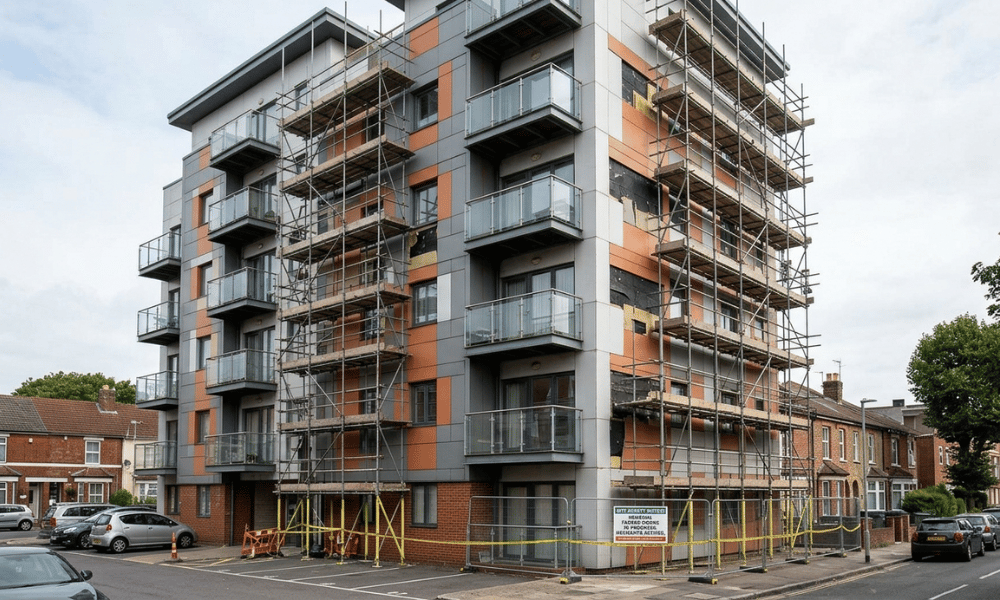
Vivid Housing Limited owns a block of 72 flats at Collins Place in Portsmouth, covered by a Housing Warranty Insurance Policy. Building LifePlans Ltd issued the policy on Allianz's behalf under a binding authority arrangement. The key clause - clause 3(a)(iii) - covers the cost of repairs where a defect causes "the threat of imminent destruction or physical damage to the Premises which requires immediate remedial measures."
The cover ran from May 22, 2008 to May 21, 2020. On or about May 19, 2020 - days before the policy expired - Vivid notified a claim. A facade fire risk assessment by CBRE had identified four defects: combustible Rockpanel cladding installed alongside combustible foam insulation, missing vertical cavity barriers, missing or defective horizontal cavity barriers, and construction debris left inside building cavities.
CBRE rated the absence of compartmentation - the barriers meant to stop fire spreading unseen through wall cavities - as critical, its highest-priority category. The assessment found this provided a route for the spread of fire in the facade cavity.
When Vivid filed its claim, it answered "N/A" to the question about whether urgent repairs were needed. It had, however, put a waking watch in place - a measure described on the form as "preventative and associated measures."
Allianz's position was straightforward: no fire, no imminence. The insurer argued the policy could only respond if something made the ignition of a fire itself imminent - a fire about to break out. Passive defects in cladding and cavity barriers, however dangerous, did not cross that threshold.
There was an additional wrinkle. For the purposes of its summary judgment application, Allianz accepted that the alleged defects were "Defects" within the meaning of the policy. It also chose not to rely on a fire exclusion clause that, on its face, appeared to exclude this type of claim. Those concessions applied only to this application - Allianz reserved its right to argue both points at any future trial.
The High Court, in a decision by the Technology and Construction Court dated December 16, 2025, was not persuaded by Allianz's reading. Applying a test from earlier case law - whether a reasonable observer would regard the damage as "sufficiently likely to happen sufficiently soon" - the court found Vivid's claim had a real prospect of success. The court reasoned that fire risk is, by its nature, constant and arises from a wide variety of causes. Requiring proof that a fire was about to break out, the court said, would leave the policy with almost no practical application to fire-related defects. That, the court concluded, would not be a commercial reading of the policy.
The court also considered the waking watch. Rather than proving the absence of urgency, the lower court said the measure pointed the other way: it reflected a concern that if a fire broke out, the consequences could be "catastrophic damage both to persons and property."
The Court of Appeal found the lower court had applied the correct legal test and reached a conclusion it was entitled to reach. Whether the fire risk at the building was "sufficiently serious" and would "eventuate sufficiently soon" was a question of fact and degree - the kind of question that belongs at trial, not on a summary judgment application.
The appellate court acknowledged that Allianz's interpretation of "imminent" was not unreasonable in the abstract. But it endorsed the lower court's observation that Allianz's approach would mean the policy only responded to defects if there was something making the ignition of a fire itself imminent. The court noted an obvious relationship between the severity of a risk and the urgency of remedial repairs, and called these "paradigm matters for resolution at a trial."
Vivid's evidence on fire risk currently consists of the CBRE report and a schedule of fires across its property portfolio - including one entry, unrelated to Collins Place, where a fire started in a kitchen fridge freezer. Vivid has indicated it would seek to expand that evidence at trial.
The case now proceeds to a full hearing on whether the defects at Collins Place actually satisfy the policy wording. The Court of Appeal was careful not to answer that question.
For claims teams and underwriters working in latent defects and construction lines, the ruling narrows the scope for disposing of passive-defect claims before trial and signals that courts will treat the meaning of "imminent" in fire-safety contexts as an inherently factual question.