What happened: A Scottish court dismissed a £20,000 crash claim after finding the driver was not credible - his car's odometer had lost over 22,000 miles while in his possession.
Who's involved: First Central Insurance Management, Scottish Accident Group, MARC Car Body Repair, Automobile Assistance Ltd - the last three controlled by one individual.
What's at stake: A £20,000 claim for personal injury and vehicle repairs, dismissed in full.
Why it matters: The ruling lays out a casebook of fraud indicators for claims handlers - mileage tampering, an undisclosed one-man claims pipeline, and inflated repair costs with undamaged parts listed for replacement.
Where it stands: Decided. The court ruled in favour of the insurer; expenses reserved.
A private hire driver's car lost 22,394 miles on its odometer while he still owned it. He had no explanation.
That was one of several problems a Scottish court identified in throwing out a £20,000 personal injury and vehicle damage claim arising from a low-speed rear-end collision in Glasgow. The judgment, handed down on November 19, 2026, by the All-Scotland Sheriff Personal Injury Court in Edinburgh, found the claimant was neither credible nor reliable - and took apart the evidence of his repair assessor along the way.
The collision itself was minor. On September 5, 2023, the claimant was stationary at a junction on Danes Drive, Glasgow, when a vehicle driven by the insurer's policyholder struck his Ford S-Max from behind. Dashcam footage captured the moment. The court found the claimant's car did not visibly move.
First Central Insurance Management admitted fault for the collision but denied it caused any injury or damage worth paying for.
The insurer's policyholder gave evidence that after the collision, both drivers got out, agreed there was no damage - or at most very minor damage - and began exchanging phone numbers. When the claimant saw the photograph of her baby on her lock screen, he told her: "Don't worry, I am not a bad person." She found it odd.
She did not see any passengers in his car. The claimant said two friends were with him - one in the front, one in the rear - and that both had also made claims through the same solicitors. Neither gave evidence. The court received no explanation for their absence.
The claimant's account of his injuries shifted depending on who was asking. He told the court his knee pain started the day after the accident and lasted six to eight weeks. He told his GP - 23 days after the collision - that the pain had been gradually worsening. He told the medical expert that his symptoms were significant for two to three weeks. He mentioned a neck injury to his GP and to the expert but did not raise it at all during his main evidence in court, only mentioning it when confronted with the expert's report in cross-examination.
The medical expert, a GP who prepared around 400 medico-legal reports a year, did not fare much better. His report contained multiple errors: he recorded the wrong GP attendance date, miscalculated the gap between the accident and that attendance, mistakenly wrote that an X-ray showed a bony injury when it did not, and overlooked an X-ray report sitting in the medical records he reviewed. He accepted that his diagnosis depended entirely on the claimant being an accurate historian - and that if the energy transfer from the collision was not enough to move the occupant, injury was unlikely.
The court found it was not enough. The dashcam showed no forward movement. No injury was established.
Then there was the question of vehicle damage. The claimant had brought in a man who ran a claims management company, Scottish Accident Group (SA Group). That same man also ran Automobile Assistance Ltd, which assessed repair costs. And - as emerged during cross-examination - he was the sole shareholder of SARG (Scotland) Ltd, trading as MARC Car Body Repair, the garage that actually did the repairs.
He had not volunteered any of this. He initially denied having a financial interest in MARC. Then he said he might own a few shares. Then it emerged there was only one share, and he owned it.
The repair estimate he prepared listed 17.3 hours of labour at £65 per hour, totalling £1,196. The correct figure was £1,124.50. His report included parts for replacement - a towing eye cover, version and equipment badges - that appeared undamaged in photographs. He admitted he had not had the vehicle stripped down before preparing the estimate, and accepted that insurers would usually require exactly that before approving it.
He also stood to earn a commission of up to 25% of the repair invoice value from the subcontractor. The court found his financial interest was "clear, obvious and direct" and had existed from his very first involvement in the claim.
The court rejected his evidence on damage and repair costs entirely. It also rejected the claimant's argument that the court should estimate repair costs broadly from the available evidence, finding it impossible to conclude whether any repairs were even necessary.
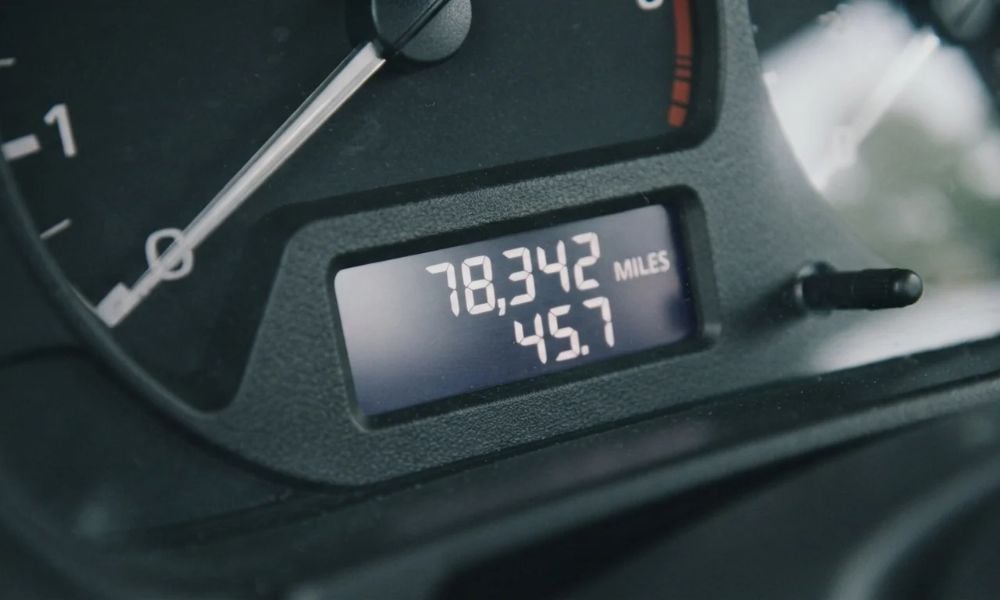
Underpinning all of it was the odometer. When the assessor inspected the vehicle on September 8, 2023, three days after the accident, the mileage read 94,083. He photographed it. When the car went for an MOT on June 25, 2025, the mileage was recorded as 71,687 - over 22,000 miles fewer. The car had been in the claimant's possession the entire time.
The claimant said he did not understand the discrepancy. He suggested the testing centres may have recorded the mileage incorrectly. The court rejected that, noting the mileage was recorded on three separate MOT occasions and that the September 2023 figure was captured in photographs.
The claim was dismissed in full. First Central was granted judgment in its favour, with the question of legal costs reserved for a later hearing.
The case amounts to a red-flag catalogue for anyone reviewing low-speed motor claims: a single individual controlling the claims management, engineering assessment, and repair functions without disclosure; repair estimates prepared without stripping the vehicle; undamaged parts listed for replacement; inflated labour calculations; absent corroborating witnesses; and an odometer that lost more than 22,000 miles without explanation.