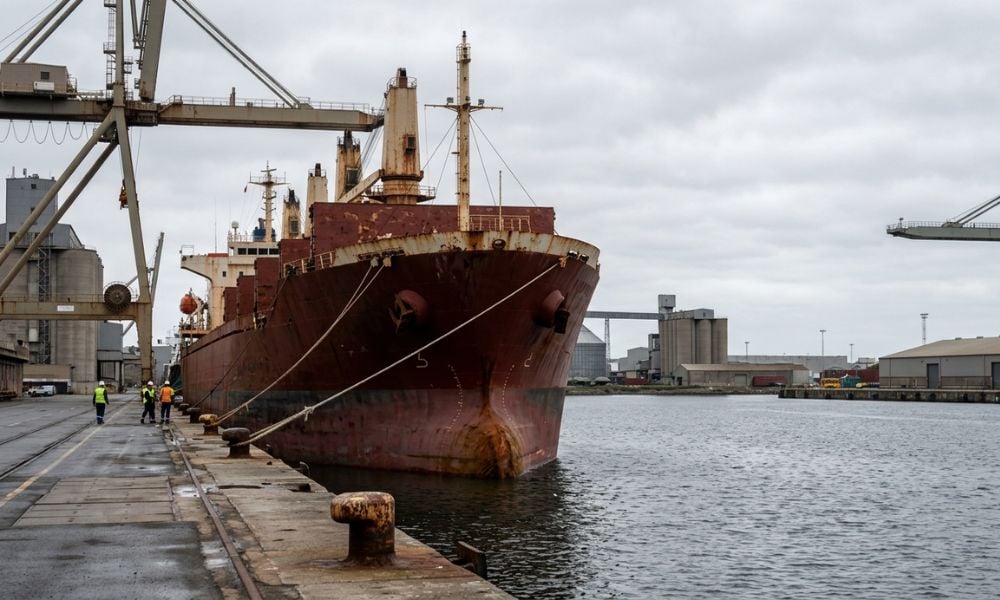
What happened: A UK court ruled on who pays for keeping a bulk carrier operational during over a year of war-zone detention at Mykolaiv, Ukraine.
Who's involved: Shipowners Ithaca Prospect LLC and Dalex Shipping, insured by Lloyd's Insurance Company SA, Markel Insurance SE, and Berkshire Hathaway European Insurance DAC.
What's at stake: Approximately US$3.46M in claimed expenses, on top of a US$16M total loss settlement already paid.
Why it matters: The ruling defines which detention expenses war risks insurers must cover - and confirms that settling a total loss does not mean the insurer has taken ownership of the vessel.
Where it stands: Decided on 21 October 2026. The split of recoverable legal fees still to be finalised.
For more than a year, a bulk carrier sat loaded with cargo at Mykolaiv, Ukraine, her crew keeping the engines warm in case the port reopened. The shipowners say that vigilance saved the vessel from becoming a write-off sooner. The war risks insurers say it was an ordinary cost of doing business.
The Commercial Court has now drawn the line between the two - and both sides lost something.
The vessel Ithaca Prospect, a Panamanian-flagged bulk carrier, arrived at Mykolaiv on 21 February 2022 to load fertiliser bound for the US Gulf. Three days later, Russia invaded Ukraine. The port closed. The connecting channel was mined. The vessel never left.
The case, heard in the High Court in London, turned on what happened next - and who should pay for it.
The shipowners faced a choice: shut the vessel down entirely - a process known in the industry as "cold layup," which can take weeks to reverse - or keep a skeleton crew on board so the vessel could sail at short notice if conditions changed.
They chose the crew. The original Filipino seafarers exercised their right under the Maritime Labour Convention 2006 to leave a vessel in a war zone, and were repatriated. The owners hired local Ukrainian replacements - at minimum safe manning levels set by the Panama Maritime Authority - and kept them on board for over a year.
The insurers had cancelled war risks cover for Ukrainian ports before the invasion, effective from 2 March 2022. The owners scrambled to find replacement cover, paying US$2,285,435.42 in premiums over roughly ten weeks before concluding it was commercially unsustainable. They stopped renewing in May 2022.
By February 2023 - twelve months of detention, the threshold under the policy's war risks clauses - the vessel qualified as what marine insurers call a "constructive total loss," meaning it was treated as though it had been lost entirely. The owners formally offered to hand ownership to the insurers. The insurers declined that offer but acknowledged the total loss claim was valid. In May 2023, the parties struck a deal: the insurers paid the full insured value of US$16,000,000, and the vessel was sold to a third party for US$2,900,000, with the sale proceeds going to the insurers.
That left two outstanding bills. The first: approximately US$1.18M in expenses for keeping the vessel ready to depart - crew wages, fuel, legal fees, and port charges. Under a marine insurance concept called "sue and labour," an insurer can be required to reimburse an owner for reasonable steps taken to prevent or reduce an insured loss. The second: US$2.29M for the replacement insurance premiums. The owners argued that by settling the total loss and directing the vessel's sale, the insurers had effectively taken on ownership - and with it, the financial obligations stretching back to the date of the invasion.
The insurers argued the owners knew from the outset the vessel was not leaving Mykolaiv any time soon, and that crew costs were ordinary running expenses driven by the shipping contract and the need to look after the cargo on board.
The court disagreed. It found the owners had made a genuine, reasonable decision to keep the vessel in a state of readiness, even if the prospects fluctuated wildly. One of the vessel's owners described it as "a rollercoaster of events" - the nearby city of Kherson falling to Russia, then being retaken by Ukraine, with constant signals that the port might reopen. The July 2022 Grain Agreement, which opened three other Ukrainian ports, fuelled that hope further.
Crew-related expenses of US$550,134.52 were allowed in full. The court held these were extraordinary in the circumstances: the original crew had been repatriated from a war zone, local replacements were hired specifically to enable a quick departure, and - after the shipping contract was terminated in April 2022 - there was no contractual obligation driving the crewing decision. Fuel costs of US$192,000 were also allowed, on the basis that the bunkers were consumed in pursuit of keeping the vessel departure-ready.
Legal fees fared less well. The court allowed fees spent exploring options to get the vessel out, but not the substantial portion spent pursuing a claim over the cargo or investigating its arrest by Ukrainian authorities - those served the owners' commercial interests against the shipping charterers, not the goal of preventing an insured loss. The exact split remains to be finalised.
Port fees of US$300,000 were dismissed entirely. By the time the owners paid that sum into an escrow account as part of the vessel's sale, the total loss had already been established. The payment could not be characterised as preventing a loss that had already happened.
The replacement insurance claim rested on a bolder argument: that the settlement deal amounted to the insurers implicitly accepting ownership of the vessel, which would transfer the financial obligations of ownership - including the cost of replacement cover - back to the insurers from the date of the invasion.
The court found the argument did not succeed. The insurers had explicitly rejected the owners' formal offers to hand over the vessel. The settlement was a commercial compromise, not a one-sided act by an insurer choosing to take over the owners' interest. The owners remained the legal sellers of the vessel throughout. The deal's own no-admission clause and its structure - expenses assumed only from February 2023, not February 2022 - were inconsistent with the kind of backdated transfer of ownership the claim required.
The court did find that replacement insurance premiums would qualify as a financial obligation of ownership if the insurers had accepted the transfer. It also found the claim would not have been blocked by the settlement's release provisions. But without that acceptance, neither point mattered.
The practical effect: marine insurers can settle a total loss claim, direct the sale of the insured vessel, and collect the proceeds - without that conduct being treated as taking on ownership and the historic liabilities that come with it.
For war risks underwriters and claims teams handling vessels caught up in the ongoing conflict in Ukrainian waters, the decision offers a detailed framework for assessing which detention expenses qualify for reimbursement - and a clear signal that the line between "keeping the vessel ready" and "protecting a commercial interest" will be drawn carefully.