Ships are supposed to behave like cars: they lose value the moment they leave the garage. Not this autumn.
Secondhand very large crude carriers (VLCCs), the 2mn-barrel workhorses of the global oil trade, are now selling for more than it costs to order a brand-new one. That has never happened before on shipbrokers' records. For insurers writing hull and war cover on these maritime monsters the numbers underneath their policies are moving uncomfortably fast.
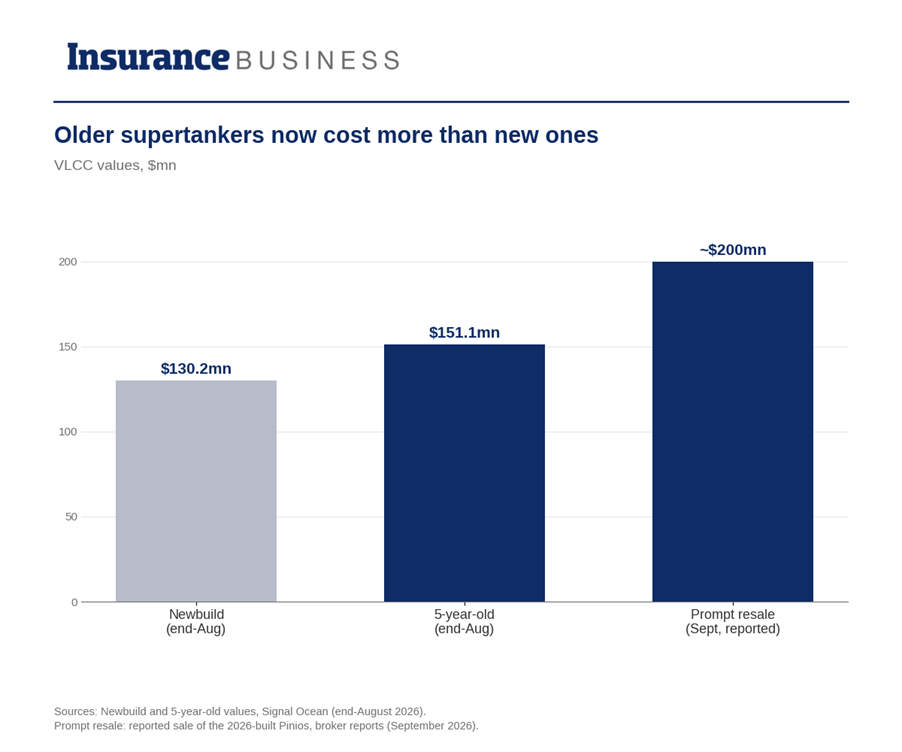
Several supertankers built before 2016 have changed hands in the past week for $150mn or more. Brokers put the average newbuild price at about $135mn, and one shipbroker, speaking to the Financial Times, described the market simply as "bananas".
Data from Clarksons puts the benchmark cost of contracting a new VLCC at around $131mn at the start of September. Analysts at Signal Ocean valued five-year-old ships at roughly $151mn at the end of August, while 15-year-old tonnage had risen by about 61% in a year.
The logic behind this is fairly simple, buyers want ships right now. A VLCC ordered today will not be delivered for years, because shipyards are full and the orderbook has swollen to about 38% of the existing fleet, according to valuation specialist Veson Nautical.
A ship already on the water can start earning straight away, and right now it can earn a great deal. Rates on the Middle East-to-Asia route hit an all-time high of about $1.27mn a day earlier this week, according to LSEG data. The Baltic Exchange's VLCC time-charter average reached nearly $723,000 a day on 18 September, compared with under $80,000 a year earlier.
In a note to clients, Braemar said age now counts for very little in pricing, and that what matters is how fast a buyer can take delivery. The clearest example is the Pinios, a 2026-built tanker owned by Greek shipowner George Prokopiou's Dynacom, which reportedly sold with prompt delivery for close to $200mn. That is one of the highest prices ever paid for a crude tanker.
Read next: Hormuz war-risk rates face fresh pressure as Iran-US clashes resume
Gulf state oil companies are a big part of the answer. Having long relied on chartered tonnage, they now want their own fleets so they are not dependent on third-party owners to send ships through the Strait of Hormuz. According to maritime consultancy Drewry, Abu Dhabi's Adnoc has bought at least six supertankers in the past two months. Kuwait's national oil company and buyers moving Iraqi crude are also said to be in the market.
They are up against South Korea's Sinokor, which spent about $6bn on tonnage at the start of the year and now owns the world's largest VLCC fleet. Commodity traders are buying as well. Trafigura has just launched Volare Shipping, a 14-ship VLCC company with six vessels trading and eight on order. It plans to raise about $500mn and list in Oslo in early October.
Alexander Saverys, chief executive of Belgian owner CMB Tech, called the market "once-in-a-generation". He argued that at current rates a ship can pay back a large share of its purchase price within months.
Most of the coverage has focused on shipowners. For the London market, though, the valuation shock matters in at least three ways.
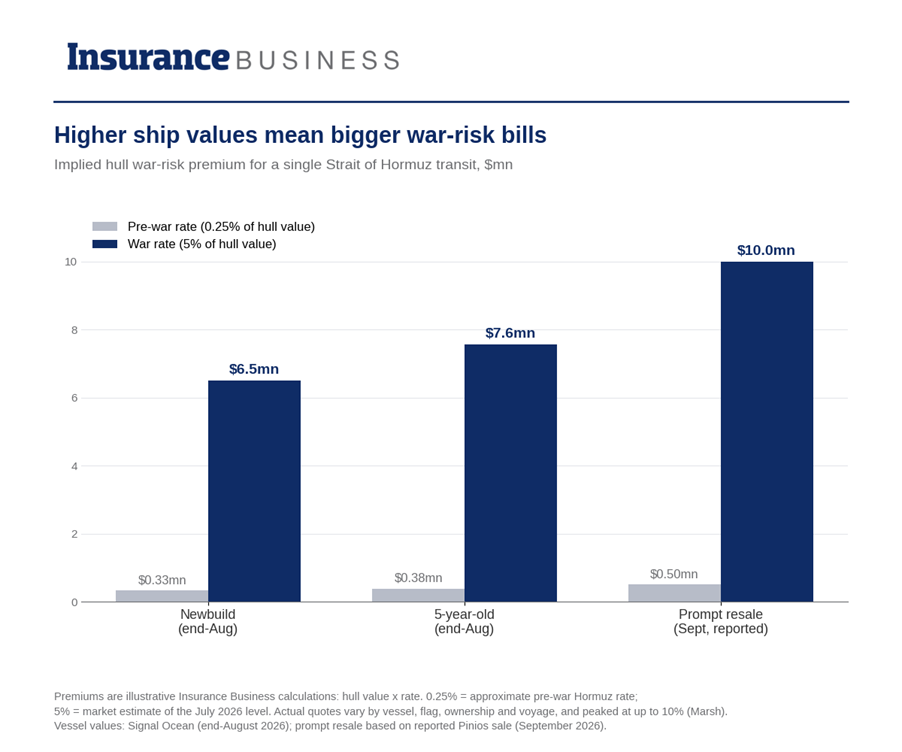
The first is war-risk premiums. These are priced as a percentage of hull value, so when values jump, so does the cash bill, even if the rate stays the same. Before the conflict began on 28 February, Hormuz hull war rates sat at around 0.15% to 0.25%. Marsh's global head of marine, Marcus Baker, has said they then surged to between 3% and 10%. As a rough illustration, a 5% rate on a $130mn ship comes to $6.5mn per transit. The same rate on a $200mn resale comes to $10mn.
The second is accumulation. A Howden Re report from March estimated that the conflict could generate $2bn to $3bn in war, terror and political violence claims. That is more than the segment's estimated annual global premium of $1.5bn to $2bn. Every step up in hull values makes that overhang larger.
The third is agreed values. Hull and machinery policies usually fix an agreed value at inception. In a market moving this quickly, a ship bought at $175mn but still insured at last year's figure may be seriously underinsured. The opposite risk appears if the market collapses: agreed values set at the peak could end up far above what the vessel would fetch on the open market. That gap matters when a claim edges towards a constructive total loss.
Read next: New Lloyd's clause could invalidate tankers' insurance
On top of all this sits a compliance problem. On 24 August the US Treasury's Office of Foreign Assets Control warned about sanctions exposure linked to Hormuz passage payments and named three Iranian-designated bodies, including the Persian Gulf Marine Insurance Company. The Lloyd's Market Association has also drafted model wording that allows insurers to cancel cover if a toll payment comes to light. Anyone placing tanker business now has to check both the route and the money trail.
The strait remains effectively closed to normal traffic, and attacks have continued. On 23 September a seafarer was killed when projectiles hit the bulk carrier Cape Dao off Oman. The BBC has reported that Iran's foreign minister has offered Washington a deal to reopen the strait within seven days, but Tehran's security chief has said it stays shut until Iran's conditions are met.
A reopening is exactly the scenario that worries owners, several of whom have warned it could trigger a crash. For now, many are holding their ships to capture record rates. That keeps sale-and-purchase supply thin and pushes prices higher still.
George Macheras, head of global maritime at law firm Watson Farley & Williams, is less gloomy. He thinks rates would stay structurally higher than before the war even if they fell sharply, and that owners would still be profitable at around $200,000 a day.
Read next: Strait of Hormuz complexity as insurers keep war risk pricing on edge
Underwriters may want to prepare for both outcomes. A long boom means bigger sums insured and bigger war bills. A sudden bust leaves a portfolio of ships insured for far more than anyone would now pay for them. The industry has seen mispriced hull values before, notably after the Russia-Ukraine tanker rally, as sanctions and ageing fleets reshaped marine risk. It rarely ends quietly.
Read next: "It's Madness" – Shock Iranian announcement upends marine insurance