The broker's global headquarters sits in Leadenhall Street. The business it just bought sits entirely in the American middle market
Aon has agreed to buy USI Insurance Services from KKR and other shareholders for $17.0bn (£12.6bn), a deal that pushes the broking and consulting giant deeper into the US middle-market territory it first staked out with its purchase of NFP two years ago. The transaction itself has nothing to do with the UK market. USI is a Valhalla, New York-based brokerage with no meaningful presence outside the US. But the deal was announced from, and will ultimately be funded through, a corporate structure with deep roots in London.
Aon plc is incorporated in Ireland, but its global headquarters occupies the Aon Centre in the Leadenhall Building in the City of London, and two of its UK-incorporated subsidiaries, Aon Global Limited and Aon Global Holdings plc, sit in the guarantee chain for the group's outstanding bonds, according to Aon's own securities filings. Aon says it plans to fund the USI purchase entirely with new debt, meaning at least part of the financing will run through that same London-anchored structure even though every pound, or rather every dollar, of USI's revenue is generated in the US.
On a net basis, after accounting for roughly $278m (£206m) in tax attributes, the price works out to $16.7bn (£12.4bn) - about 14.5 times USI's synergised trailing-12-month adjusted EBITDA. USI is the tenth-largest insurance broker in the US, generating around $3bn (£2.2bn) in annual revenue through more than 10,500 employees across nearly 200 US offices. It sells property and casualty cover, employee benefits, personal risk products and retirement plan advice, largely to businesses too small for the largest brokers but too complex for a local agency.
Under the deal, USI chairman and chief executive Mike Sicard will become president of Aon plc and global chief executive of its middle-market business, reporting directly to Aon chief executive Greg Case and taking a seat on the firm's executive committee. Case said the deal would make Aon "the premier US middle-market platform," deepening what he calls the firm's data and analytics edge over rivals. In an interview with the Wall Street Journal, he put the rationale more plainly: "We see this having a financial impact almost immediately."
Aon expects the combination to generate about $395m (£293m) a year in run-rate synergies once fully integrated, and expects the deal to add to adjusted earnings per share from 2028. The firm says it intends to keep its current credit ratings - Baa2 at Moody's, A- at S&P - by holding off on share buybacks while it pays down the new debt. BofA Securities and Citi are advising Aon on the transaction, with Cravath, Swaine & Moore handling the legal work. Subject to regulatory sign-off, the deal is expected to close in the fourth quarter of 2026.
USI has spent the better part of a decade under private equity ownership: KKR and Canadian pension fund Caisse de dépôt et placement du Québec bought the firm from Onex Corporation in 2017 for $4.3bn (£3.2bn), including debt. KKR later put in more than $1bn (£740m) of additional capital, becoming USI's largest shareholder - a stake that, at Monday's headline price, has multiplied several times over.
Most of the recent traffic in insurance brokerage M&A has run the other way, with private equity firms buying up agencies and consultancies rather than selling them to strategics. That makes this one of the largest PE exits the sector has seen, and a notable one for KKR, which reported its best-ever quarter for asset sales in the most recent period, at $1.29bn (£960m). Recent exits include its data-centre cooling business CoolIT, sold at roughly 15 times the equity KKR put in, and the aerospace and defence unit of pump-and-valve maker Circor. Earlier this year, KKR closed a $23bn (£17.0bn) fund dedicated to private-equity investments in North America, taking the total raised across the most recent vintages of its flagship regional funds to $46bn (£34.1bn).
For Aon, the move echoes its acquisition of NFP, the middle-market broker it bought from Madison Dearborn Partners and HPS Investment Partners for a deal valued at roughly $13.4bn (£9.9bn) when it was announced in December 2023. That transaction reshaped Aon's standing among the world's largest brokers and has continued to generate headlines since, including last year's decision to sell most of NFP's wealth management arm back to Madison Dearborn for roughly $2.7bn (£2.0bn).
That earlier trade signals where Aon believes its edge lies: not in managing individual investors' wealth, but in the corporate risk, employee benefits and institutional retirement work that sits at the centre of a middle-market client's balance sheet. USI fits the same thesis. Once the deal closes, Sicard will be tasked with knitting USI's operations together with NFP and Aon's existing middle-market business under one roof. That integration work will draw scrutiny given what happened last time: in June, five specialty executives left Aon's NFP platform for rival Relation Insurance, a departure that industry watchers linked to the retention pressure large consolidations can put on senior producers.
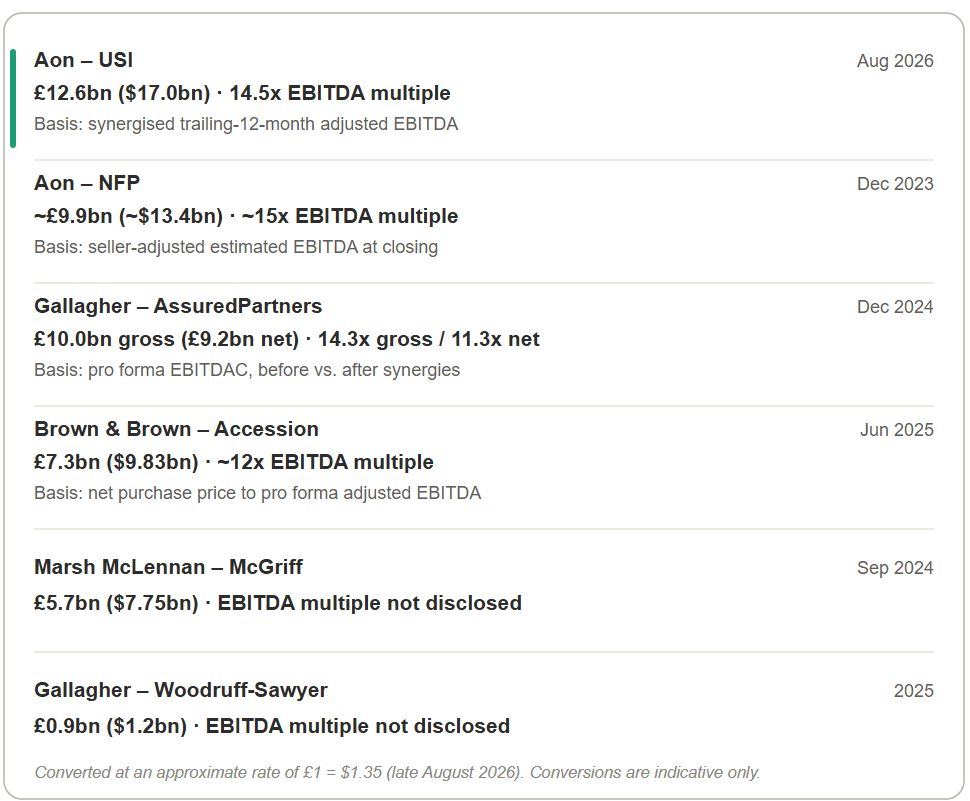
USI's absorption into Aon reshuffles a hierarchy that hasn't moved much at the top in years. Aon currently sits second among US brokers with $16.99bn (£12.6bn) in 2025 brokerage revenue, behind Marsh McLennan's $26.66bn (£19.7bn), according to Business Insurance's brokerage rankings; USI, at $2.89bn (£2.1bn) in 2025 brokerage revenue and nearly 11,000 staff, ranked tenth. Folding USI's revenue into Aon widens the gap Arthur J. Gallagher has been trying to close from third place - a gap Gallagher itself has attacked with acquisitions of its own, closing its $13.45bn (£10.0bn) purchase of AssuredPartners in August 2025.
That pattern - big, publicly traded brokers using their stock as currency to buy scale rather than build it organically - has defined the sector for two years now. Describing the trend in a July 2025 analysis of the industry's top 100 brokers, MarshBerry chairman and chief executive John Wepler said publicly traded brokers were effectively taking a "victory lap": years of a depressed share price had kept them from competing with private equity-backed buyers on price, and a stronger stock now gave them the currency to pay full multiples for large, earnings-accretive deals. That same logic produced Marsh McLennan's $7.75bn (£5.7bn) purchase of McGriff Insurance Services, Gallagher's AssuredPartners deal, and Brown & Brown's $9.83bn (£7.3bn) purchase of Accession Risk Management last year.
For a London readership, the more pointed competitive subplot sits with Howden. The employee-owned broker, headquartered a short walk from Aon's own Leadenhall Street offices, has spent the past year building a US retail broking operation from scratch rather than buying its way in, hiring more than a thousand staff from rivals in the process. That build-out has put Howden on the wrong side of separate lawsuits from Aon, Marsh, Willis Towers Watson, Brown & Brown and Alliant over alleged poaching, Insurance Business has reported. Aon closing a $17bn deal to add scale in the same US middle market Howden is trying to break into by hiring away its people adds another data point to a rivalry that is currently being fought in court as much as in the market.
Aon reported adjusted second-quarter earnings of $3.81 (£2.82) per share on 29 July, ahead of analyst estimates, and its stock had a market value of roughly $75bn (£55.6bn) as of the Friday before the deal was announced. Shares of Aon rose on Monday following the announcement, while KKR's slipped modestly - a fairly typical reaction for an acquirer taking on new debt to fund a large deal, paired with a seller giving up a long-held, high-performing asset.
The announcement also arrives weeks after Aon's chief financial officer, Edmund Reese, stepped down; the company said he plans to serve as a senior adviser to Case through August 2027. A CFO transition landing in the middle of a debt-funded, $17bn acquisition is the kind of detail investors and analysts will likely press Aon on during its conference call.