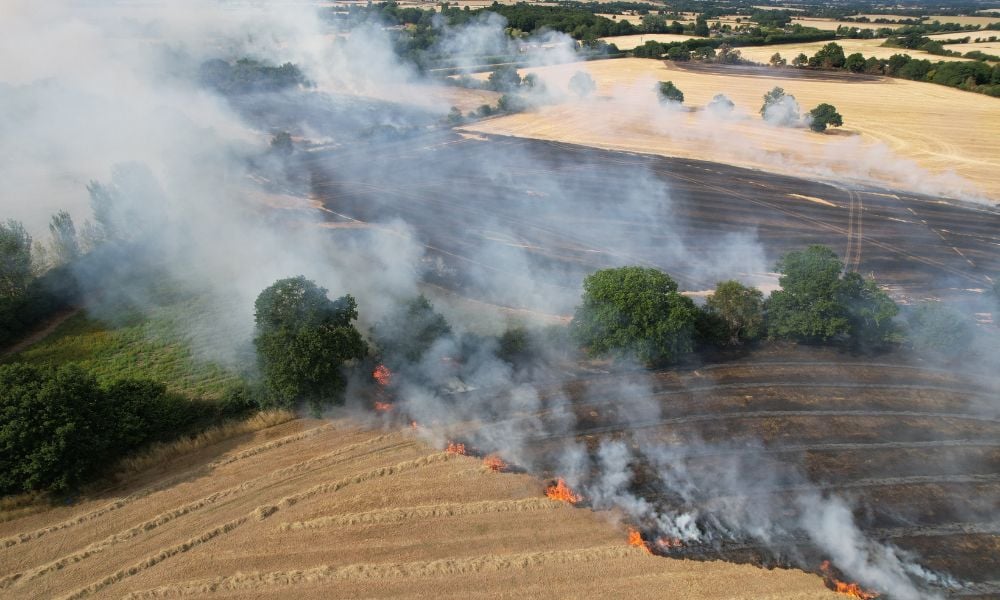
The estimated cost of farm fires reported to NFU Mutual reached £118 million in 2025, up 18% on 2024, with agricultural vehicle fires adding a further £32 million. The figure, published in NFU Mutual's 2026 Farm Fires Report, reflects a year in which the UK recorded its highest ever temperatures and most hours of sunshine - conditions that turn a single spark into a blaze before a fire crew can reach a rural location.
The East of England took the heaviest blow at an estimated £23.9 million - a 173% increase on 2024 - driven by vast areas of arable land exposed to prolonged drought. Scotland (£14.7m, +22%), Northern Ireland (£11.8m, +73%), and the North West (£7.6m, +78%) all saw significant rises. The South West recorded a 20% fall but remained the second most costly region at £18.2 million.
The primary known causes of fires involving crops, buildings and equipment were arson, lightning strikes, and electrical faults. Tractor fires accounted for over half of agricultural vehicle losses at £16.1 million, while combine harvester fires cost £4.8 million.
With 2026 having already recorded further extreme dry periods and broken additional temperature records, the NFU Mutual report warns that the risk of fires becoming uncontrollable blazes "has never been more acute." As Insurance Business reported in September, the third heatwave of 2026 had already renewed wildfire risk warnings for rural insurers before this report was published.
NFU Mutual rural affairs specialist Hannah Binns said the threat is structural, not seasonal.
"For centuries, fire has been a devastating, ever-present threat for our nation's farmers, and NFU Mutual was founded in response to this persistent risk," she said. "Farmers do what they can to minimise risk, but prevention cannot fall to farmers alone. Stronger policy is needed, more than ever, to help tackle the causes of farm fires and protect rural businesses from their devastating impact."
The NFU, which hosted a Westminster event with parliamentarians including Dr Peter Prinsley MP, shadow EFRA minister Robbie Moore MP, and Alistair Carmichael MP - chair of the EFRA Committee - called for five specific measures: sufficient funding for rural fire and rescue services; expanded equipment to enable fire engines to access on-farm water supplies; improved coordination for wildfire incidents; local authority powers to restrict high-risk activities during heightened danger periods; and a National Wildfire Strategy.
NFU vice-president Robyn Munt was direct about the resourcing gap.
"It's crucial that the right support is available should an incident take place. Fire services must have proper funding and appropriate equipment and training to respond to blazes in rural areas," she said. "To reduce the likelihood of wildfires, particularly during prolonged periods of dry weather, local authorities should also use Public Spaces Protection Orders to ban campfires and barbecues when the risk is high."
An 18% year-on-year increase in farm fire costs, against a backdrop of record temperatures that are now a seasonal expectation rather than an exception, raises specific questions that agricultural brokers should be putting to clients at renewal.
Are combine harvesters equipped with accredited fire suppression systems? NFU Mutual offers premium discounts to policyholders who install them - and the £4.8 million combine harvester fire cost in 2025 is the direct argument for that conversation. Are electrical systems on older tractors being serviced annually? Tractor fires cost £16.1 million in 2025, and electrical faults are among the primary identified causes. Have clients attended pre-harvest fire prevention training? NFU Mutual's Risk Management Services runs workshops specifically for this purpose.
For underwriters pricing agricultural risk, the East of England's 173% increase is the most striking regional signal. It reflects both the concentration of arable exposure in that region and the severity of the drought conditions that amplified fire risk through the 2025 harvest season. Whether the 2026 season produces a similar pattern will depend on how the autumn and winter unfold - and the El Niño conditions forecast to drive a wetter-than-usual period may actually reduce the fire risk for the remainder of this year, while raising flood and crop loss exposure in its place.