The UK insurance industry has a talent problem that sits beneath the transformation conversation and is rarely named directly. It is not a shortage of technology skills, although those are in genuinely short supply. It is a shortage of people who have both - who understand how insurance works well enough to know what needs to change, and understand technology well enough to change it.
More than one quarter of UK insurance staff are already over 50, according to RSM UK research. Half of the current workforce could retire in the next 15 years, taking decades of tacit underwriting and claims knowledge with them. At the same time, Gallagher's 2026 AI Adoption and Risk survey found that more than half of businesses cite a shortage of AI-ready talent as a primary barrier to implementation. Graduate vacancies in the insurance sector fell 18% in 2025. The pipeline is thinning precisely as the need for transformation-capable talent is accelerating.
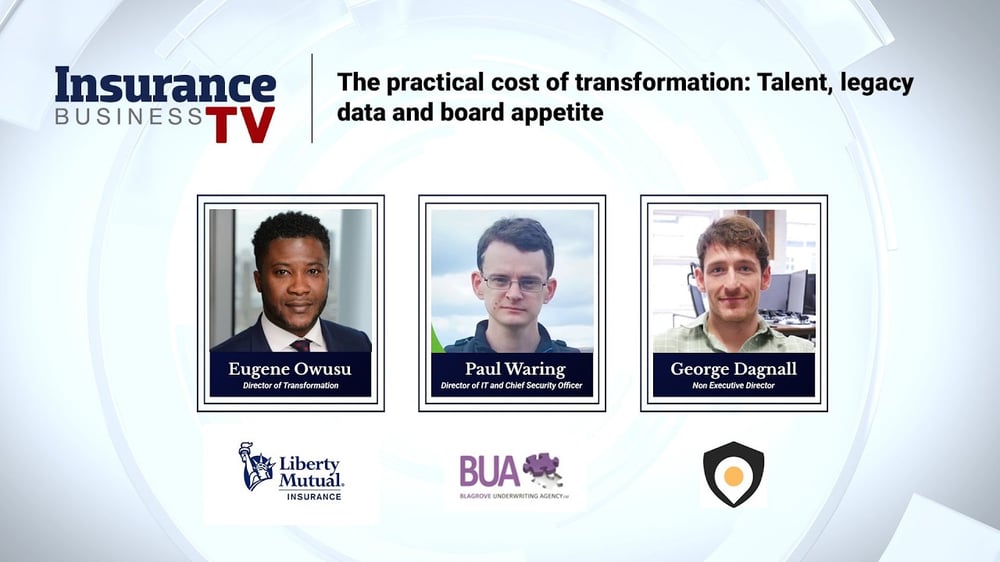
Paul Waring, director of IT and CISO at Blagrove Underwriting Agency, names the specific gap that technology programmes consistently underestimate. "The biggest challenge by far is always the domain-specific knowledge in insurance, because most people don't deal with insurance, certainly not the complex or technical aspects of insurance, on a daily basis," he said at the Insurance Business UK Leaders Network's digital transformation roundtable.
The comparison he uses is instructive. "It's not like going to work for a supermarket where everyone kind of knows what a supermarket looks like." A technology hire in almost any other sector arrives with at least a working consumer understanding of the industry they are entering. An insurance technology hire typically does not. How premium tax works, how commission structures operate, how claims processes function - none of this is general knowledge, and all of it is necessary context for making sound technology decisions in an insurance business.
Waring's response at Blagrove has been methodical. A skills matrix mapping the technology capabilities the business needs against what it currently has produces a clear picture of where training can close gaps, where hiring is required, and where capacity constraints - rather than skill deficits - are the primary limitation.
"When we bring in technical people, we have to build up their insurance knowledge gradually - things like how does insurance premium tax work, how does commission work, how do claims work," he said. "It's not just the technical knowledge, but it's the domain-specific insurance knowledge that's always the big challenge."
The skills matrix can only capture what is already known. Building the insurance knowledge incoming technology staff need is not something a skills audit addresses. It requires deliberate investment in induction, mentoring, and structured exposure to the business - investment that most transformation programmes underinvest in because the return is not immediately visible on a programme timeline.
"It's sometimes not seen as perhaps the most exciting or interesting industry," Waring acknowledged. "I think it is, but I'm probably a bit unusual in that amongst tech people." The perception problem compounds the pipeline problem: the sector that most needs domain-technology crossover talent is also the sector that struggles most to attract it.
George Dagnall, NED at Hotspot Cover and director of insurance and partnerships at Concentrix, describes an approach to closing the domain-technology gap that he characterises as building a crossover "hive mind" - people who have absorbed enough of both worlds to translate effectively between them.
"Hiring talent that is aligned to transformation work but has an interest in this area. And the first point, of course, is to make sure that they understand our area, they learn how it works, they digest everything before they start trying to think about the tech development,” he said.
The risk of moving too fast is concrete. "If you bring in someone who's tech-focused, they'll say, 'You can do this. You can change this. It's fine.' But then only until they start to digest and understand the systems and the reason why the systems work, they go, 'Actually, that way of technological development is going to cut off what you're doing here.'"
Technology decisions made without insurance domain understanding do not just produce suboptimal outcomes. They can undermine the existing business while the firm is still depending on it. The investment of time Dagnall describes - getting technology hires to absorb the business before they start changing it - is front-loaded and invisible on a programme timeline. It is also the cost of not making expensive mistakes later.
"Both parties teach each other," Dagnall said. The insurance expert learns what technology can do. The technology expert learns why insurance processes exist. Out of that exchange comes the capacity to redesign workflows that are genuinely better rather than merely different. "We have to elevate the subject matter understanding - blending that human wisdom with the digital toolsets."
Eugene Owusu, director of transformation and global compliance at Liberty Mutual Insurance, names the dimension that compounds the talent problem over time. At Liberty, the people who have built institutional knowledge of jurisdictions, products, client outcomes, and regulatory obligations are the backbone of transformation rather than the obstacle to it.
"Having our subject matter experts who know their jurisdictions, they know their products, they know the work that they do, they know their customers and what the right outcomes are for those customers - they've very much been involved in that transformation work because they bring a certain level of understanding of our culture and our focus on integrity when it comes to dealing with our clients, which you can't simply get by hiring,” he said.
Owusu's approach is to retain that knowledge within transformation processes rather than treating transformation as something done to the existing workforce. "What we do is use that knowledge, making sure that they are trained or retrained. With any change, there's a level of being retrained and understanding what the new world looks like."
The UK government's AI Skills Hub, expanded in January 2026 with £27 million in funding, targets 10 million workers with AI skills by 2030. A Level 4 AI and Automation Practitioner apprenticeship standard launched in March 2026. These are useful signals at the national level - but there is no insurance-specific equivalent, and the domain knowledge gap that Waring identifies is not one a general AI skills programme can close. That is the gap the industry needs to close internally, deliberately, and earlier in the hiring process than most firms currently do.
The firms that navigate the next decade of insurance transformation most effectively are those that treat the domain-technology crossover as a structural investment rather than an onboarding problem. It does not happen on its own. It cannot be hired in ready-made. And the cost of not building it shows up later, in decisions that looked technically sound and turned out to be operationally wrong.