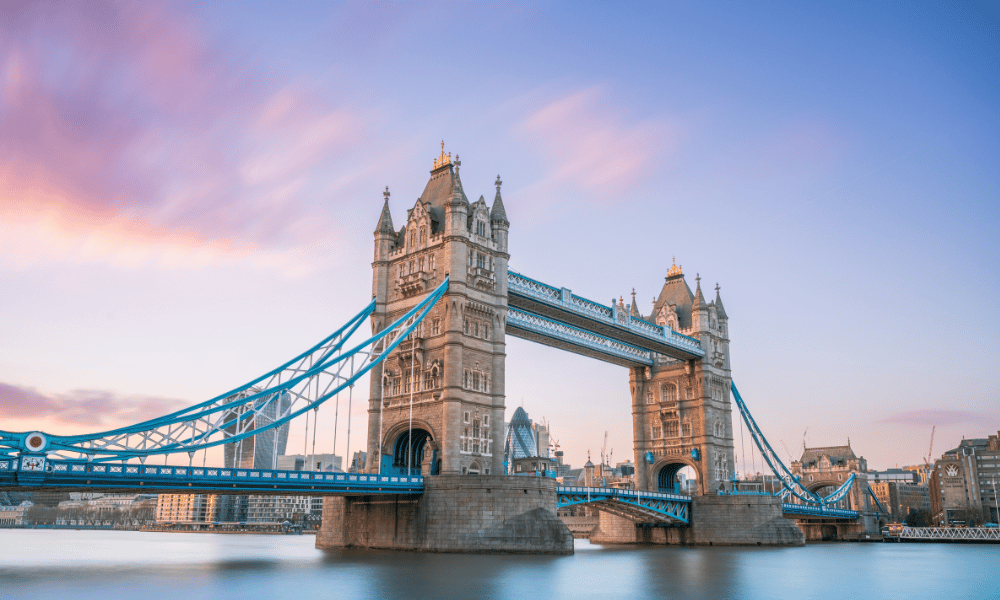
The UK ranks seventh in the World Economic Forum's Travel and Tourism Development Index 2026, unchanged year on year but down four places since 2019, with a score that has been essentially flat while faster-improving economies, particularly across Asia-Pacific, closed the gap and overtook it in the wider table.
Japan leads the 2026 rankings with a score of 5.27, followed by the United States (5.23), Spain (5.22), Australia (5.18) and France (5.17). Germany sits sixth at 5.09, the UK seventh at 5.08, China eighth at 5.00, Switzerland ninth at 4.97 and Italy tenth at 4.93. Advanced economies hold nine of the top ten positions, with China the sole exception. Albania is the most improved economy since 2024, lifting its score by 7.0%, followed by Vietnam at 6.3% and Laos at 6.1%. Seven of the ten most-improved spots are in Asia-Pacific, with South-East Asia advancing faster than any other subregion.
The TTDI covers 110 economies across 17 pillars grouped into five dimensions: enabling environment, tourism policy and enabling conditions, infrastructure and services, tourism resources, and sustainability. It does not rank countries by visitor numbers, spending or traveller satisfaction. It asks how well each economy is set up for tourism to create lasting value, and how well it functions when things go wrong.
That second question is where the index departs from a conventional tourism ranking and becomes directly relevant to the travel insurance market. Zurich contributed expertise on resilience, risk and destination preparedness through its role as one of the world's largest travel insurers, and the report's central argument is that resilience now separates successful destinations from the rest. Strong attractions are no longer sufficient. A destination's ability to keep people moving, inform travellers about what is happening, protect critical infrastructure and restore confidence quickly after a disruption is now a formal scoring dimension, built in advance through planning and coordination rather than assembled once a crisis has started.
Cara Morton, CEO of global businesses and operations at Zurich Insurance Group, said the places that plan for disruption recover faster and maintain travellers' trust. "That's not just good risk management. It's how you stay competitive," she said.
The report points to aviation disruption linked to the conflict in Iran alongside heatwaves and wildfires across Europe and North America as recent illustrations of how quickly destinations come under pressure.
A record 1.5 billion people travelled internationally in 2025, contributing USD 11.6 trillion to the global economy and supporting 366 million jobs. But the conditions underlying that volume are worsening in ways that bear directly on travel insurance risk. Tourism costs rose faster than inflation across most markets, with 75% of economies becoming less affordable for travellers. Investment has not kept pace with demand since 2022, and the gap is expected to persist into the 2030s. The sector is also projected to face a shortfall of 43 million workers by 2035, roughly 16% fewer than it needs, which the report identifies as one of the clearest constraints on service quality and recovery capacity.
The TTDI is a reference point worth understanding for brokers advising clients on travel risk, particularly those placing group travel, corporate travel or high-volume leisure programmes. Zurich's formal contribution to the index means the resilience framework it contains reflects how at least one of the market's largest travel insurers is thinking about destination risk and preparedness.
The distinction the report draws between destination attractiveness and destination resilience is a useful one for renewal and placement conversations. A destination that scores well on attractions but poorly on infrastructure, digital connectivity and crisis communication capability presents a different risk profile on cancellation, curtailment and emergency assistance than its headline popularity would suggest. The TTDI's resilience scoring gives brokers a documented, independently published basis for asking those questions, rather than relying on general reputation or recent incident history alone.