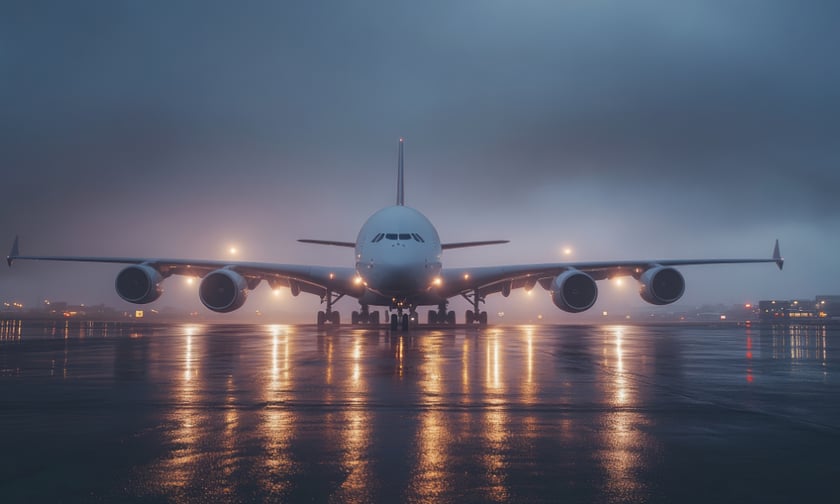
A morning of thick fog across Brisbane on July 23, 2026, forced five inbound flight diversions and triggered multiple road crashes – a sub-catastrophe weather event that arrives as regulators and the industry itself are warning that repeated severe weather incidents, including those that fall below formal declaration thresholds, are accumulating into a structural challenge for Australian insurers across motor, travel, and property lines.
Brisbane Airport confirmed four inbound flights were diverted to the Gold Coast and one to Sydney shortly after 7am on Thursday. Affected services included Qantas flights QF016 from Los Angeles, QFA98 from Manila, and QFA52 from Singapore, as well as Virgin Australia flight VA446 from Darwin and Jetstar Airways flight JQ965 from Perth, according to Sky News Australia. Multiple additional international flights faced delayed arrivals. “Brisbane Airport is currently experiencing thick fog across the precinct,” the airport said in a statement. A spokesperson later confirmed visibility was improving and that no departing flights were cancelled.
On the road network, Queensland Police confirmed a two-vehicle crash at the intersection of Klumpp Road and the Mains Road exit, where one vehicle rolled onto its roof. Minor injuries were reported. Separate incidents were recorded on Gympie Road at Carseldine – where multiple lanes were blocked – and on the Warrego Highway at Riverview following a single-vehicle crash. The Bureau of Meteorology (BOM) issued a road weather alert for parts of Brisbane as conditions developed.
Thursday’s disruptions sit within Brisbane’s established winter fog pattern. A BOM aviation hazard publication, updated July 2025, identifies fog as a major cause of low visibility at airports, with its occurrence following a clear seasonal trend – least likely in summer and most likely during winter and the transition seasons. The BOM’s monthly fog frequency data for selected Australian airports show Brisbane experiences its highest fog frequencies during the winter months, particularly from June to August. Climate statistics for Brisbane Airport show July has the lowest long-term mean minimum temperature (9.4°C), with these cooler overnight temperatures, together with typically clear skies, light winds, and adequate moisture, creating favourable conditions for the radiation fog characteristic of Brisbane’s winter mornings.
The diversion of long-haul services from Los Angeles, Manila, and Singapore carries materially higher per-claim costs under travel policies than domestic disruptions, given the accommodation, rebooking, and associated expenses international passengers incur when rerouted to secondary airports. The volume of travel insurance complaints reaching the Australian Financial Complaints Authority (AFCA) has been sufficient to prompt direct regulatory intervention: AFCA published a dedicated Travel Insurance External Dispute Resolution (EDR) Response Guide in July 2025, setting mandatory compliance expectations for insurers from that date. AFCA’s own member forum materials noted that firms engaging with the guide saw more complaints resolved at an early stage. That intervention reflects a complaint category that had grown to the point of requiring formalised industry guidance – a practical signal for travel insurers managing weather-related delay claims.
For motor underwriters, Thursday’s crashes represent a weather-concentrated accumulation event in a state where road safety and complaint trends have both moved in the wrong direction. Queensland recorded 308 road fatalities in 2025 – the highest annual toll in 16 years – prompting the RACQ, the Royal Australasian College of Surgeons (RACS), the Safer Australian Roads and Highways (SARAH) Group, and the Queensland Trucking Association (QTA) to call jointly for urgent action. RACQ managing director and group CEO David Carter described the figure as “a clear signal that all Queenslanders must do better to tackle the road safety crisis.”
At the national level, comprehensive motor vehicle insurance was the most complained-about insurance product in 2024-25 according to AFCA’s Annual Review, generating 11,231 complaints – a 10% rise on the prior year and more than double the 4,386 recorded in 2020-21, with motor vehicle claims delays making up one in four of all general insurance complaints referred to AFCA. AFCA has stated it considers insurance claims delay complaints to be largely avoidable and has urged insurers to review their processes to reduce complaint volumes – publishing an updated claims delay EDR Response Guide in February 2026 in direct response to increased complaint numbers.
Thursday’s event is unlikely to reach the threshold for an Insurance Council of Australia (ICA) significant event or catastrophe declaration, which is determined by claim volume, complexity, and geographic spread. Not every severe weather event reaches those thresholds – but insurers continue to monitor recurring events because their cumulative claims costs influence underwriting performance over time.
That point is now underpinned by formal regulatory modelling. The Australian Prudential Regulation Authority’s (APRA) Insurance Climate Vulnerability Assessment (ICVA), published in March 2026, found that Australian home insurance premiums rose at an annual average rate of 7.2% between 2010 and 2025, while wages grew at just 3.1% annually over the same period. The ICVA estimated that around one in seven Australian households are currently uninsured, with that figure potentially rising to one in four by 2050 – equivalent to approximately one million additional uninsured households under the modelled climate scenarios. In response, the ICA said: “The risks it models are already materialising and its findings support the insurance industry's calls for urgent action to reduce extreme weather risk.”
Extreme weather generated almost $3.5 billion in insured losses from 264,000 claims across Australia in 2025, with Southeast Queensland a repeated focal point across the Severe Spring Storms and the Queensland and New South Wales severe storms and hail event in November – which together produced more than $1.4 billion in losses. The ICA had not declared any significant event or catastrophe in connection with the July 23 Brisbane fog event at the time of publication.