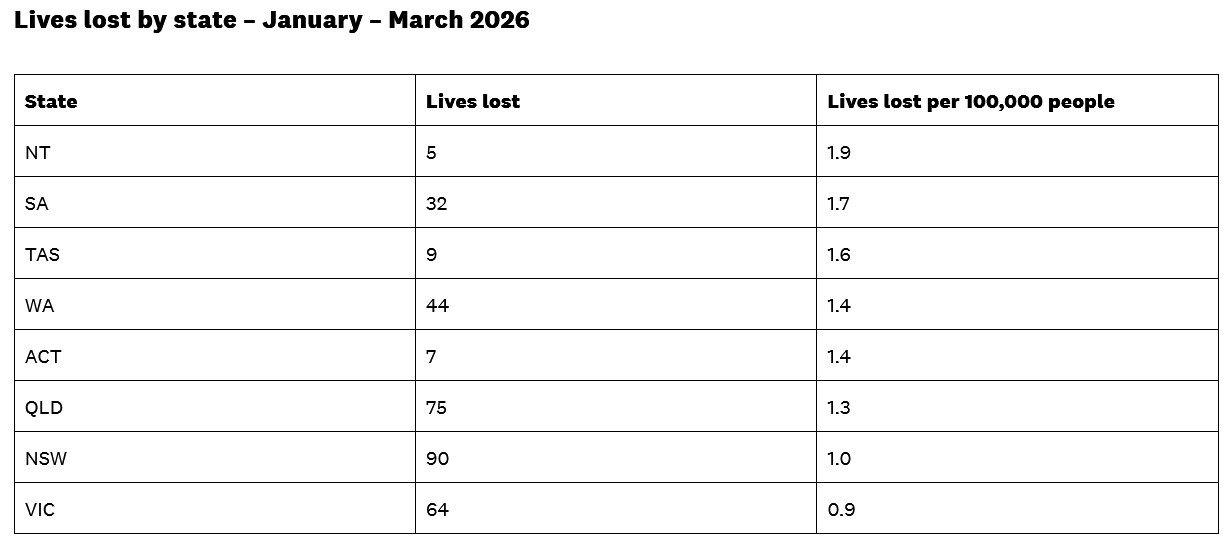
South Australia has entered 2026 with the highest per capita road death rate of any Australian state, a development likely to be closely tracked by motor and injury insurers. RAA’s latest quarterly crash analysis records 32 fatalities and 226 serious injuries on South Australian roads between January and March 2026. On a population basis, this is 1.7 deaths per 100,000 people over the quarter, placing SA ahead of all other states and behind only the Northern Territory nationally.
RAA senior manager road safety and infrastructure Charles Mountain said the early-2026 figures showed a continued burden of road trauma. “It has been a tragic start to the year on SA roads. Every life lost on our roads represents a family torn apart, and this is happening far too often across the country,” Mountain said. March accounted for 19 deaths, which RAA reports as the highest monthly toll on South Australian roads in more than a decade. Regional areas remain a substantial component of the problem, with 59% of first-quarter fatalities occurring on country roads. The regional skew may influence assessments of claim severity, travel distances to treatment, and recovery costs.
The composition of the first-quarter toll highlights exposure in motorcycle and young adult segments. According to RAA, seven motorcyclists were killed on SA roads between January and March, 46% above the state’s five-year average for riders. Over the same period, eight people aged 20-29 died in crashes, 90% above the long-term average for that age group. Mountain said: “The rate of serious crashes has been rising in the last 5-6 years despite vehicles getting significantly safer, which is alarming and shows just how much more needs to be done to get the message across to road users. Motorcyclists are significantly overrepresented in lives lost in the first part of the year, and this is a real concern given how vulnerable riders are on our roads. Ten motorcyclist deaths so far this year is a community tragedy, particularly given that three of these riders lost their life across the Easter long weekend.” The patterns in the data point to continued attention on pricing and risk differentiation for motorcycle cover and younger drivers and riders, as well as the potential role of loss-prevention initiatives and rider training partnerships.
Read next: ICA says Queensland e-mobility bill addresses injuries, CTP gaps
South Australia’s 10-year Road Safety Strategy to 2031 sets a goal of reducing lives lost by at least 50% and serious injuries by at least 30%. In practical terms, the state is aiming for fewer than 43 deaths and 474 serious injuries per year by 2031. With 32 fatalities and 226 serious injuries already recorded in the first quarter of 2026, the state’s trajectory remains above those target thresholds. Sustained trauma rates may influence long-term injury claim trends, reserve assumptions, and reinsurance arrangements, particularly in compulsory third-party schemes.
Preliminary figures using the latest ABS population data show the Northern Territory recorded five deaths at a rate of 1.9 per 100,000 people in the first quarter. South Australia followed at 1.7, with Tasmania at 1.6 (nine deaths), Western Australia and the ACT at 1.4 (44 and seven deaths respectively), Queensland at 1.3 (75), New South Wales at 1.0 (90), and Victoria at 0.9 (64). Mountain urged road users to remain aware of the “Fatal 5” contributors to serious crashes: distraction, speeding, seatbelts, drugs or alcohol, and dangerous behaviour.
Read next: Queensland faces surge in illegal e-mobility device injuries
Alongside conventional motor risks, powered personal mobility devices such as e-scooters are adding another element to transport-related exposure. Survey results released by RAA indicate low public awareness of the e-scooter rules introduced in South Australia in July 2025. According to the survey, 85% of respondents could not correctly identify the 10km/h maximum speed limit for e-scooters on footpaths, and 80% did not know the 25km/h limit that applies on roads.
The research also found 77% of people were unaware that riders must be at least 16 years old to use an e-scooter in a public area, while 61% were unsure whether any minimum age applied. Only three of nine key e-scooter road rules were correctly identified by most respondents. Nearly 22% of South Australian households include at least one e-scooter owner. Among those owners, 71% mainly use their devices for recreation or leisure and 45% for shopping or errands. SA Police data for 2025 shows one death and 63 injuries linked to e-scooter crashes, though RAA notes some incidents are likely to go unreported, complicating a full view of injury and liability exposure.
Under existing South Australian regulations, e-scooter riders must be at least 16 years old and wear a helmet. Devices are limited to 25km/h on roads and dedicated bicycle paths and 10km/h on footpaths, shared paths, and crossings. Riders must use a white front light and red rear light in low light or adverse conditions. E-scooters may operate on roads signed at 60km/h only where there is an operating bike lane; otherwise, they are limited to roads with a 50km/h or lower speed limit or to footpaths, where the 10km/h cap applies. Other personal mobility devices, such as e-skateboards, may be used on roads with a 50km/h or lower speed limit and must use bike lanes where provided. The combination of a relatively high road toll, concentration of casualties in defined cohorts, and growing use of personal mobility devices is likely to remain a factor in pricing decisions, coverage terms, and risk-management initiatives in the South Australian market.