The Australian Reinsurance Pool Corporation’s (ARPC) cyclone reinsurance pool now provides reinsurance cover for about 3.2 million properties in cyclone‑exposed regions, with cumulative claim payments to cedant insurers exceeding $1 billion as at Dec. 31, 2025. The latest statistics, released on May 1, 2026, outline the size of the portfolio, premium flows, claims development, and mitigation discounts under the government‑backed scheme, which has been in operation since 2022.
ARPC reports that the cyclone pool reinsures around 3.2 million risks across home, strata, and small and medium‑sized enterprise (SME) business. Home policies comprise the largest share, with more than 3 million properties ceded. The pool also includes about 73,000 strata buildings and more than 100,000 small business properties. Total annual cyclone pool premiums are estimated at about $653 million. Average premiums have remained relatively stable in recent quarters, at around $189 per home policy, $778 for strata, and $237 for SME. The premium structure is risk‑rated, with higher average costs in locations with greater cyclone exposure, particularly in northern Australia. These averages provide a reference point for how cyclone risk is being charged within the pool and how reinsurance terms may influence retail pricing, product design, and capital management in cyclone‑prone regions.
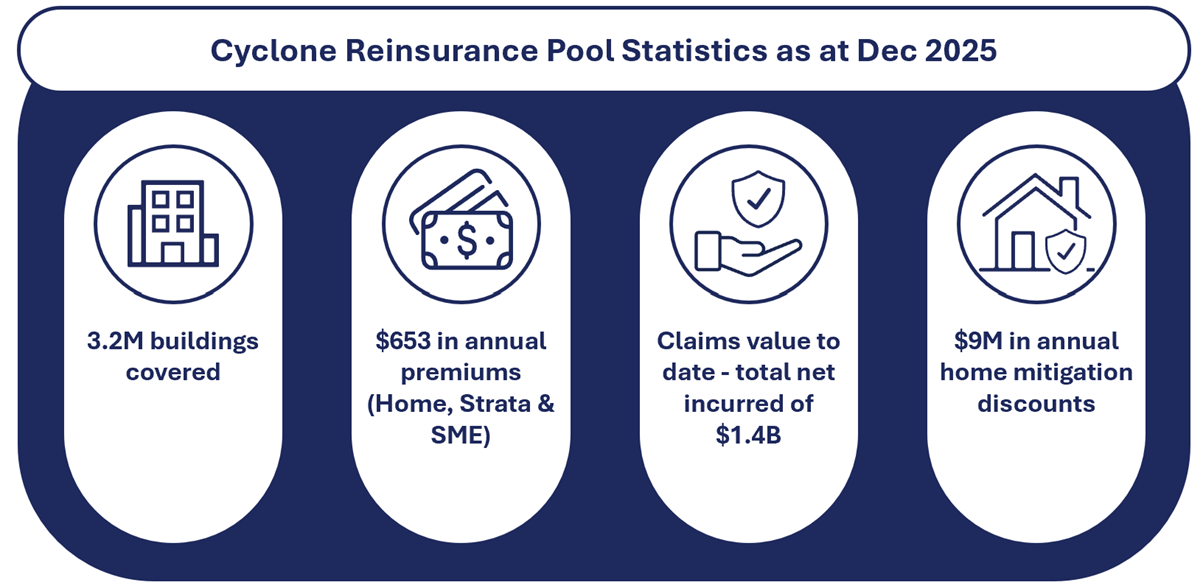
Since its commencement on July 1, 2022, the cyclone reinsurance pool has responded to 20 declared cyclones, including Tropical Cyclone Gabrielle, which affected Norfolk Island in 2023, and Tropical Cyclone Alfred, which accounts for a large share of total losses to date. As at Dec. 31, 2025, the pool had received more than 126,000 claims, with a net incurred value of approximately $1.4 billion. ARPC has confirmed that cumulative claim payments to cedant insurers have now surpassed $1 billion, showing the volume of post‑event recoveries paid under the scheme.
ARPC chief executive officer Dr Christopher Wallace said the milestone reflects the volume of payments made to policyholders via participating insurers. “Passing $1 billion in claim payments is a significant achievement for the scheme, and more importantly, for the communities it was designed to support. The cyclone pool was established to lower insurance premiums for households, small businesses, and strata properties in medium‑to‑high cyclone risk areas by providing insurers with affordable, government‑backed reinsurance. This milestone demonstrates that the pool is working as intended – delivering timely, reliable support following severe cyclone events,” Wallace said.
Wallace also referred to the impact on affected communities of the events that have triggered recoveries from the pool. “As we acknowledge this achievement, it’s important to remember the people and communities who have been displaced, disrupted, or have lost so much as a result of these disasters. Our role is to ensure the cyclone pool delivers reliable support when it’s needed most and help those communities recover and strengthen over time,” he said.
Read next: ARPC cyclone pool claim payments pass $1 billion mark
All properties ceded to the cyclone pool include cyclone wind cover. Within the home segment, about 87% of policies in the pool also carry flood cover. Storm surge cover is available on a more limited basis, determined by individual insurer offerings and local exposure. The data indicates a concentration of cyclone risk in northern Australia, with average premiums higher in areas that face greater hazard intensity and asset concentrations. The regional distribution of premiums and exposure is relevant for accumulation management, catastrophe modelling, and capital allocation.
Mitigation is a stated feature of the scheme’s design. As at Dec. 31, 2025, ARPC reports that approximately $9 million in mitigation discounts had been applied to in‑force premiums. These discounts are linked to risk‑reducing measures undertaken by policyholders and recorded by insurers, such as property strengthening or other resilience‑focused improvements. Uptake of mitigation measures is expected to change over time as participating insurers refine data collection and as policyholders respond to price signals.
Read next: ARPC details cyclone pool claims and insurer participation
ARPC has said it plans to continue funding targeted mitigation activities that aim to improve the long‑term risk profile of properties in cyclone‑exposed regions. “From our first declared event, with Tropical Cyclone Gabrielle impacting Norfolk Island in 2023, the cyclone pool has scaled rapidly. It has demonstrated its capability to support insurers through multiple events while maintaining operational integrity and financial strength. As the scheme continues to mature, ARPC will focus on enhancing operational efficiency, maintaining responsive claims processes, and supporting targeted mitigation activities that improve the long-term risk profile of properties across cyclone exposed regions,” Wallace said.
The cyclone reinsurance pool, established in July 2022 and administered by ARPC on behalf of the Australian government, is designed to improve the availability and affordability of cyclone‑related cover for households, strata, and SMEs in areas exposed to cyclone risk, according to the scheme’s stated objectives. The latest figures on coverage, premiums, claims, and mitigation discounts provide updated insight into the scheme’s role in managing cyclone risk. The data is likely to inform cedant decisions on participation levels, treaty structures, product settings, and risk‑transfer strategies across cyclone‑prone parts of Australia.