Data from two of Australia’s largest motor insurers, corroborated by current ABS population figures and a Victorian Parliamentary Inquiry, collectively reframes what has historically been treated as a rural risk as a measurable and accelerating liability in Melbourne’s suburban growth corridors – one that points to a coverage gap brokers are well placed to address. RACV Insurance members lodged almost 31,000 kangaroo-related collision claims between January 2021 and June 2026, peaking in 2025 with 7,232 – nearly 20 per day on average. Independently, AAMI’s analysis of 23,840 wildlife collision claims received between July 2024 and June 2025 found that one in five resulted in a total write-off, with the average damage bill around $8,000, and Victoria recorded the highest number of animal collisions of any state at 7,851. The two datasets, drawn from different insurers across different reporting periods, converge on the same conclusion: wildlife collision write-offs in Victoria are a material and worsening cost driver in motor books.
Read next: New IAG study: 7,850 casualties preventable if drivers kept ADAS on
The average RACV kangaroo collision claim reached almost $9,000 in 2025, up 48% since 2021. One in six such claims resulted in a write-off in 2025, compared with one in nine in 2021. The mechanism behind that deterioration is documented at the industry level. The Insurance Council of Australia’s (ICA) March 2025 Motor Insurance Policy Paper noted that vehicles are declared total losses when the cost of repairs exceeds their insured value, and that rising repair costs, longer waiting times, and additional claims expenses such as rental cars are pushing insurers toward writing vehicles off rather than repairing them. Repair costs have climbed 26% since 2022, owing to rising wages, more expensive spare parts, and longer repair times.
Kangaroo strikes can crush bonnets, smash windscreens, and trigger airbags, according to Sheen Panel Service, a Victoria-based repairer – the type of multi-system damage that is particularly susceptible to crossing a total-loss threshold as repair economics tighten. This is where the claims pattern intersects with a documented complaints surge. Comprehensive motor vehicle insurance was the most complained-about general insurance product in the Australian Financial Complaints Authority’s (AFCA) 2024-25 Annual Review, accounting for around a third of general insurance complaints.
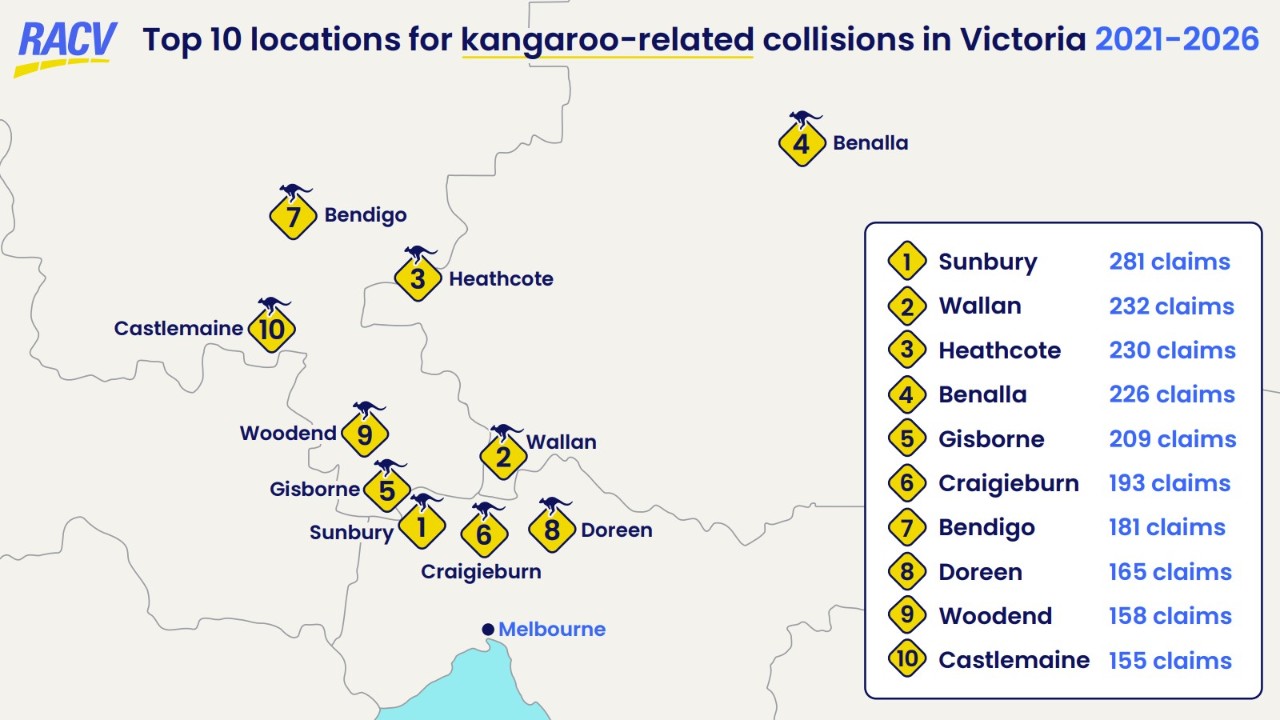
The steepest claim increases between 2021 and 2025 were recorded on Melbourne’s fringe: Wallan up 112% (from 33 to 70 claims), Kilmore up 193%, Mickleham up 169%, and Gisborne up 93%. Sunbury ranked second nationally in AAMI’s wildlife collision hotspot data and leads RACV’s suburb list with 281 claims. The alignment between two independent datasets on the same suburbs confirms a cross-insurer market pattern.
The structural driver is residential development that is still accelerating. According to ABS June 2025 regional population data analysed by .id (Informed Decisions), Mitchell Shire – which includes Wallan, Kilmore, and Beveridge – is the second-fastest growing LGA in Victoria. Mitchell Shire Council separately reported 4.2% population growth in 2024-25, citing ABS data. Craigieburn, which features in both insurers’ hotspot data, has grown an estimated 11.4% since the 2021 Census, according to AreaSearch analysis of ABS estimated resident population data.
The Victorian government has committed to a 10-year plan releasing 27 new greenfield areas across Melbourne's outer south-east, north, and west. With development continuing across areas already identified as wildlife-collision hotspots, the expansion of Melbourne’s urban footprint represents a structural change in the geography of motor risk. The proposal aligns with recommendations from a Victorian Parliamentary Inquiry into wildlife roadstrikes, which found significant gaps in roadstrike data collection and inconsistent reporting arrangements, with Wildlife Victoria recording a 288% increase in wildlife-vehicle collision cases over the past decade. With no central data repository consolidating wildlife collision figures at postcode level, the most granular intelligence on localised risk currently sits in individual insurers’ own claims books.
RACV general manager insurance and roadside Bill Bloodworth acknowledged the geographic shift directly. “A lot of people assume this is only a rural-road issue. As our outer suburbs grow, more cars are sharing the road with more kangaroos, and the result is more collisions, more written-off vehicles, and bigger repair bills for everyday Victorians,” he said.
ABS 2021 Census data for the highest-collision suburbs – figures that predate the most recent growth surge and therefore likely understate current exposure – shows Wallan with a median age of 33, median monthly mortgage repayments of $1,733, and an average of 2.2 motor vehicles per dwelling. Craigieburn recorded a median age of 32, median monthly mortgage repayments of $1,850, and an average of two motor vehicles per dwelling. These are young, mortgaged, multi-vehicle households. The newer arrivals since 2021 are broadly drawn from the same profile.
From 2019 to 2024, new vehicle prices in certain segments rose by up to 39%, with used vehicle costs also increasing by around 32%. For a financed vehicle in a growth-corridor postcode – where the likelihood of a wildlife write-off has risen materially – the difference between a market value and agreed value policy is increasingly consequential. The ICA notes that market value is assessed at claim time and can fall as the vehicle depreciates, while agreed value is a fixed dollar amount set at policy inception. For a client carrying vehicle finance, a market value payout that falls short of an outstanding loan balance is a direct financial loss – and the probability of encountering that scenario in these postcodes has risen sharply since 2021. National Insurance Brokers Association of Australia (NIBA) president Nick Cook has framed the broader advisory obligation plainly. “As trusted advisers, brokers help clients to identify, manage, and mitigate their exposures, ensuring the right and important levels of cover are in place, as well as offering support and guidance throughout the claims journey,” he said.
Read next: Brokers gain street-level crash data on Australia’s worst road jurisdiction
RACV data shows claims from April to August run more than 20% higher than the rest of the year – a predictable seasonal window that creates a structured renewal prompt. For brokers with clients in Melbourne’s northern and western growth corridors, three questions are worth working through before the next renewal: whether the vehicle is insured for agreed or market value, and whether the client understands what a write-off payout will actually deliver; whether financed vehicles carry gap cover to address any shortfall between payout and outstanding loan balance; and whether fleet schedules for businesses running vehicles through growth-corridor routes reflect the documented and rising write-off frequency in those postcodes. The data reporting gap that makes postcode-level wildlife risk difficult to price is also a gap that brokers, through direct client engagement, are uniquely positioned to bridge – identifying a material exposure before a claim makes it visible.