Insurers have plenty to worry about: cyber threats, supply chain inflation and a cost-of-living squeeze that has customers questioning every renewal. But Australia’s corporate regulator used the industry’s biggest event of the year to bring the conversation back to something more basic. It wants insurers to fix the paperwork and payouts their customers actually deal with.
Speaking at the Insurance Council of Australia’s annual conference in Sydney on Friday, ASIC commissioner Alan Kirkland said that with household budgets stretched, getting the basics right was “now more important than ever”. APRA member Suzanne Smith spoke after him in the regulators’ session.
Kirkland has been making this argument since his first appearance at the conference in 2024, and he returned to it last year. This time he had a year of reviews and court results behind him. He also outlined two new pieces of work that brokers handling home and motor business should watch.
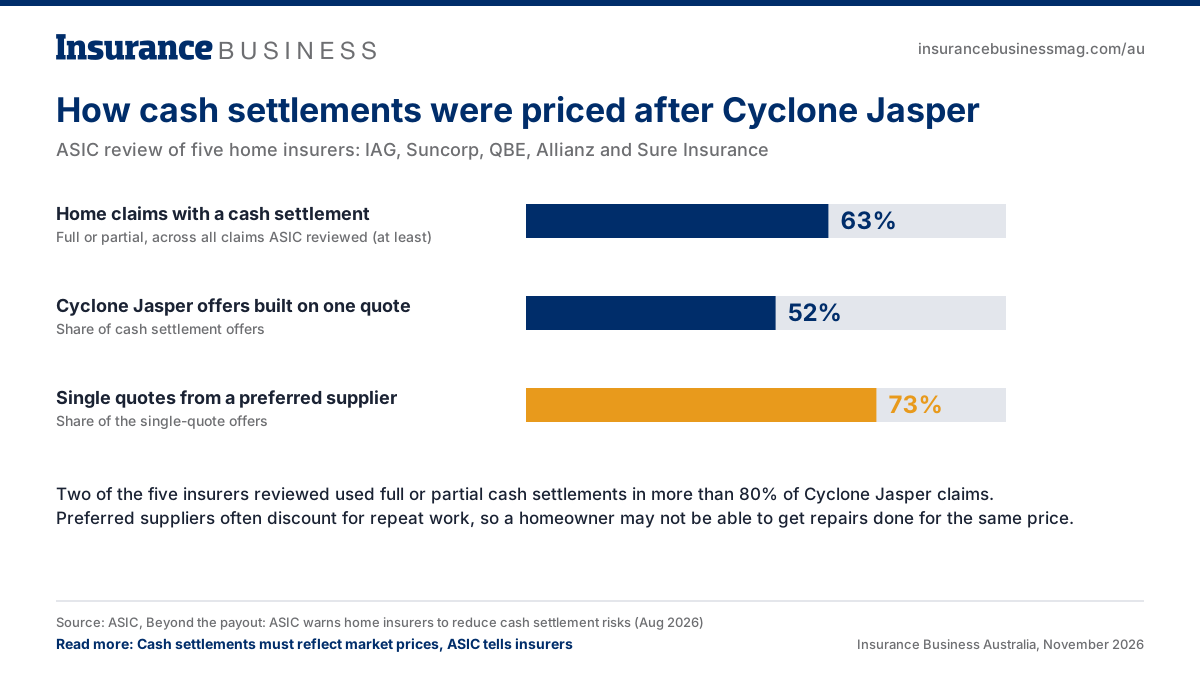
Kirkland started with cash settlements and ASIC’s August review, Beyond the payout. At least 63% of the home claims ASIC examined included a full or partial cash payment. After Cyclone Jasper, two of the five insurers reviewed paid cash on more than 80% of claims.
ASIC’s concern is less that insurers pay cash and more how they arrive at the figure. In 52% of the Jasper cash offers, the insurer relied on a single quote. Insurers’ data showed that 73% of those single quotes came from a preferred supplier. Panel builders tend to discount in return for steady work, and a homeowner who later calls the same builder is unlikely to get that price.
Kirkland gave an example. One policyholder took their settlement figure back to the builder whose quote had produced it and asked whether the builder would do the work for that amount. The builder said it had cut its costs by about 40% for the insurer. After the customer complained, the insurer increased its offer. Kirkland said that outcome itself raised questions about how fair some first offers are.
He also said some customers are not told clearly whether they can change their minds after accepting cash, where the policy allows it. As Insurance Business has reported, insurers are pricing cash settlements at discounts clients can’t access.
Read next: Cash settlement claims stall five months after Cyclone Narelle
On motor, Kirkland drew on ASIC’s Report 838. Premiums rose 8% in the 12 months to July 2025. Over the same period the ABS monthly CPI indicator rose 2.8%, so premiums grew almost three times as fast as prices generally. That increase followed a rise of more than 42% between 2019 and 2024. Motor is now the most complained-about product in insurers’ internal dispute resolution data, and price is the most common reason for complaints.
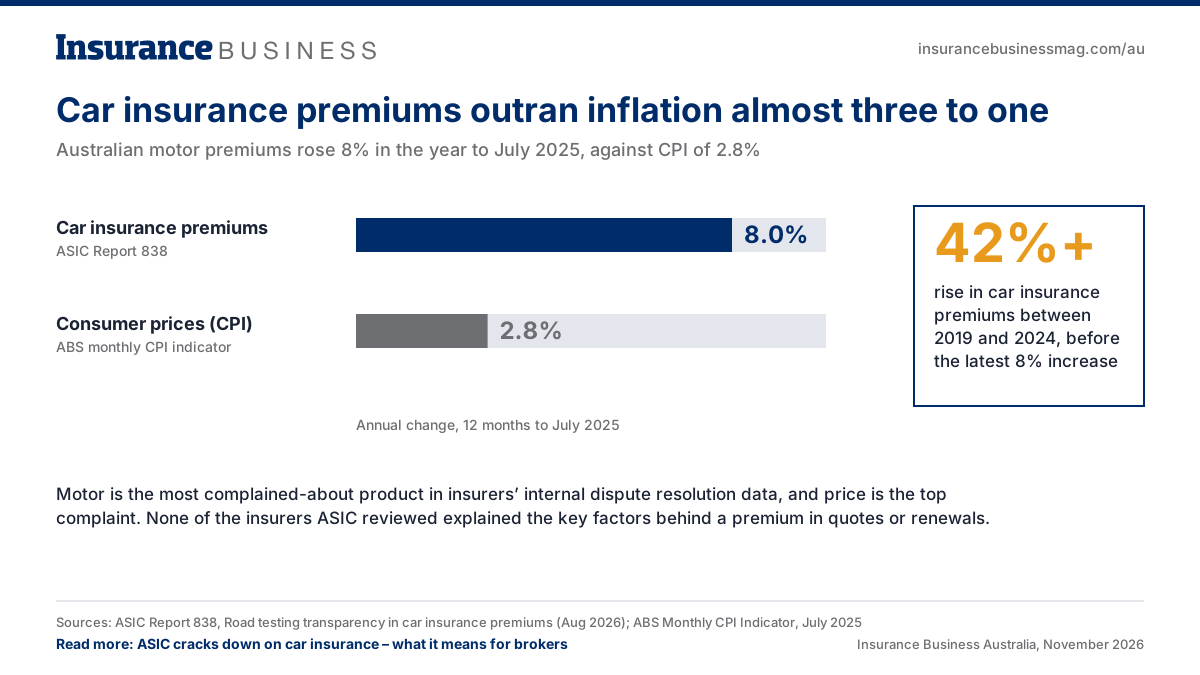
None of the insurers ASIC reviewed explained, in quotes or renewal notices, which factors drove a customer’s premium or why it had changed from the previous year. Insurers that charge more for monthly instalments did not point this out at renewal. ASIC’s September supervisory letter estimates that customers could save 10% to 20% by paying annually. Five insurers also left out a clear year-on-year comparison of insured value or excess.
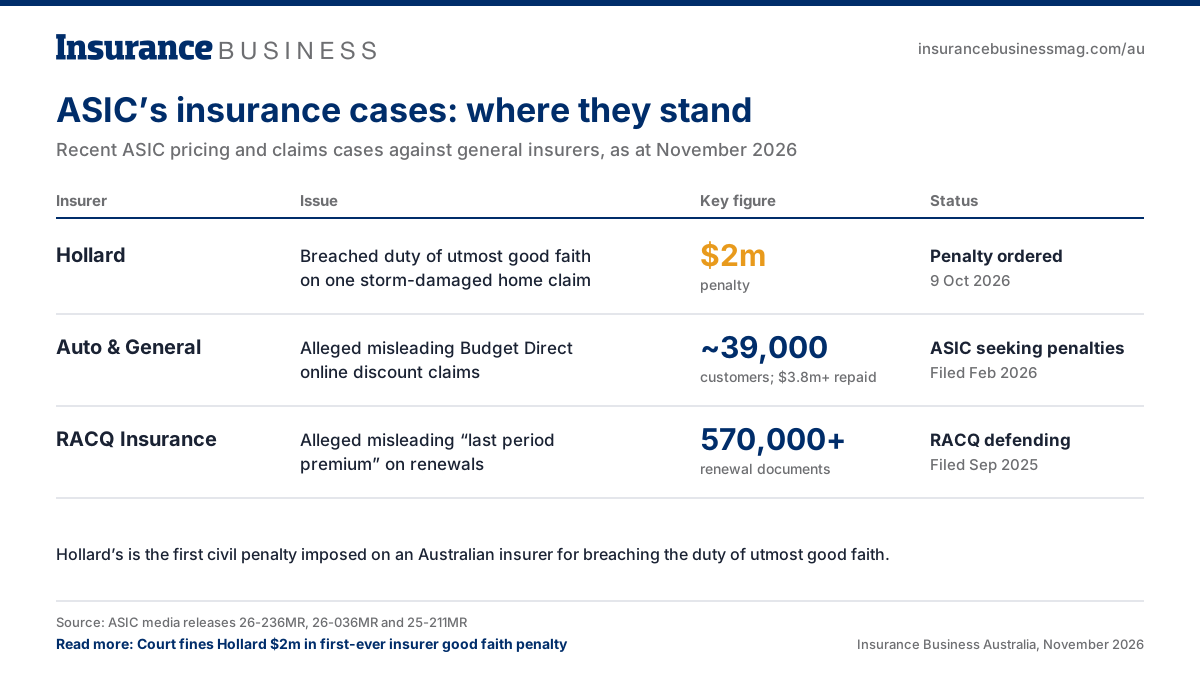
Kirkland called this “a clear opportunity to do more”. ASIC is already in court on the issue. It alleges that RACQ Insurance sent more than 570,000 renewal documents between 2019 and 2024 containing misleading “last period premium” figures. RACQ is defending the case.
Read next: ASIC cracks down on car insurance: what it means for brokers
In October the Federal Court ordered Hollard to pay $2 million for breaching its duty of utmost good faith. It is the first civil penalty imposed on an Australian insurer under that provision. The case concerned a single home claim lodged by a regional Victorian family after a storm in October 2021. ASIC had asked for $30 million and Hollard had argued for $100,000 to $300,000. The result shows that mishandling one claim can now cost an insurer seven figures.
ASIC is also suing Auto & General. It alleges that Budget Direct advertised online discounts of up to 30% and then quietly removed them when roughly 39,000 customers changed their policies in the first year. Auto & General says it reported the problem itself, and it has paid more than $3.8 million in remediation.
The newest work Kirkland announced is a review of licensed, for-profit third-party claims managers in home insurance. ASIC started it after representations from the ICA and consumer groups. It covers the operators known as “disaster chasers”, who move into communities after severe weather.
The review will look at how these firms sign up clients, the fees and cancellation terms they set, their role in claims and complaints, and their commercial arrangements with repairers. ASIC also wants to establish where legitimate claims help ends and harmful practice begins. The work was flagged in ASIC’s 2026–27 priorities, and it is getting under way just before the high-risk weather months.
For brokers, this is a commercial issue as well as a compliance one. Supporting clients through claims after a catastrophe is a large part of what brokers offer, and some of these firms compete for the same work.
Read next: Disaster chasers land on ASIC’s watchlist as weather costs climb
ASIC is also assessing the redrafted General Insurance Code of Practice, which the ICA lodged on 22 October after two delays. Kirkland said ASIC would begin consulting stakeholders next week, through direct meetings and written submissions. After that, ASIC will discuss any required changes with the ICA before the final Code is formally submitted, which he hopes can happen early in 2027.
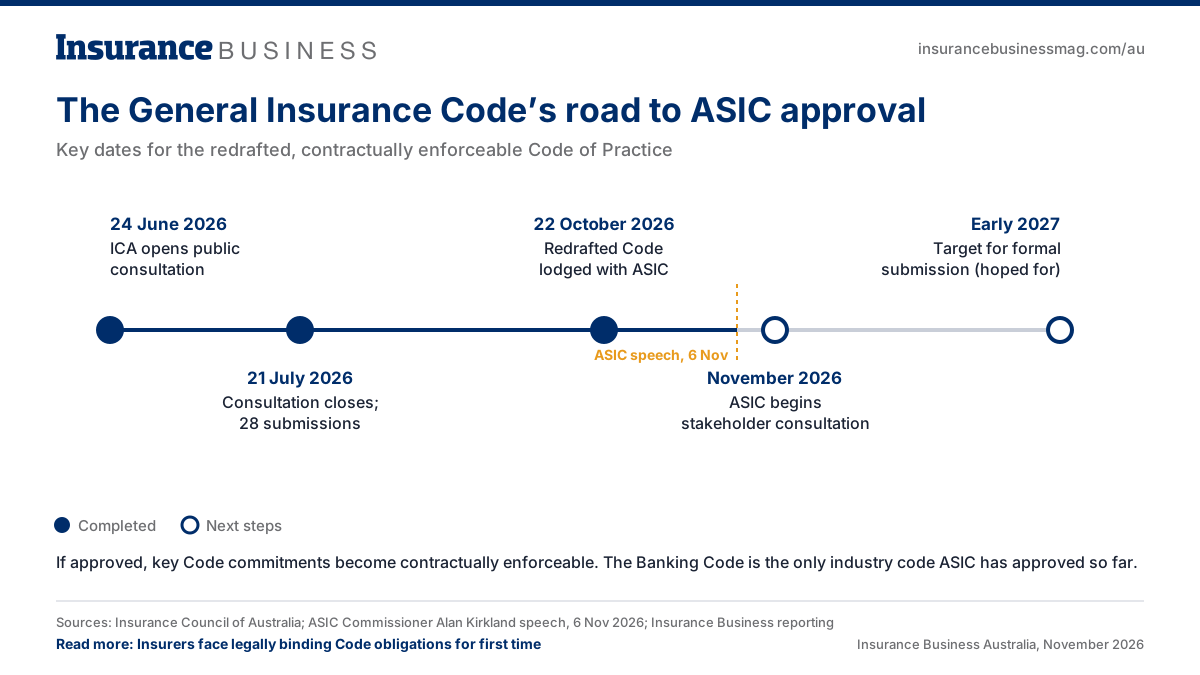
The redraft would make key insurer commitments contractually enforceable for the first time. The Banking Code is currently the only industry code ASIC has approved. If the insurance Code is approved, the problems Kirkland described on Friday would become obligations written into the policies brokers place.
When a client is offered a cash settlement, ask the insurer how the figure was calculated, whose quote it relies on, and whether the client can reverse the decision later. Before renewals, check whether the client is paying more for instalments and compare this year’s sum insured and excess with last year’s. In disaster-affected areas, make sure clients know you can help with their claim before a door-knocker offers to.