Nine months into 2026, the world's insurers have paid out less for natural disasters than in any comparable period since 2019. It has hardly been a calm year. Earthquakes killed thousands of people in Venezuela and Colombia, hail battered Europe and Illinois recorded a provisional state record for tornadoes. But most of the damage fell where little insurance had been sold.
Insured losses from January to September reached US$92bn, according to Gallagher Re's Q3 2026 Natural Catastrophe and Climate Report [EDITOR: add link to report page]. That is 29% below the 10-year average of US$128bn for the period and the lowest nine-month total since 2019. Economic losses, insured and uninsured, were at least US$242bn, the lowest since 2015.
The number of disasters was close to normal. Fifty-four events caused at least US$1bn in economic damage, compared with a decade average of 52, and 24 caused at least US$1bn in insured losses, exactly the average.
Read next: Fame! Fortune! Well, fame anyway. You KNOW you deserve an award.
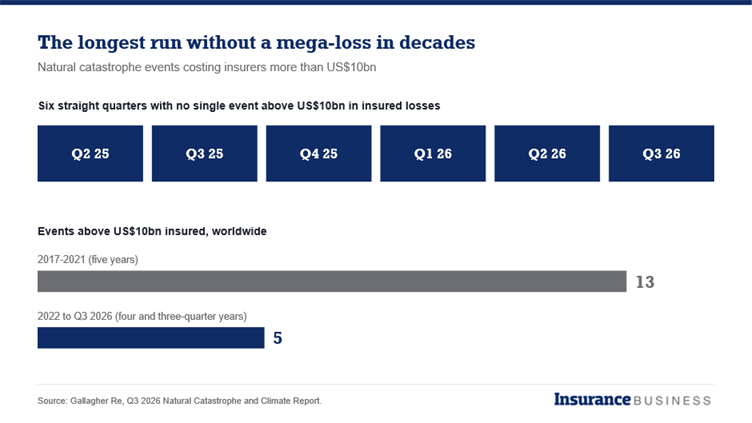
What was missing were the very large events. The industry has now gone six consecutive quarters without a natural catastrophe costing insurers more than US$10bn. Only five events have passed that mark worldwide since 2022, compared with 13 between 2017 and 2021.
Steve Bowen, the chief science officer at Gallagher Re, said significant disasters had continued but that "relatively few have occurred in locations or under circumstances that generated outsized insured losses". Insurance Business has reported the global figures in more detail.
Read next: El Niño is here, it could be the strongest since 1950, and the bushfire clock is ticking
Australia barely features in the report's global top five tables, which are dominated by convective storms in the US and drought-related subsidence in France. The country's costliest event was the Victorian bushfires from 7 to 16 January, which Gallagher Re estimates caused about US$810m in economic damage and more than US$430m in insured losses. The Insurance Council of Australia put the cost at $599m across 4,852 claims.
The report also records a flash flood across the Otways and Sydney in January, and Cyclone Narelle in March, which caused economic losses of about US$100m and US$150m respectively.
For Australian underwriters, the most useful part of the report is its analysis of the El Niño-Southern Oscillation, known as Enso. The Bureau of Meteorology declared an El Niño on 16 June. The World Meteorological Organization expects sea surface temperatures in the key Niño 3.4 region to average about 3.7C above normal from October to December, peaking around December.
The US National Oceanic and Atmospheric Administration (Noaa) has said the event could surpass every El Niño in its records, which go back to 1950. Gallagher Re goes further, suggesting it could be the strongest in 1,000 years. The EU's Copernicus Climate Change Service said September temperatures in a key part of the Pacific exceeded the peaks of the 1982-83, 1997-98 and 2015-16 events, although it has not yet described this as the strongest El Niño on record.
Gallagher Re compared its loss database with monthly Pacific temperature readings from 1980 to 2025. In months when El Niño was "strong" or "very strong", global economic losses averaged about US$55.1bn a month, compared with US$21.3bn in all other Enso conditions, or about 159% higher. Insured losses averaged US$12.9bn a month, compared with US$6.3bn. The uninsured share of losses also rose, from 70% to 77%.
The broker urges caution. Its analysis is descriptive, there have been only 29 months of strong or very strong El Niño since 1980, and a single large event can skew the averages. It treats Enso as a sign that the odds are shifting rather than as a forecast of annual losses.
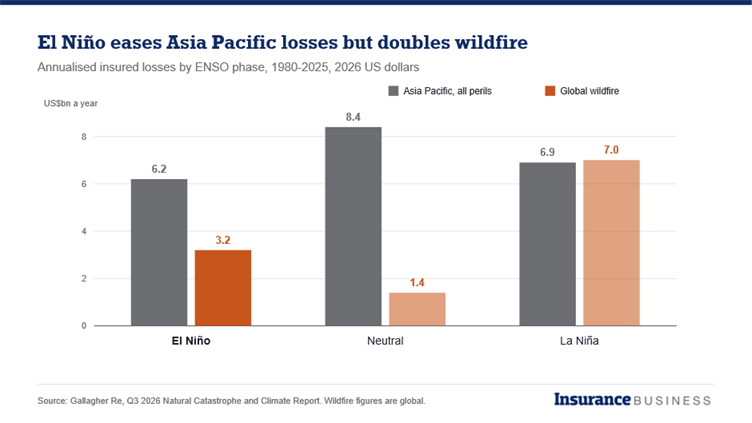
The picture for Australia is more complicated. Across the Asia-Pacific region as a whole, El Niño periods have historically been the least costly. Annualised insured losses averaged US$6.2bn under El Niño, compared with US$8.4bn in neutral conditions and US$6.9bn under La Niña. That probably reflects the weight of flood and typhoon losses in Asia, which tend to fall when the monsoon is drier.
Bushfire follows the opposite pattern. Gallagher Re's figures show global annualised insured wildfire losses of US$3.2bn under El Niño, more than double the US$1.4bn in neutral years. Modelling by Moody's suggests El Niño raises the risk of bushfire in Australia by more than 50%.
Moody's also says Australia has had its wettest El Niño year on record, and that the rain has produced grass and scrub that will become fuel as it dries out. Insurance Business has looked at the Moody's analysis in more detail.
The Australasian Fire and Emergency Service Authorities Council's spring outlook flagged an increased fire risk in northern and south-eastern New South Wales, south-east Queensland, north-eastern Tasmania, large parts of the Northern Territory, and parts of Western Australia, South Australia and Victoria. The CSIRO has warned that several of Australia's worst fire and drought seasons came during relatively weak El Niño events, so a record reading in the Pacific does not necessarily mean record losses at home.
Claims are already rising in some rural portfolios. The insurer WFI recorded 73 haystack fire claims in its latest financial year, more than double its five-year average of about 30.
Read next: Insurers take resilience push to Canberra as record El Niño nears
Reinsurance, meanwhile, continues to get cheaper. Gallagher Re's latest market report recorded a first-half return on equity of 19.9% for reinsurers and record global reinsurance capital of US$688bn. Property catastrophe rates fell by about 16% at the July renewals, and the ratings agency Fitch has kept its "deteriorating" outlook for the sector in 2027 as capital outstrips demand.
That should give Australian insurers some leverage at the 1 January renewals. But Moody's has found that the better terms went mostly to larger insurers, while smaller ones saw attachment points hold or rise. Bushfire and other frequent, smaller perils often fall below those attachment points, meaning a bad summer could land largely on insurers' own balance sheets.
Andrew Hall, the chief executive of the Insurance Council of Australia, said earlier this month that the bureau's forecast of a likely record El Niño underlined the need for governments, insurers and communities to prepare for extreme weather this summer.
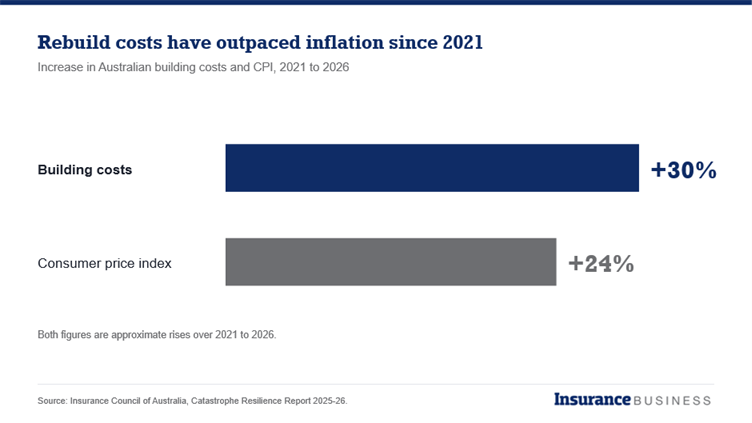
Rising rebuild costs add to the pressure. The council's Catastrophe Resilience Report found building costs rose by about 30% between 2021 and 2026, outpacing growth in the consumer price index of about 24%. Bushfire also had the highest average claim of any peril, at $114,888. Brokers may want to check sums insured on rural and peri-urban properties before the fire danger period peaks.
Read next: El Niño threatens to extend Australia's bushfire liability window
Gallagher Re expects El Niño to peak in the last quarter of 2026 and weaken through 2027, possibly giving way to La Niña. For Australia, that would swap fire risk for the wetter conditions associated with floods and cyclones. In Gallagher Re's data, strong La Niña months were the most costly of all, with global insured losses averaging US$20.7bn a month.
The broker still expects insured losses for 2026 to exceed US$100bn. Adjusted for inflation, that would make it the 10th consecutive year above that level. Gallagher Re said the industry could absorb a major loss but warned against treating the recent lull as a sign that major losses had stopped.
Read next: IAG's $12.4 billion claims bill signals what brokers face at renewal