This starts, of all places, with cotton.
In the early 1900s, insuring baled cotton in American warehouses and gins was an absolute nightmare.
A pool of insurers called the Cotton Insurance Association covered the risk between them, but the pool alone couldn't absorb everything, so it needed reinsurance on top. And reinsurance, back then, was a mess - renegotiated from scratch every single year, purely on the back of how bad the last harvest had been.
Good year, easy chat. Bad year, brutal one. Nobody could plan ahead, according to the Insurance Hall of Fame, which inducted the man at the centre of this story in 2011.
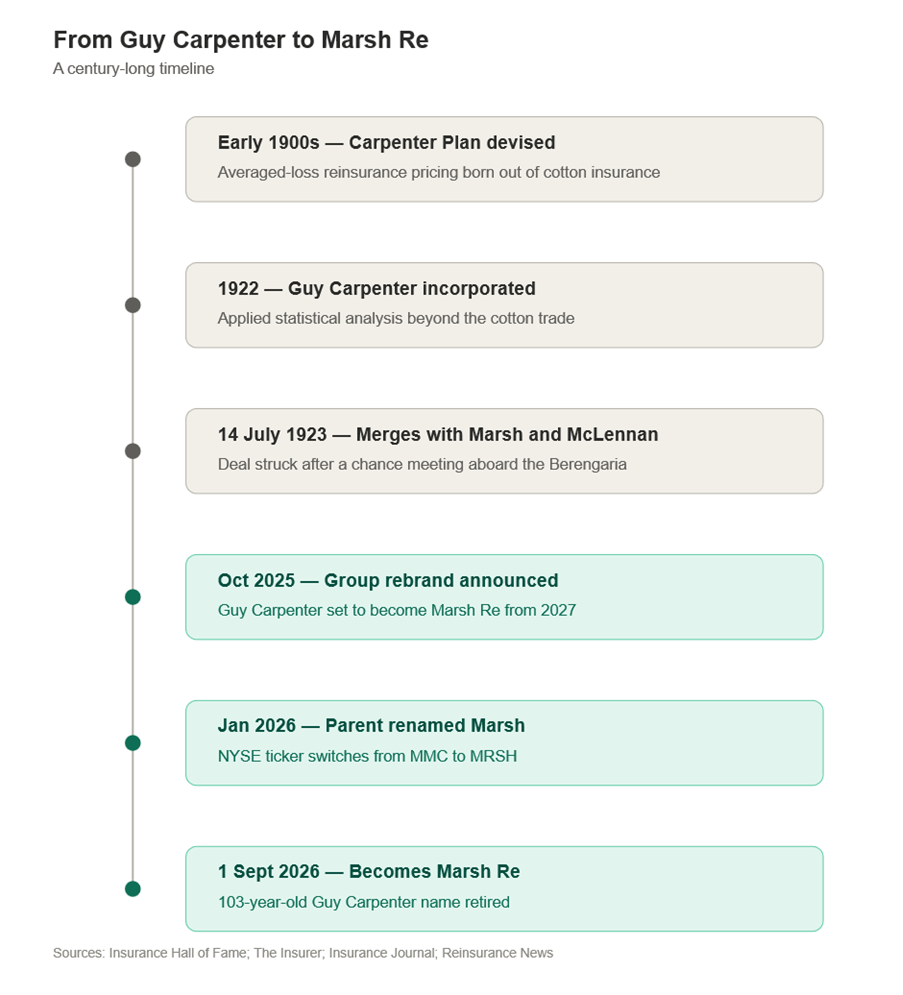
That man was Guy Carpenter, who ran the Cotton Insurance Association's affairs and got so fed up with this yearly guessing game that he invented a fix for it: average the losses out over several years instead of resetting the clock every January, then price against that rolling average. It's the kind of idea that sounds blindingly obvious once someone's said it out loud, which is usually the sign of a genuinely good one.
Lloyd's, being Lloyd's, wanted absolutely nothing to do with it - except for one underwriter called Cuthbert Heath, who Carpenter reportedly tracked down on a shooting trip in Algiers to pitch the idea to in person. Heath said yes. That handshake, in a fairly roundabout way, is where excess-of-loss reinsurance as we now know it comes from.
Carpenter incorporated the company that bore his name in 1922. The following year, he was on a ship bound for London when he got talking to two fellow passengers, Henry Marsh and Donald McLennan. By 14 July 1923, the merger between the three men's businesses was done. Guy Carpenter's name survived being swallowed by a much bigger outfit that day, and kept surviving - through the Depression, through the Second World War, through decades of every insurance executive currently reading this on their phone under a desk somewhere.
What it hasn't survived is a branding review.
Read next: Marsh insurance has decided it wants to be a racing car. And you know what? fair play to them
As of this week, Guy Carpenter no longer exists as a name. It's been folded into the great beige soup of corporate branding and now goes by Marsh Re.
This isn't some rogue decision made by a man in a shed. It's the final stage of a plan set in motion back in October 2025, when the parent company - then called Marsh McLennan, a name so clunky it sounded like a Scottish law firm crossed with a fast-food chain - announced it would simplify itself down to just Marsh. That happened in January 2026, complete with a new ticker symbol on the New York Stock Exchange (MRSH, in case you're the sort of person who cares about ticker symbols, which, deep breath, some of you reading this genuinely are).
Under that plan, Mercer becomes Marsh. Oliver Wyman becomes "Oliver Wyman, a Marsh business," which is the corporate equivalent of keeping your surname but adding "of the Marsh family" after it at every dinner party. And Guy Carpenter, the reinsurance broking arm, the bit that spends its days working out how insurers themselves get insured, which if you think about it too long starts to resemble one of those Russian dolls where eventually there's just a tiny wooden man shrugging, becomes Marsh Re.
The man now in charge of steering this newly badged operation is Dean Klisura, president and CEO of Marsh Re, who has been at this company since 1993, which is longer than some of you have been alive, and considerably longer than most marriages. He described it as a business that carries forward "a hundred years of trust" while adding the scale of the wider Marsh operation behind it.
Which is a very diplomatic way of saying: we're keeping the reputation, binning the badge.
To put some numbers on what's actually being rebadged here, this isn't a small operation being quietly renamed in a back office somewhere. It's a business running out of more than 70 offices across 41 countries, employing something in the region of 3,700 people, and one that placed roughly US$75 billion of ceded premium in 2025 alone - that's the industry term for the sums insurers pay to pass their own risk on to reinsurers, which is a genuinely enormous amount of money to be quietly rebranding without most of the public noticing.
Read next: Formula 1 bosses to target motor insurance
Now, you might ask why any of this matters if you're not personally involved in placing catastrophe reinsurance for a Caribbean windstorm portfolio. Fair question. Here's why.
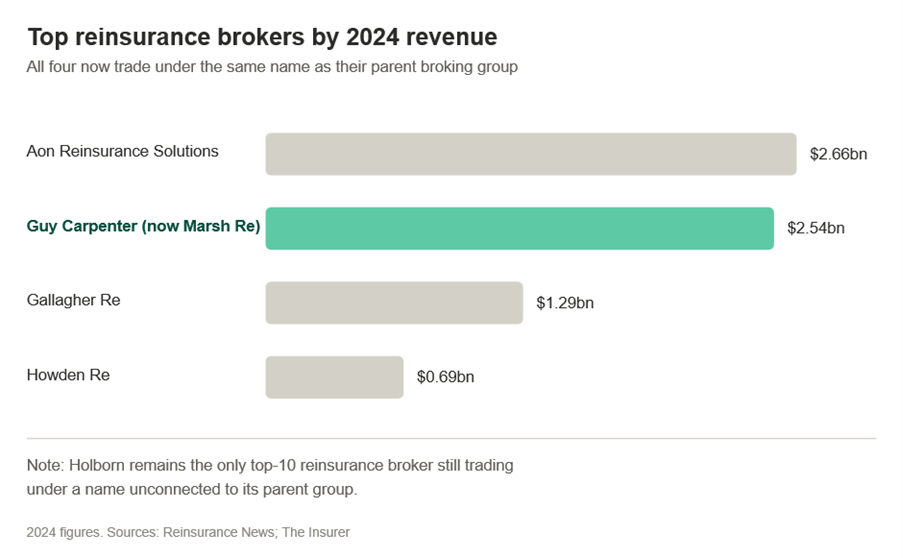
Guy Carpenter's disappearance means nine of the top ten reinsurance brokers in the world now trade under the same name as their group's main insurance broking business, usually with a tidy little "Re" bolted on the end. Aon Re, Gallagher Re, you get the idea. The only holdout left standing with an entirely independent name is a firm called Holborn.
This is basically what happened to every interesting regional car badge over the past thirty years. Once upon a time you had proud, distinct names like Holden, Valiant, Leyland - and now everything from a supermini to a seven-seater gets slapped with the same three letters because some consultant worked out it's cheaper to run one global marketing budget than five interesting ones.
Reinsurance broking has just done exactly the same thing, except instead of losing a badge with a nice bit of chrome on it, the industry has lost a hundred years of institutional memory, all so the group's brand book can have one fewer font in it.
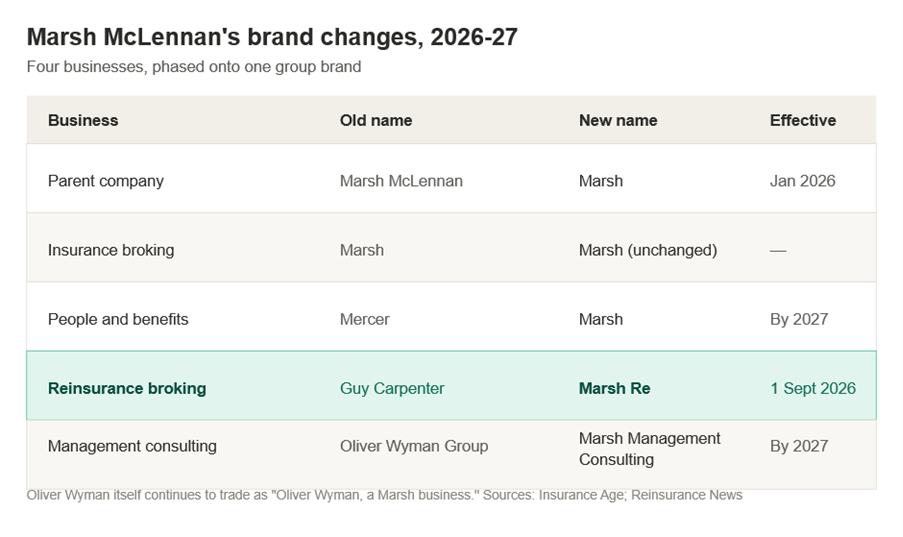
I'll be honest with you: from a purely commercial standpoint, none of this is remotely surprising. The parent company said back in 2025 that it wanted every part of the business trading under one Marsh name by the start of 2027, and here we are, more or less on schedule, which for a corporate rebrand is practically a Swiss train timetable. It also lines up neatly with two big Marsh Re publications timed for the Rendez-Vous de Septembre in Monte Carlo - the reinsurance industry's answer to Splendour in the Grass, except with fewer wellies and considerably more actuaries - namely a 2027 renewal outlook and a market update on specialty lines.
So there it is. A name that outlasted a world war, a stock market crash, and the Ford Falcon, has finally been retired - not by a catastrophe, not by a scandal, but by a branding review. The man who tracked a reluctant Lloyd's underwriter down on a hunting trip in Algiers just to get reinsurance pricing sorted properly would probably have found that mildly funny.
There's a joke about actuaries in there somewhere, but frankly, I think the facts do the job on their own.