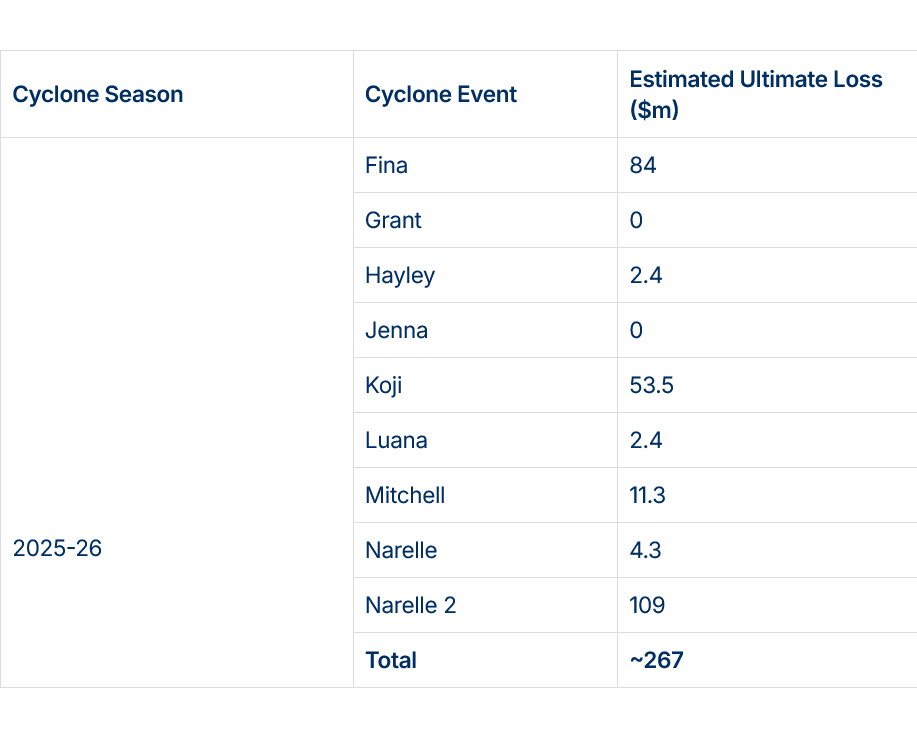
The Australian Reinsurance Pool Corporation (ARPC) has put a preliminary price tag of around $267 million on the 2025-26 tropical cyclone season, drawing on a central actuarial estimate of $195 million and a $72 million risk margin. The figures, released May 11, 2026, are unaudited and will be updated as claims data comes in.
Nine events reached the declaration threshold during the season. None produced losses large enough to move the needle at the portfolio level – an outcome ARPC attributed to the storms largely tracking away from densely populated areas. That said, several systems left behind damage spread across multiple regions, making it harder to draw clean boundaries around each event and adding uncertainty to early loss estimates.
Tropical Cyclone Narelle 2 generated the season’s largest individual bill at $109 million, followed by Cyclone Fina at $84 million and Cyclone Koji at $53.5 million. At the other end of the scale, Cyclones Grant and Jenna closed out with zero estimated losses. The remaining four events – Mitchell ($11.3 million), Narelle ($4.3 million), Hayley ($2.4 million), and Luana ($2.4 million) – made up the balance. ARPC flagged that loss data for Tropical Cyclone Narelle has not yet been received, and several other events are still in the early stages of assessment. Figures for systems that caused prolonged or widespread damage are likely to shift as more information flows through.
 ARPC chief executive Dr. Christopher Wallace said the season showed the cyclone pool holding up under a higher-than-usual volume of activity. “The 2025-26 season was one of the most active in recent years. Despite this, losses remain within expectations and do not change our overall view of the pool’s resilience. Importantly, the pool has continued to operate as intended – providing certainty of cover, supporting insurer balance sheets, and reducing reliance on global reinsurance markets,” Wallace said.
Read next: ARPC cyclone pool reaches 3.2 million‑property portfolio
Cyclone Narelle drew particular attention from ARPC due to its path and duration. The storm moved through multiple regions across an extended period, producing a loss pattern that cut across the standard event-definition framework. “Narelle followed an unusual and extended path, impacting multiple regions over a prolonged period. While two events were declared in line with the legislative framework, these reflected distinct phases of one underlying weather system. We will continue to work closely with insurers to support recovery, taking a practical approach that reflects both the formal framework and how losses emerge in practice,” Wallace said. Together, the two Narelle declarations account for $113.3 million, or roughly 42% of the season's estimated total.
Read next: ARPC cyclone pool claim payments pass $1 billion mark
To understand where the 2025-26 figures sit, it helps to look at what the pool has absorbed since it opened in July 2022. Across all seasons to date, total estimated ultimate losses now stand at around $2 billion – a number heavily skewed by the prior year. The 2024-25 season contributed approximately $1.591 billion on its own, with Tropical Cyclone Alfred responsible for $1.58 billion of that. Alfred remains the single largest loss event the pool has faced. Before that, the 2023-24 season came in at about $139 million, with Cyclone Jasper ($96 million) and Cyclone Kirrily ($40 million) doing most of the damage. The pool’s inaugural season in 2022-23 was quiet, recording just $60,000 in combined losses across Cyclones Gabrielle and Ilsa. Those cumulative losses translate into a parallel claims payment story.
On April 8, 2026 – roughly five weeks before the season update was published – ARPC announced that actual claim payments to policyholders had crossed $1 billion since the scheme began, spanning 20 declared events and reaching home, SME, and strata policyholders across northern Australia. Alfred accounts for a disproportionate share of that total. Wallace framed the payment total as evidence that the scheme is functioning as designed. “Passing $1 billion in claim payments is a significant achievement for the scheme, and more importantly, for the communities it was designed to support. The cyclone pool was established to lower insurance premiums for households, small businesses, and strata properties in medium-to-high cyclone risk areas by providing insurers with affordable, government-backed reinsurance. This milestone demonstrates that the pool is working as intended,” Wallace said. He also directed attention to those on the receiving end of the claims. “It’s important to remember the people and communities who have been displaced, disrupted, or have lost so much as a result of these disasters. Our role is to ensure the cyclone pool delivers reliable support when it’s needed most and help those communities recover and strengthen over time,” he said.