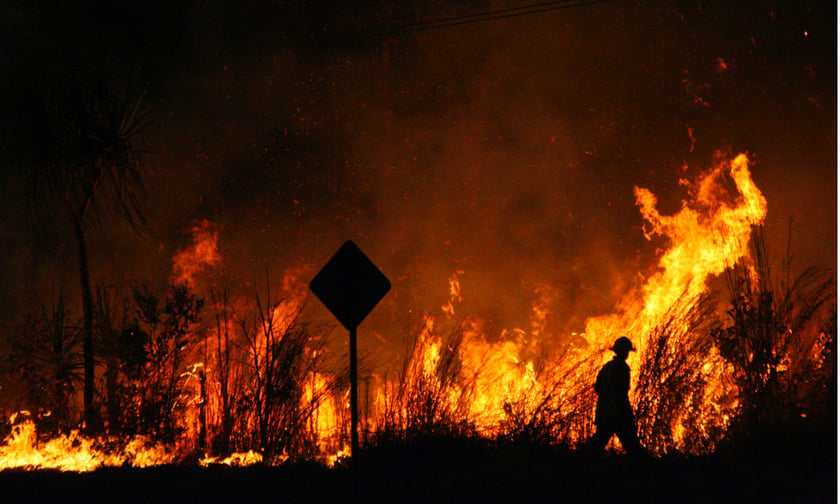
New data from the January 2026 Victorian bushfires has given the Australian insurance industry its clearest evidence yet that postcode-level risk assessments leave a material gap in how bushfire vulnerability is measured – and how premiums are priced.
Geospatial imagery company Nearmap found that properties it had pre-rated as most vulnerable to bushfire were 3.6 times more likely to be destroyed or badly damaged in the January fires than those it rated least vulnerable, according to analysis published September 10. Among properties near the fire front, 6.6% of the most vulnerable homes were destroyed or badly damaged, against 1.8% of those in the least vulnerable group.
Those results came from within the same fire zones. Proximity to the fire front alone did not determine outcomes. Individual property characteristics did.
Nearmap examined 36,012 buildings within 500 metres of a structure classified as destroyed or badly damaged. Of those, 2,980 were in one of those categories themselves. Using aerial imagery captured before and after the fires, Nearmap compared its Bushfire Vulnerability Score against actual post-fire outcomes. Losses concentrated among the properties it had flagged as highest risk before the fires began.
The analysis also found a consistent link between defensible space – cleared ground around a structure – and survival. Among homes that were not destroyed, those within 100 metres of a destroyed building had more cleared ground across every zone assessed.
Nearmap CEO Andy Watt said the variation in outcomes within a single event is the finding the industry should focus on. “The challenge is not simply understanding that a postcode or corridor is exposed to bushfire. It’s understanding how that risk varies from one property to the next. When insurers can see property condition, vegetation, and defensible space at scale, they can move from a broad view of hazard to a much more precise understanding of where vulnerability is concentrated,” Watt said.
The fires burned across 18 local government areas between January 7 and 13, 2026. The Insurance Council of Australia (ICA) declared a Significant Event on January 11 and escalated that to an Insurance Catastrophe on January 16. Catastrophe data provider PERILS revised its insured loss estimate to $810 million in April 2026. More than 4,700 claims were lodged by May 2026 across household, commercial property, and motor lines.
That context matters for understanding why the cost of bushfire claims is a distinct underwriting problem. NRMA Insurance’s internal claims data, published in its Wild Weather Tracker in June 2026, showed the average bushfire claim in New South Wales costs 69% more than the next most expensive peril, flood.
NRMA meteorologist Peter Chan said the boundary of that risk is also shifting. “Bushfire risk is increasing in Australia as climate change drives hotter, drier conditions and communities expand into the bushfire-urban boundary, placing more people and homes at greater risk,” Chan said.
Postcode-level pricing remains the dominant mechanism across much of the Australian home insurance market. It does not distinguish between a property with cleared surrounds and maintained structures and one that has not addressed its exposure. A broker who can identify and document lower-risk property characteristics is in a stronger position at renewal – for clients who may currently be paying premiums that do not reflect their actual risk profile.
National Insurance Brokers Association of Australia (NIBA) CEO Richard Klipin has described climate risk as a front-line challenge for the broking profession. “APRA’s report underscores what brokers have been experiencing on the ground,” Klipin said, responding to the Australian Prudential Regulation Authority’s (APRA) March 2026 Insurance Climate Vulnerability Assessment (CVA). “Climate risk is already putting pressure on affordability, increasing underinsurance, and threatening the ability of too many Australians to protect their home,” Klipin said.
A pricing mechanism to act on already exists for residential clients. As of July 2026, approximately half the Australian home insurance market – NRMA Insurance, Suncorp, NAB Insurance (underwritten by Allianz), and CommBank Insurance (provided by Hollard) – recognises certified ratings from the Resilient Building Council’s (RBC) Bushfire Resilience Rating scheme, according to a joint government media release from the National Emergency Management Agency (NEMA).
Households complete a self-assessment through a free RBC app. Once upgrades are verified by an RBC accredited certifier, a Resilience Rating Certificate can be submitted to participating insurers. NEMA confirmed participating insurers cut the bushfire risk component of premiums by up to 60%, with total premium reductions of 5% to 21%. The RBC estimated annual savings for some households at $840.
ICA CEO Andrew Hall said the scheme demonstrates what property-level data can achieve. "The Resilience Ratings system is an Australian innovation now being studied globally as proof that household-level risk reduction can help improve insurance affordability. This free program is vital in helping Australians be more prepared before the inevitable next disaster strikes,” Hall said.
Allianz Australia managing director Richard Feledy, whose company participates through NAB Insurance, said the scheme addresses a gap in how clients understand their exposure. "Allianz is proud to support initiatives that empower customers to better understand their exposure to risk and take practical steps to strengthen resilience. Through our partnership with NAB on the Bushfire Resilience Rating app, we are helping Australians to make their homes safer and more resilient to extreme weather events like bushfires,” Feledy said.
One boundary brokers should be clear on: the RBC scheme covers detached residential dwellings only. No equivalent certified rating pathway currently exists for commercial or strata properties.
APRA’s March 2026 Insurance Climate Vulnerability Assessment found home insurance premiums rose at an annual average of 7.2% between 2010 and 2025, against wage growth of 3.1%. APRA estimated around one in seven Australian houses are currently uninsured – a share it projects could reach one in four by 2050.
With an active El Niño and seasonal forecasts pointing to elevated bushfire risk heading into spring and summer, Watt said property intelligence is becoming operationally necessary, not just analytically useful. “The insurers that can see their properties clearly before an event, and assess what has changed when an event occurs, are better positioned to make informed decisions across underwriting, prevention, and claims. Property intelligence gives insurers that visibility at the level where risk actually exists – the property,” he said.