Australian life insurers recorded their smallest customer impact from code breaches since the Life Insurance Code of Practice took effect in 2016, according to the Life Insurance Code Compliance Committee’s (Life CCC) 2024-25 Annual Industry Data and Compliance Report – though the same report identified rising breaches in income protection payment delays and early claims communication, signalling that progress across the industry remains uneven.
Separate regulatory data published by the Australian Prudential Regulation Authority (APRA) and the Australian Securities and Investments Commission (ASIC) provides a quantitative backdrop to the conduct issues the Life CCC has flagged. The APRA and ASIC claims and dispute statistics, covering 13 direct life insurers for the 12 months to Dec. 31, 2025, point to entrenched difficulties in claims processing and dispute management that continue to draw scrutiny from oversight agencies. The two publications describe an industry where headline breach metrics are moving in one direction while the underlying mechanics of claims – speed, communication, and dispute resolution – remain under pressure.
Two areas drew particular attention in the Life CCC's report: delays in income protection benefit payments and failures to provide claimants with adequate information at the start of the claims process. Breaches in both categories increased over the reporting period. The Life CCC said some insurers are not consistently meeting the code’s requirements for initiating contact with customers and keeping them informed once a claim is lodged.
Jan McClelland AM, chair of the Life CCC, said the stakes for affected customers are high. “Income protection benefits are designed to provide financial stability at a time when customers may be at their most vulnerable. Delayed payments can place additional strain on people who are already dealing with significant personal and financial challenges,” McClelland said. On communication, McClelland said early clarity shapes the entire claims experience. “When customers don’t receive timely and clear information at the start of a claim, it can create uncertainty at an already stressful time. Clear communication helps people understand what to expect and supports better outcomes throughout the claims process,” she said.
Read next: APRA and ASIC map 2025 life claims and disputes
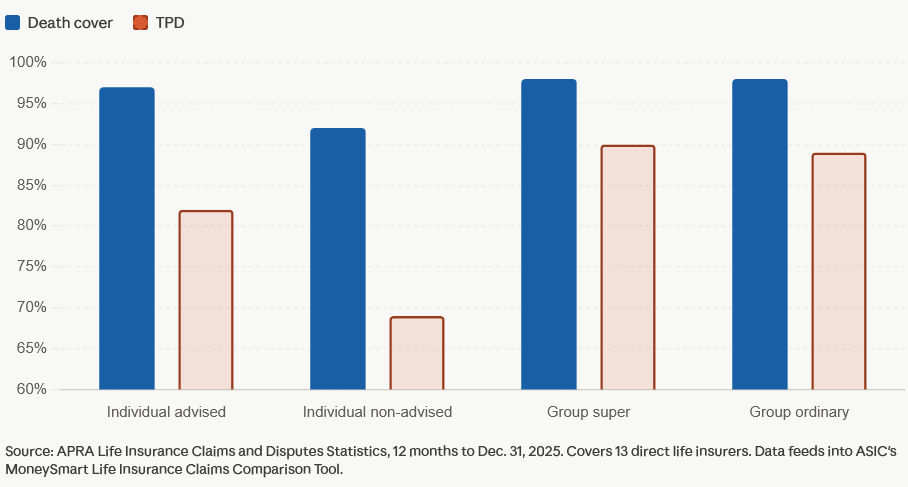
The APRA and ASIC claims and disputes dataset covers acceptance rates, processing durations, dispute lodgement ratios, and market share across individual advised, individual non-advised, group superannuation, and group ordinary channels. The figures feed into ASIC’s MoneySmart Life Insurance Claims Comparison Tool. Across death cover, acceptance rates were high in most channels. Life insurers admitted 97% of individual advised death claims, 92% of individual non-advised claims, and 98% of claims in both group superannuation and group ordinary business. TPD acceptance rates were lower and showed wider variation by distribution channel. Individual advised TPD business recorded an 82% admittance rate, compared with 69% for individual non-advised policies. Group business showed higher rates, with 90% of group super and 89% of group ordinary TPD claims admitted.
Processing timeframes diverged sharply by product. Death claims moved through the system quickly – 76% were finalised within two weeks and 93% within two months, with an estimated average duration of 1.0 month. TPD claims took considerably longer. Only 22% were completed within two weeks and 50% within two months. A further 34% took more than two months up to six months, 12% took more than six months up to 12 months, and 4% extended beyond 12 months. The estimated average duration for TPD claims was 3.8 months. Disability income insurance claims were processed faster on average, with 52% finalised in two weeks and an average duration of 1.4 months.
Read next: APRA reviews three life insurance standards in APRA Connect transition
The Life CCC reported that while aggregate complaints fell, those specifically relating to TPD have risen over consecutive years. The committee attributed this in part to the nature of TPD assessments, which frequently involve complex medical and occupational questions and are lodged under conditions of significant financial pressure. McClelland said that trend warrants a closer look at process design. “These claims are often made in difficult and complex circumstances and customers need confidence that insurers’ processes will support timely, consistent, and well-communicated outcomes. Understanding the drivers of dissatisfaction is an important step in improving both processes and customer experience,” McClelland said.
The APRA and ASIC figures quantify the dispute burden more precisely. Dispute lodgement ratios for disability income insurance were the highest of all cover types reported: 315 per 100,000 lives insured for individual advised business and 446 for individual non-advised. By comparison, TPD dispute lodgement ratios were 106 for individual advised and 67 for non-advised policies, while death cover reported lower dispute ratios of 14 for individual advised and 28 for individual non-advised. When disputes were resolved, most resulted in insurers holding their original position. For cases where original decisions were overturned, the reasons differed by product type. In TPD, 31% of reversals were recorded as the original outcome being incorrect, and 58% resulted from additional information received after the initial determination. For trauma claims, 71% of reversals were attributed to the original outcome being incorrect and 18% to additional information.
The Life CCC acknowledged the drop in customers affected by breaches but framed it as a baseline, not a conclusion. “It is pleasing to see fewer customers affected by breaches this year, and we hope to see that improvement continue. However, insurers must ensure their systems, controls, and oversight are strong enough to prevent repeat issues and support reliable outcomes for customers,” McClelland said. The committee said findings from its 2024-25 monitoring and inquiry activities will feed into the upcoming independent review of the Life Insurance Code of Practice – a process that will set the terms of conduct expectations for the sector in the years ahead.