New Zealand brokers have a narrowing window to review client cover – and the science says conditions will keep deteriorating.
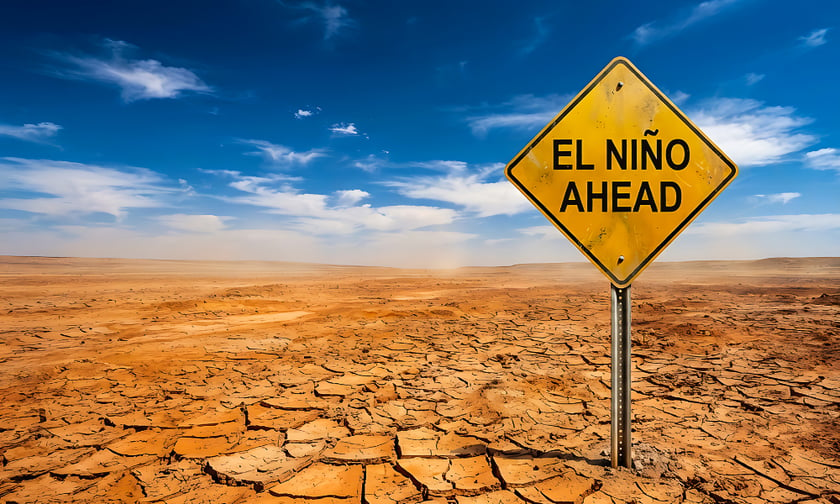
The World Meteorological Organisation (WMO) confirmed in its latest update that an intensifying El Niño is already generating droughts and floods across the Pacific. The weather event is expected to peak towards the end of 2026 and continue well into 2027, according to RNZ.
That extended timeline carries consequences for brokers managing weather-exposed client portfolios across New Zealand and the wider Pacific.
Earth Sciences New Zealand (ESNZ) declared the current El Niño on July 2, 2026, classifying it as “very strong” – defined as sea surface temperatures running 2°C or more above the usual average in the Niño 3.4 region of the Pacific. Spring 2026 is expected to be drier than normal for northern and eastern parts of both islands, with the greatest odds for dryness over northern and eastern parts of the North Island.
An active, stormy spring is expected for the western and lower South Island, driven by frequent fronts and low-pressure systems. At times, strong wind will drive unusually warm weather, with eastern parts of both islands likely to see spikes in high temperatures – which, combined with dryness, will result in increased wildfire risk. Canterbury, Otago, and Marlborough are identified as regions of particular concern. A return to neutral conditions is not expected before April to May 2027.
For brokers, that duration matters. An El Niño running across two full policy years creates compounding exposure that event-by-event modelling does not readily capture. What does sustained dryness do to agricultural clients’ sum insured assumptions? Are clients in eastern regions adequately covered for wildfire as conditions worsen?
The El Niño forecast arrives against a backdrop of elevated weather-related losses. IAG’s Wild Weather Tracker for the 12 months to the end of February 2026 recorded 46 storms, up from 29 the previous year, and 33,174 storm-related claims across IAG brands – a 256% year-on-year increase from 9,324 claims. One in every eight days experienced a damaging storm, compared with one in 19 days over the previous 15 years.
New Zealand experienced three notable natural hazard events in 2025, resulting in approximately $120 million in insured losses – two severe convective storms (SCS) and Ex-Cyclone Tam in April, according to Aon’s 2026 Climate and Catastrophe Insight report. “From a New Zealand perspective, the past two years have been relatively benign in terms of insured losses. That context reinforces the importance of preparedness as global loss volatility continues,” said James Knight, head of Asia-Pacific view of risk advisory for Aon.
That context matters heading into an El Niño cycle. The cost baseline extends beyond discrete events. Research commissioned by the New Zealand Infrastructure Commission – published in July 2026 by Earth Sciences New Zealand – found that under 2025 conditions, total annual inland flooding costs were already estimated at an average $471.9 million, covering private buildings, water infrastructure, local roads, and central roads.
Under a high-emissions scenario, annual inland flood damage to infrastructure alone is projected to grow from around $300 million in 2025 to $465 million by 2075, with coastal flooding losses expected to nearly double from $165 million to $325 million over the same period. That trajectory directly shapes how brokers should frame long-term risk conversations with clients in flood-exposed areas.
The Insurance Council of New Zealand (ICNZ) has been direct about what the claims trajectory means for the market. “The commission’s message is clear. New Zealand must act to get ahead of growing climate risk,” ICNZ chief executive Kris Faafoi said in May 2026, responding to the Climate Change Commission’s 2026 National Climate Change Risk Assessment.
ICNZ polling found 87% of New Zealanders support taking action before disaster strikes to protect communities from natural hazards.
Faafoi has also flagged the market-level consequence of inaction: without investment in adaptation, the affordability and availability of cover are at risk – a direct concern for brokers trying to maintain access to insurance for clients in high-exposure areas.
The WMO’s warning extends beyond New Zealand’s coastline. Several Pacific nations are already experiencing severe drought conditions, with smoke from Indonesian forest fires crossing into Papua New Guinea and Malaysia, according to RNZ.
The Pacific Catastrophe Risk Insurance Company (PCRIC) has already activated drought payouts for Tonga this year. Tonga received a TOP$114,168 parametric insurance payout from PCRIC to support early drought preparedness in the Niuas following below-average rainfall recorded in May 2026 – the second payout triggered under Tonga’s drought policy, according to Talanoa o Tonga.
Tuvalu and the Republic of the Marshall Islands have declared states of emergency, and for the first time since COVID, the Pacific Islands Forum has invoked the region’s emergency response mechanism in anticipation of a crisis, according to the Council on Strategic Risks.
For New Zealand brokers with clients operating across the Pacific – in trade, logistics, agriculture, and development – these are live exposures, not a future scenario.
UN Secretary-General António Guterres framed the risk plainly: “The race now is between rising risks and our commitment to take climate action and protect people. We must win that race.”
The practical implication is client-level and immediate. The elevated loss environment could affect premiums even for businesses with no recent claims history, as insurance markets respond to a global weather trend rather than individual loss performance.
Clients who have not reviewed agricultural cover, business interruption limits, or wildfire exposure since the last significant El Niño cycle may be carrying gaps they are not aware of.
Earth Sciences New Zealand publishes monthly Seasonal Climate Outlook updates as the event develops. Each release covers regional rainfall and temperature probabilities – a ready-made checklist brokers can use to track which client segments face the most acute conditions in the months ahead.