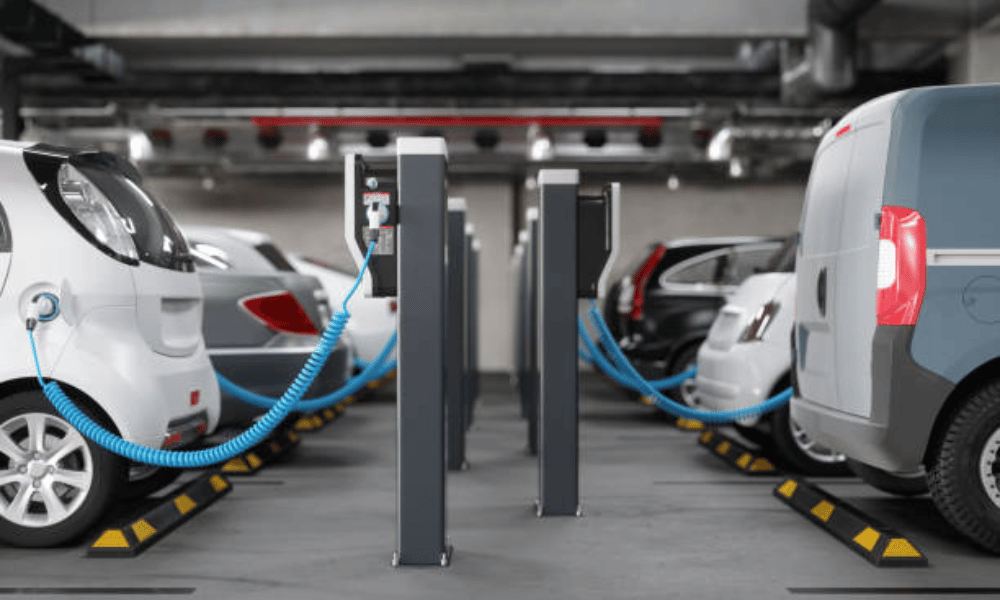
The UK government is expected to announce this week a significant reduction in its electric vehicle sales targets, according to the BBC. That move will ease immediate pressure on carmakers but leave commercial motor underwriters and fleet brokers managing a prolonged period of uncertainty they have been navigating for years.
Under the current Zero Emission Vehicle (ZEV) mandate, 80% of new cars sold in the UK must be fully electric by 2030. The Financial Times reported, citing government sources, that the Burnham government is leaning towards a 60% target, with the Business department having pushed for as low as 50% to protect UK car manufacturing from the pressures of Chinese competition and US tariffs.
The 2030 deadline for phasing out purely petrol and diesel car sales is expected to remain unchanged, with a formal government decision expected imminently.
Commercial motor insurers have been absorbing rising EV claims costs against a backdrop of weak repair infrastructure and limited actuarial data. Thatcham Research, the automotive risk intelligence firm whose findings underpin the Association of British Insurers’ (ABI) insurance group ratings, has confirmed that EV repairs cost approximately 25% more than their petrol equivalents and take 14% longer to complete - findings the organisation first published in a report funded by Innovate UK. Those gaps are driven by battery diagnostics, specialist labour shortages, and the high cost of replacement parts.
Research from FWD Consulting, published in December 2025, found that UK businesses face more than £461 million annually in EV write-off costs, with roughly one in five EVs being declared a total loss after relatively minor collisions. The firm attributed this largely to the absence of a national EV repair capability that can assess battery damage accurately and economically, with collision write-offs rising at a pace that neither fleets nor insurers can absorb indefinitely.
The commercial sector, however, has been slow to adapt. A Broker Barometer survey conducted by Direct Commercial Limited (DCL) between June and July 2025, polling 64 UK brokers in the commercial motor market, found that only 13% believed their clients were adapting well to electric or hybrid vehicles, and just 9% said clients appeared prepared for incoming sustainability rules including the ZEV mandate.
The same survey found reduced underwriting capacity for certain EV models, with high battery costs, complex claims handling and elevated total-loss exposure making some vehicles difficult to place.
A reduced ZEV target does not resolve the insurance problem. Rather, it extends the timeline over which that problem must be managed. Fleet operators who have already committed to electrification will continue transitioning regardless of where the mandate lands, while those who have been holding back will have further justification to do so.
The result is a prolonged mixed-fleet period: a combination of internal combustion engine vehicles and EVs operating under the same policy, each requiring different risk assessment, different repair protocols, and in many cases different premium structures.
That complexity is already a live concern for underwriters. AXA XL’s UK and Lloyd’s business has moved to address the data gap directly, partnering with EV data platform Gecko Risk in October 2026 to improve how it assesses commercial EV risk. That is a signal of how far the market still has to travel in building the claims history that reliable underwriting requires. Only around 20% of UK technicians are currently qualified to work on high-voltage EV systems, according to the Institute of the Motor Industry, compounding the write-off risk at the point of claim.
The Thatcham Research EV Blueprint, published in March 2026, sets out eight requirements directed at vehicle manufacturers, battery producers, repairers and insurers to create more economically viable repair outcomes across the EV lifecycle. Its existence reflects the same underlying reality: the infrastructure needed to underwrite EV fleets confidently does not yet exist at scale, and policy decisions in Westminster do not accelerate its arrival.
Fleet renewal planning operates years in advance, and the mandate’s annual targets - 33% for 2026, 38% for 2027, 52% for 2028 - have been a reference point for fleet managers deciding when to accelerate vehicle replacement programmes. A change to those targets removes some of the regulatory urgency, but does not remove the fleet operator’s exposure to the insurance cost gap that electrification brings.
Brokers advising commercial motor clients in this environment need to understand that the transition risk does not track the mandate’s headline percentage. The gap between what the government requires and what the repair market can deliver is where claims complexity lives, and that gap is unlikely to narrow materially before the next round of fleet renewals.