The London marine war market has rarely had to hold two such contradictory positions at once. In the Middle East Gulf, where claims are still mounting, underwriters are cutting prices to win business. In the Black Sea, prices have gone through the roof.
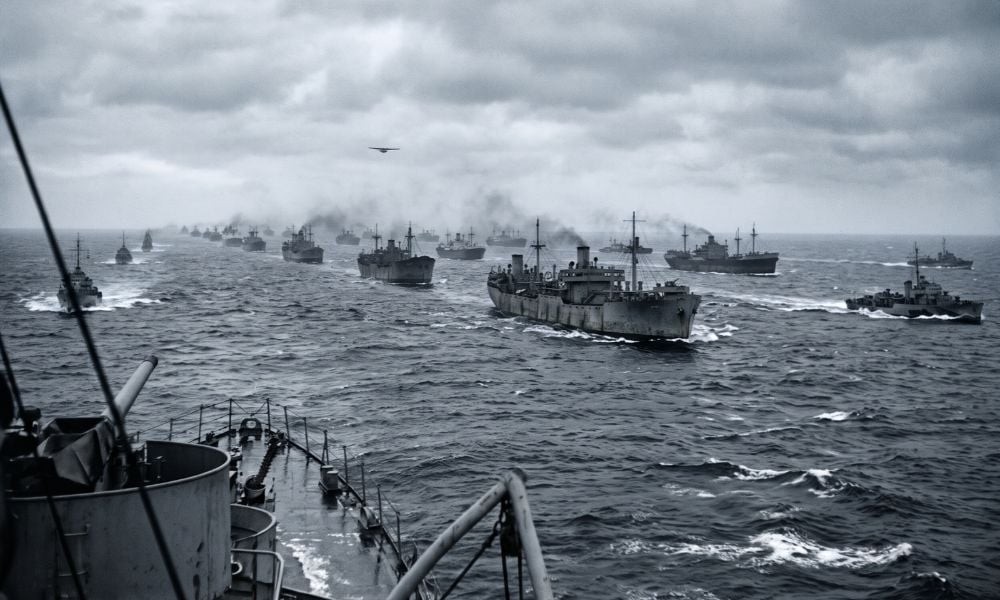
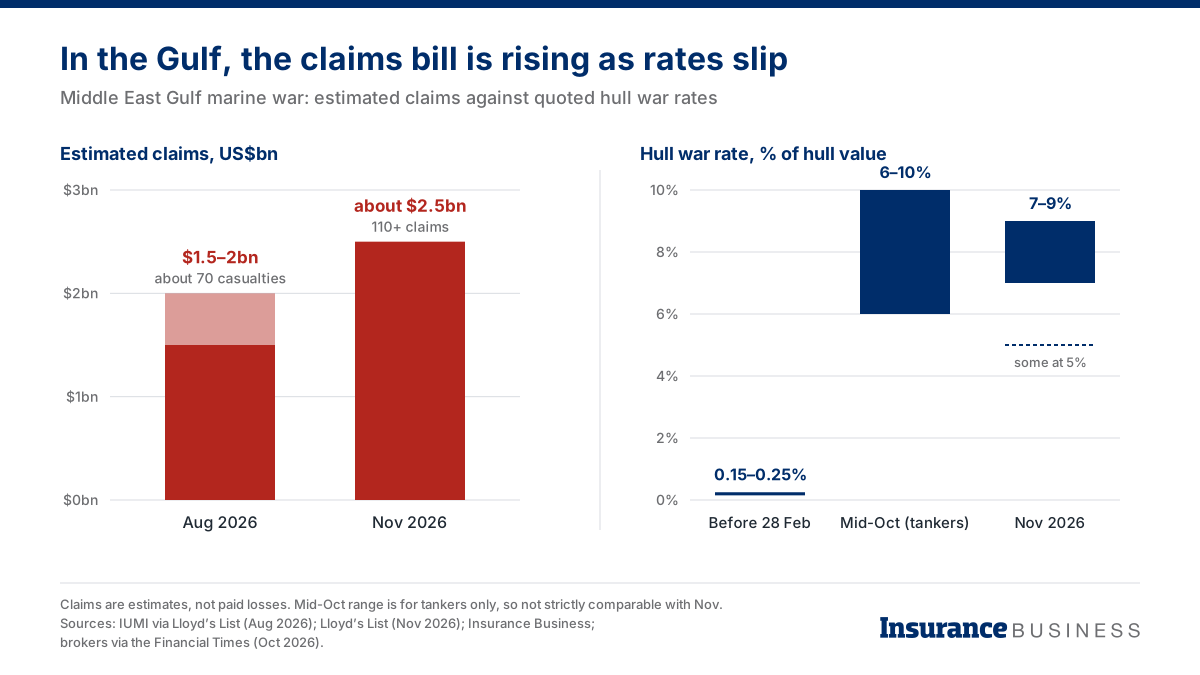
Lloyd’s List puts the extremes side by side. Gulf rates have eased to 7–9%, with some cover written as low as 5%, despite more than 110 claims and estimated payouts of around US$2.5 billion. Meanwhile Black Sea hull war premiums have climbed as high as 20%, roughly four times tanker war levels and well above Second World War benchmarks. The publication reckons that is about ten times what Atlantic convoys paid.
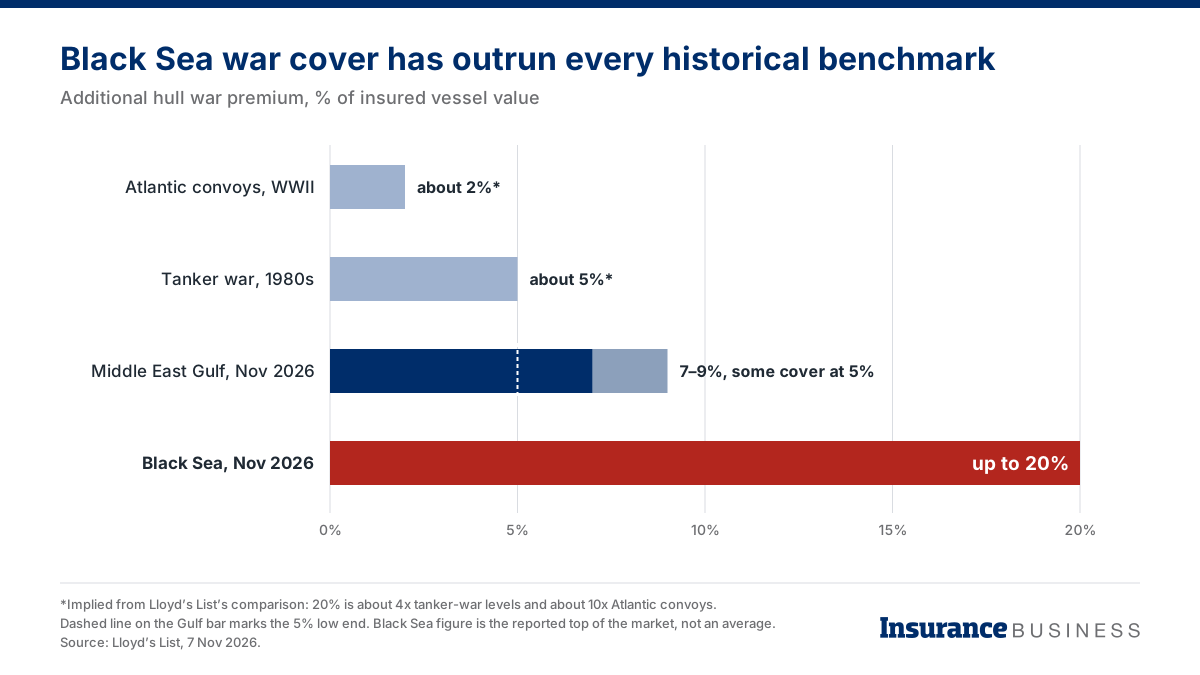
To put the Black Sea figure in pounds and pence: a vessel insured for US$50 million would, at 20%, attract about US$10 million in additional premium for one exposure. Owners can pass some of that on to charterers. A rate like that also makes a lot of voyages simply uneconomic.
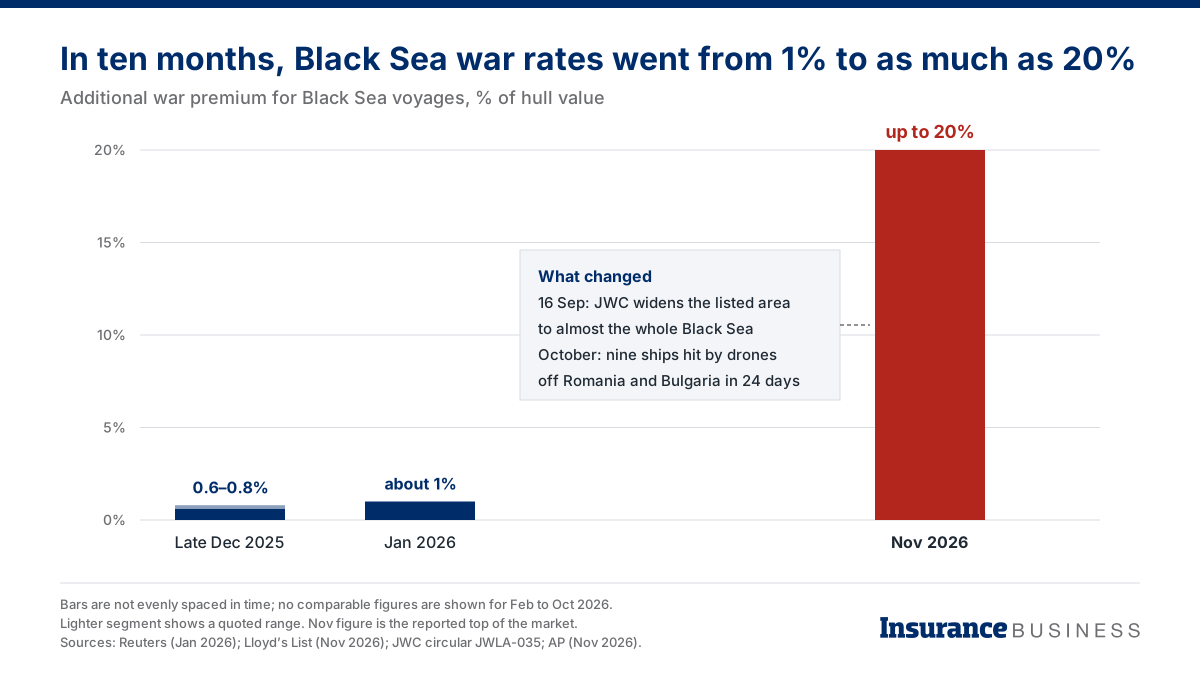
At the turn of the year this was still a market measured in fractions of a percent. War cover for Black Sea port calls rose to about 1% of hull value in January, from 0.6–0.8% in late December.
The first big shift came from London itself. The Joint War Committee, a joint committee of the LMA and the IUA, issued circular JWLA-035 on 16 September. It extended the listed area across most of the Black Sea, leaving out only the territorial waters of Turkey, Bulgaria, Romania and Georgia.
October showed us all why. Over 24 days, drones hit nine cargo ships and tankers near the Bulgarian and Romanian coasts, and at least 30 seafarers were confirmed dead or reported missing. The Khoryv, a Comoros-flagged carrier, capsized and sank about 13 nautical miles off Constanta on 23 October. Maritime security firm Ambrey counts 696 security events in the Western Black Sea, around 537 of them in Ukrainian waters.
Read next: Hormuz sinking hands marine war underwriters another total loss as attacks surge
Diplomatic pressure is building too. An October submission to the International Maritime Organization was backed by 35 governments and the European Commission, the UK among them, alongside Black Sea states Bulgaria, Romania and Georgia. NATO has said it will deploy maritime patrol aircraft, radars and drones to strengthen its eastern flank in the Black Sea.
For shipping clients, though, the biggest change may be contractual rather than financial. Two analysts told Lloyd’s List, off the record, that they had been approached about potential charterparty disputes, with owners seeking to refuse charterers’ orders to Romanian and Bulgarian ports. Ambrey reports that some masters and crew are now reluctant to sail to either country. That puts the war risk clauses in time and voyage charters, many of them BIMCO forms, under scrutiny. Those clauses decide when an owner can say no and who pays for the extra cover.
The commercial fallout is already large. Ukraine suspended its Black Sea port operations in late July, rerouting cargo via Danube ports and Romania’s Sulina Canal. Russian grain exports through the Black Sea and Sea of Azov dropped to 0.3 million tonnes in September, from 4.74 million tonnes a year before.
The Gulf story is going in the opposite direction. The reason for it isn’t a cessation in hostilities - attacks there haven’t stopped: UK Maritime Trade Operations reports show more than 20 vessels, mostly tankers, attacked in Hormuz, the Persian Gulf and the Gulf of Oman since 1 October. The loss estimates have also grown. In August, IUMI director general Lars Lange estimated US$1.5–2 billion of claims from about 70 casualties.
The rate cycle has swung hard, though. Marsh global head of marine Marcus Baker put the pre-war rate at about 0.25%. As recently as mid-October, brokers were quoting additional premiums of 6–10% of hull value for Gulf tankers.
Read next: Washington’s $40 billion Hormuz insurance fix: zero takers
Two forces are pulling rates down. The first is capacity, much of it raised in London. Beazley put together a US$1 billion marine war consortium at Lloyd’s in April, split equally between hull war and cargo war, with backing from Lloyd’s syndicates and London company market insurers. A further Lloyd’s facility, announced in June, offers up to US$200 million each for hull and P&I risks, plus US$200 million of cargo capacity for Hormuz transits.
The second is competition on terms. Some underwriters have introduced no-claims bonuses for Hormuz voyages, reportedly returning as much as half the premium to owners whose ships get through without incident. That makes headline rates look higher than what owners actually pay.
Read next: The Hormuz war risk market isn’t printing money. Here is what it is doing
Lloyd’s has so far played down the balance-sheet risk. In a 14 May market message, the Corporation said it did not expect the conflict to become a capital event. Lange’s view is that softening carries its own danger: he argues that war risk can only stay insurable if it is priced well above peacetime levels.
The reinsurance market is showing the strain. According to Marsh Re’s Global Specialties 2026 Market Update, Middle East losses in the war, terrorism and political violence class are above US$2 billion, against annual gross premiums of roughly US$2.5 billion. That could make this the class’s first loss-making year. London carriers will feel that when they come to renew their own protection at 1 January.
Read next: War risk reinsurance posts first loss since 9/11
For brokers placing shipping and commodity business, the practical point is that Black Sea cover now moves on a daily cycle. Calls at Russian or Ukrainian ports require additional war cover, normally written for seven days, with terms now reviewed every 24 hours. Budgets and charterparty wording both need to allow for the price changing mid-voyage.
London has decided the Gulf is a risk it can price and compete for. In the Black Sea, it’s the owners who are now deciding whether any price is worth paying.