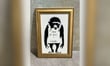
Photo from: David Henty
At an auction viewing, the painting is not what buyers study longest. According to David Henty, who forged works for years before turning to copies sold openly under his own name, people glance at the picture, check the signature, then turn it over and spend more time on the labels, stamps and chalk marks on the back.
"They're more interested in the history of the painting, which is the back," he said.
Asked whether the painting, the paperwork or the story does most to persuade buyers and experts, he said: "Well, the painting is probably the last thing."
That documented history helps underpin the valuation on which a fine art policy is written. But an insurer accepting the value does not mean it is guaranteeing the attribution.
Henty said paperwork is the easier part of the job. In his forging years, a printer produced old gallery labels, which he aged in the oven before typing in the artist, subject and date on an old typewriter, and a cooperative local auctioneer could add auction stamps. Once a work has an auction history, he said, that history travels with it.
"You're not trying to say it is, but there's enough stuff there for you to think it probably is," he said.
Scientific testing narrows the field, but Henty said forgers study the cases where analysis catches a fake and build the lesson into the next work.
"So now we reverse engineer it," he said.
Full technical examination is also costly, he added, and not every buyer pays for it. AI could now produce supporting material too, he said, such as a photograph of an artist handing over a work.
Maurice Taylor was jailed for three years in 2009 for fraud after tricking Bonhams into believing that a work by Arthur Delaney, painted in Lowry's style, was genuine. He then used the Bonhams valuation to persuade an art dealer to buy it, and was later ordered to repay more than £1.1m.
Rob Starr, who has spent 35 years in insurance, said the checks on clients' art he insured in the past went no further than the documents.
"What have you got to show me? And they'll send me what they've got, and that's it. I'm not digging any further," he said.
Starr, a friend of Henty's, has written a crime novel about art forgery in which Henty appears, and said their time together had taught him that "nothing is likely to be as it seems".
Brokers should now ask what tests have been carried out on a valuable work, and see the paperwork, before it goes to an insurer, he said. "This is a million pound. It should be tested."
Robert Read, head of art and private clients at Hiscox, said authenticity comes up in claims "occasionally as opposed to very often".
"We aren't doing the valuations and the authenticity. We rely on third parties to do that," he said.
Underwriters look at who carried out the valuation and accept it if the source is trusted, Read said. Doubt sits mainly with older works that are poorly documented or have gaps in their provenance, while a piece bought directly from a living artist's studio raises few questions.
"From our point of view, as long as we've got an agreed value and we've accepted it, that's how we'll treat it."
The exposure is not concentrated in masterpieces. Artists with a simpler style, such as LS Lowry, are easier to copy, Read said, and works valued in the thousands or low tens of thousands escape the scrutiny a multimillion-pound attribution would attract. The result, he said, is "a lot of low-level fakes".
Where fakes do come to light, it is often after a claim, when a damaged work is examined closely.
A standard fine art policy does not cover a work turning out to be fake, Read said. Separate fakes and forgeries cover is available, but few clients buy it. Those who do tend to be cautious buyers who want protection for two or three years after a purchase.
If an attribution is withdrawn, that is a material fact the policyholder must disclose, he said. The sum insured would come down and a return premium would follow, but the original value would no longer stand.
In 2022, the FBI seized 25 works presented as Basquiats from the Orlando Museum of Art, where their owners had been added to the museum’s fine art policy for the loan. The owners claimed $19.7m for a total loss. A former auctioneer, Michael Barzman, admitted in a 2023 plea deal that he and an accomplice had created the works.
The insurers, Liberty Mutual and Great American, sought a declaratory judgment, alleging the owners were added on the strength of misrepresentations about authenticity and value, and arguing there was no loss because the paintings had not been damaged or destroyed. The owners denied the allegations and said the insurers had not checked authenticity when they added them. In February 2025, a federal judge sent the case back to the Florida state court where it was first filed.
The sharper exposure, Read said, falls on the auction houses, dealers and art advisers who sold or recommended the work, who may face professional negligence claims. More of those businesses are now buying professional indemnity cover for that risk, he said.
In London, Sotheby’s refunded a US collector who had paid $10.75m in a 2011 private sale for a portrait attributed to Frans Hals, after concluding the work was a forgery. The dealer Mark Weiss, who maintains the portrait is genuine, and his company agreed to pay Sotheby’s $4.2m in a 2019 settlement without any admission of liability.
While authenticity cover remains a niche purchase, that gap rarely surfaces until a claim. A collector can have an agreed value on a policy and still carry the risk that the artist's name is wrong.