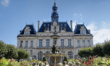
A train station in the southern German city of Augsburg was completely shut down on Wednesday morning after an explosion and the discovery of a second suspicious object, in an incident that follows Germany's formal accusation a day earlier that Russia was behind a drone attack on Leipzig airport.
Police said an unidentified object detonated near Augsburg's main station at around 3:15am local time. Two people sustained minor injuries, reported as blast-related acoustic trauma, and nearby windows were shattered by the force of the explosion. A second object was found close by and did not detonate; explosives specialists from Bavaria's state criminal police office were sent to examine it.
Both the station building and platforms were closed, with services diverted and road and public transport in the surrounding area disrupted. Augsburg, a city of around 308,000 people roughly 48 miles northwest of Munich, saw police cordon off several streets near the station while the investigation got under way. As of Wednesday morning, authorities had not said what caused the blast or whether it was connected to any other incident.
The Augsburg blast follows a tense 24 hours in Germany's relationship with Moscow. On Tuesday, interior minister Alexander Dobrindt formally blamed Russia for an attempted drone attack on Leipzig airport last month, describing it as part of a pattern of "daily hybrid warfare" against Germany and the first time Berlin has formally attributed an attempted attack on a German airport to Moscow.
That earlier incident, on August 4, involved a quadcopter drone carrying roughly 800 grams of the explosive PETN striking the wing of an Antonov Airlines An-124 cargo plane on the tarmac - the device failed to detonate. The aircraft was part of NATO's Strategic Airlift International Solution logistics chain, which uses Leipzig/Halle as a hub for heavy freight deliveries to NATO's eastern flank. A second drone collision involving a Boeing 757 freighter that had been sent around after the airport closed was reported the same night. German officials said it took weeks of investigation before they were confident enough in the evidence, including intelligence findings and the pattern of the operation, to attribute it to agents acting on behalf of Russian state entities.
In response, foreign minister Johann Wadephul announced Germany would close the Russian consulate-general in Bonn on September 18 and end the contract for Russia House, a Russian state-backed cultural institution in Berlin. The Russian ambassador was also summoned for a formal diplomatic reprimand. Moscow's embassy in Berlin dismissed the allegations as "unsubstantiated, absurd and contrary to common sense."
Germany also said it would tighten entry rules for Russian citizens and push, alongside EU partners, for further pressure on the network of ageing tankers Western governments say Russia uses to move oil in evasion of sanctions.
The response has since escalated to Brussels. Speaking ahead of a meeting of EU defence ministers in Ireland on Tuesday, the bloc's foreign policy chief Kaja Kallas said the Leipzig incident had "all the hallmarks of state-sponsored terrorism," adding that the question now facing European governments was what to do about it. The EU said it had separately summoned Russia's ambassador in Brussels over the incident.
Kallas noted the EU already has close to two dozen sanctions packages in place against Russia over its war in Ukraine, covering roughly 3,000 people and entities, including president Vladimir Putin and a number of Russian lawmakers and oligarchs. She said a further 1,600 listings targeting Russia's military-industrial complex were already in the pipeline, with more potentially to follow. Existing sanctions have primarily involved asset freezes and travel bans, and have extended to entities in Belarus, China, Iran and North Korea considered to be assisting Russia.
Despite the tougher language, EU and NATO member states have been notably cautious about steps that could be seen as escalatory against a nuclear-armed state, even as officials describe the nature of the attack as demanding a "new approach."
The incident has also become a flashpoint in domestic German politics. The AfD's lead candidate Ulrich Siegmund described the Leipzig attack as a "logical consequence" of Berlin's military support for Ukraine, and called for a return to trade relations with Moscow and an end to sanctions.
A Downing Street statement said Britain stood in "full solidarity" with Germany, condemning what it called an "egregious and reckless" act and backing Germany's response.
No link between Wednesday's Augsburg explosion and the Leipzig drone incident has been established, and German police had not commented on any connection as of Wednesday morning.