Commercial insurance buyers are still getting a good deal. Global rates fell an average of 6% in the second quarter of 2026, according to Marsh's latest Global Insurance Market Index - the eighth quarter in a row of declines, and a bigger drop than the 5% seen in Q1.
Property did most of the heavy lifting, down 12% globally. Casualty went the other way entirely, up 2%, thanks almost entirely to what's happening in the US.
Some context helps here. This is now the eighth straight quarter of decline, meaning the softening began around mid-2024, following roughly seven years of rate increases before that. The pattern is a familiar one in insurance cycles: insurers built up capital and profitability during the hard years, new entrants and reinsurers arrived to chase that profitability, and the resulting competition has been pushing prices back down ever since. The open question for the rest of 2026 is less whether rates keep falling and more how long insurers let that continue before underwriting discipline reasserts itself.
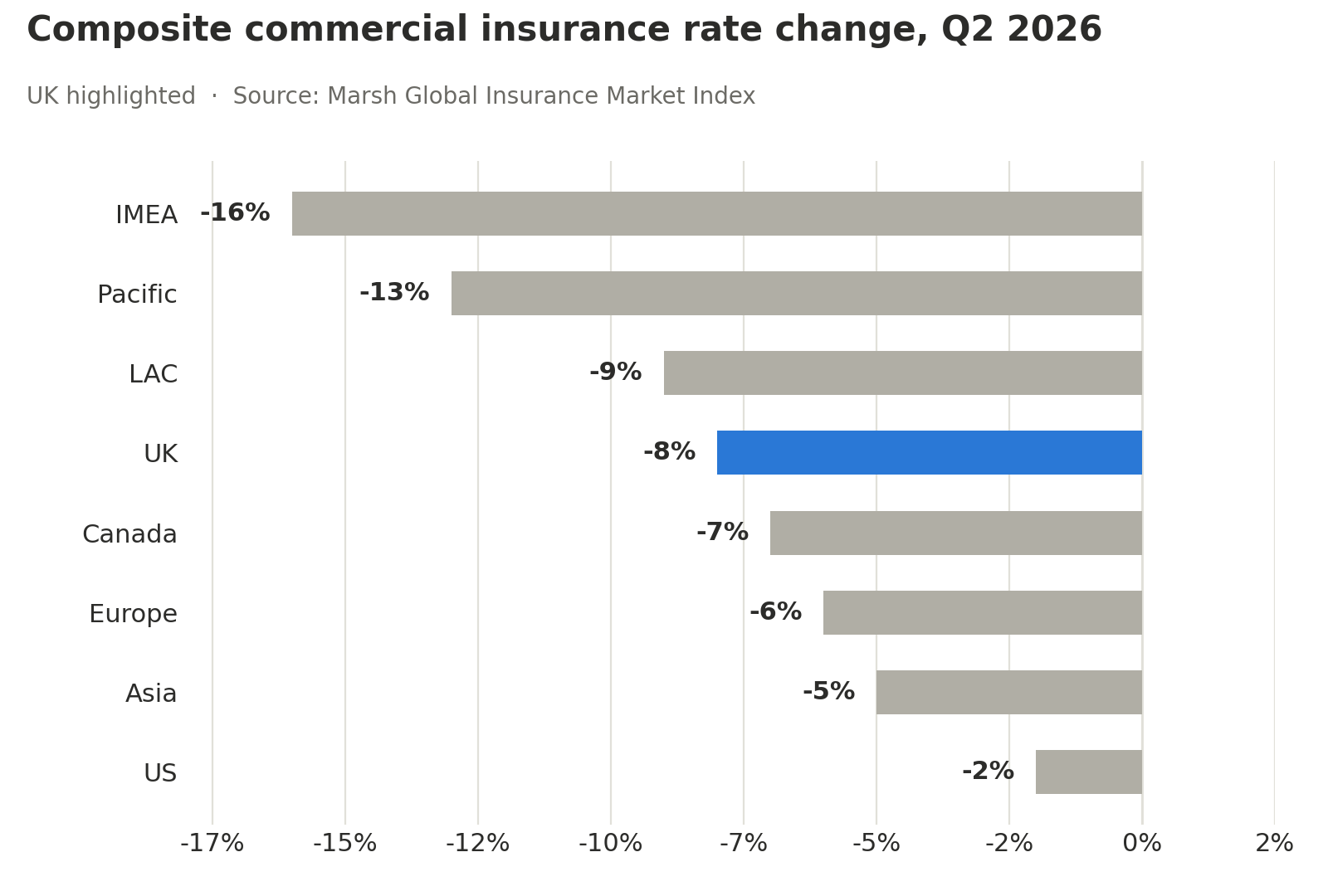
UK composite rates fell 8% in the quarter - a bit ahead of Canada (-7%), Europe (-6%) and Asia (-5%), but not as steep as the biggest fallers: India, the Middle East and Africa (-16%), the Pacific (-13%) and Latin America and the Caribbean (-9%). The US, as usual lately, saw the smallest movement of any region, down just 2%.
UK property rates dropped 11%, putting it among five regions with double-digit property declines, alongside IMEA (-19%), the Pacific (-15%), Latin America and the Caribbean (-14%) and the US (-13%).
Marsh points to the same ingredients as recent quarters: insurers are profitable, sitting on plenty of capital, paying less for reinsurance and earning more on investments - all of which is fuelling competition for business.
John Donnelly, Marsh's president of global placement, said price isn't the only lever insurers are pulling anymore: "In many markets, in addition to competing based on price, insurers are seeking to differentiate themselves through broader coverage, expanded policy terms, and lower deductibles. While economic uncertainty has led many buyers to retain premium savings, many organizations are also continuing to invest in alternative risk strategies, including captives."
For risk managers renewing programmes this year, the practical takeaway is that there's room to negotiate on more than headline premium. Donnelly's comments point to the same idea: with capacity abundant across property, financial lines and cyber, buyers who only push on price may be leaving broader coverage, lower deductibles or better terms on the table. That's a conversation to have directly with your broker ahead of renewal, rather than something likely to be offered automatically.
Marsh's outlook comes with a big caveat: the weather. "Current market conditions are likely to persist absent a severe northern hemisphere storm season or string of major natural catastrophes," Donnelly said, adding that this leaves buyers with "additional opportunities to improve coverage and refine program design" before things eventually turn.
UK brokers are already thinking about when that turn might come. A recent Ascend Insurance Holdings survey found every UK broker polled expects the current soft market to plateau by Q4 2026 - even though, for now, rates are still heading down. And as Insurance Business UK reported from BIBA 2026, the UK market's long run of rate declines is starting to raise its own questions about underinsurance and whether coverage is keeping pace as insurers compete harder for business.