For years, the defence of contact sport against brain-injury claims has leaned on one big unknown: nobody could say how common the damage really was. A study published in the US this week makes that argument harder to run, and UK insurers writing rugby, football and other contact sports should take note.
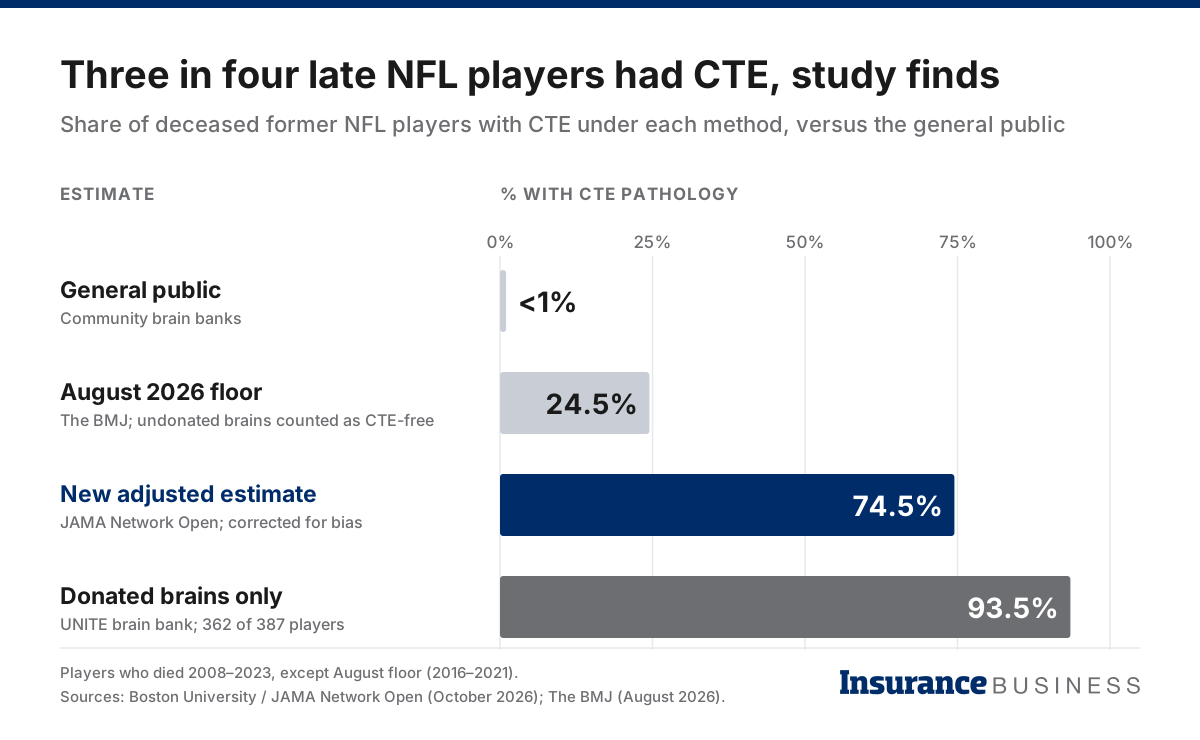
Researchers at Boston University estimated that 74.5% of the 2,362 former NFL players who died between 2008 and 2023 had chronic traumatic encephalopathy (CTE), the degenerative brain disease linked to repeated head impacts. That is roughly 1,760 men. The paper, published on 28 October in JAMA Network Open, is the first to put a population-wide figure on the disease in a professional football code rather than a count drawn only from donated brains.
American football is not rugby union, rugby league or association football, they have padding and helmets, but the timing of the report’s release could be awkward for the market here. In August, the High Court cleared more than 500 former rugby players to take their brain-injury claims against the sport's governing bodies towards trial.
CTE can only be confirmed by examining brain tissue after death, and brains tend to be donated by families who already suspected something was wrong. That pushes every brain-bank tally upwards.
The Boston team tackled that bias directly. Of 387 former NFL players examined through Boston University's UNITE brain bank, 362 (about 94%) had CTE, according to the university's summary of the study. The researchers then matched that against US National Death Index records for every player who died in the 16-year window, and found that players with cognitive decline were about five times more likely to have their brains donated. Correcting for that brought the estimate down to 74.5%. Fewer than 1% of brains in community brain banks show the disease.
The new figure is three times the minimum the same research group published in August in The BMJ. That study found CTE in at least 24.5% of NFL players who died between 2016 and 2021, but only by treating every undonated brain as disease-free, and it put the theoretical ceiling at 97.7%. The new model lands far closer to the top of that range than the bottom.
"An estimated 75 percent prevalence among NFL players who died over a 16-year period is concerning," said lead author Julia Gallini, a PhD candidate in biostatistics at Boston University.
The authors are careful about the limits. The estimate covers players who died in one era, many of them long before modern concussion protocols, and it does not predict how many living or active players have the disease. Not every player with CTE pathology goes on to develop symptoms, the university noted, although earlier research has found former NFL players develop dementia at four times the rate of the general population.
Read next: Concussion claims rising: Why brokers are the key to sports club survival
The biggest test of that exposure in Britain is the rugby head injuries litigation, in which roughly 1,100 former union and league players allege that World Rugby, the Rugby Football Union, the Welsh Rugby Union, the Rugby Football League and the British Amateur Rugby League Association failed to protect them from the long-term effects of repeated head impacts. The conditions claimed include CTE, early-onset dementia, Parkinson's disease and motor neurone disease.
The case nearly fell apart this summer. The governing bodies applied to have around 490 claims thrown out because neurological testing records had not been handed over as ordered. On 21 August, in Hughes and others v World Rugby Ltd and others [2026] EWHC 2149 (KB), Senior Master Jeremy Cook allowed those claims to continue, on condition that the players cover the governing bodies' costs of chasing the missing records, according to the barristers' chambers that acted for the players. The court blamed the failures on the players' former solicitors, Rylands Garth, which has since stopped acting for them.
The governing bodies deny liability. They dispute that any duty of care extended to long-term neurological risk, and they are relying on causation, limitation and consent (volenti) defences. World Rugby has argued that injury is an inherent risk of the sport.
That is where the Boston numbers matter. Causation is the hardest point for claimants in any long-tail disease action, and a peer-reviewed estimate that three in four deceased professionals in a comparable collision sport had CTE strengthens the general case that repeated head impacts cause the disease, even if it proves nothing about any individual rugby player.
Football is not far behind. Rylands Garth said earlier this year that it represented about 130 former footballers in a separate action against the game's governing bodies. The scientific groundwork there is already laid: the University of Glasgow's FIELD study found in 2019 that former Scottish professional footballers were around three and a half times more likely to die of neurodegenerative disease than the general population, according to findings published in the New England Journal of Medicine.
Read next: AFL players lose brain injury cover in insurance shift
The warnings are not new ones. Years ago, S&P Global Ratings argued that UK insurers should learn from the US and tighten terms on sports-related brain injury risk, through concussion exclusions, caps on payouts and conditions requiring sports bodies to run proper concussion management. Law firm Kennedys has since described the causal link between head trauma and early-onset dementia as highly controversial but a growing driver of sports litigation in England and Wales.
Other markets have already acted. In Australia, Zurich removed concussion and CTE from the disability cover it provides to Australian rules (AFL) players from 1 May, citing uncertainty over the scale of the risk. In Canada, NFP's Sarah Hanson, broker to Rugby Canada, has said carriers routinely carve out long-term neurological risk. "Specifically, neurodegenerative conditions can be excluded," she said.
A credible prevalence number cuts both ways. It can justify harder terms, sublimits and neurodegenerative exclusions for clubs, schools and governing bodies that keep the exposure. Or it can give underwriters enough confidence in the size of the risk to keep writing it rather than walk away.
The historic exposure, however, is a more difficult problem. Much of what is alleged in the rugby case dates back to the 1990s and 2000s, so the policies that may ultimately respond were written long before anyone priced CTE. Liability insurers on those years will be watching the causation arguments closely.
For brokers placing sports clubs, schools and associations, the practical advice is to get ahead of renewal. Expect underwriters to ask harder questions about concussion protocols, return-to-play rules, junior programmes and head-injury claims history.
Read next: Head injuries, asbestos and PFAS all meet in this trillion-dollar insurance niche
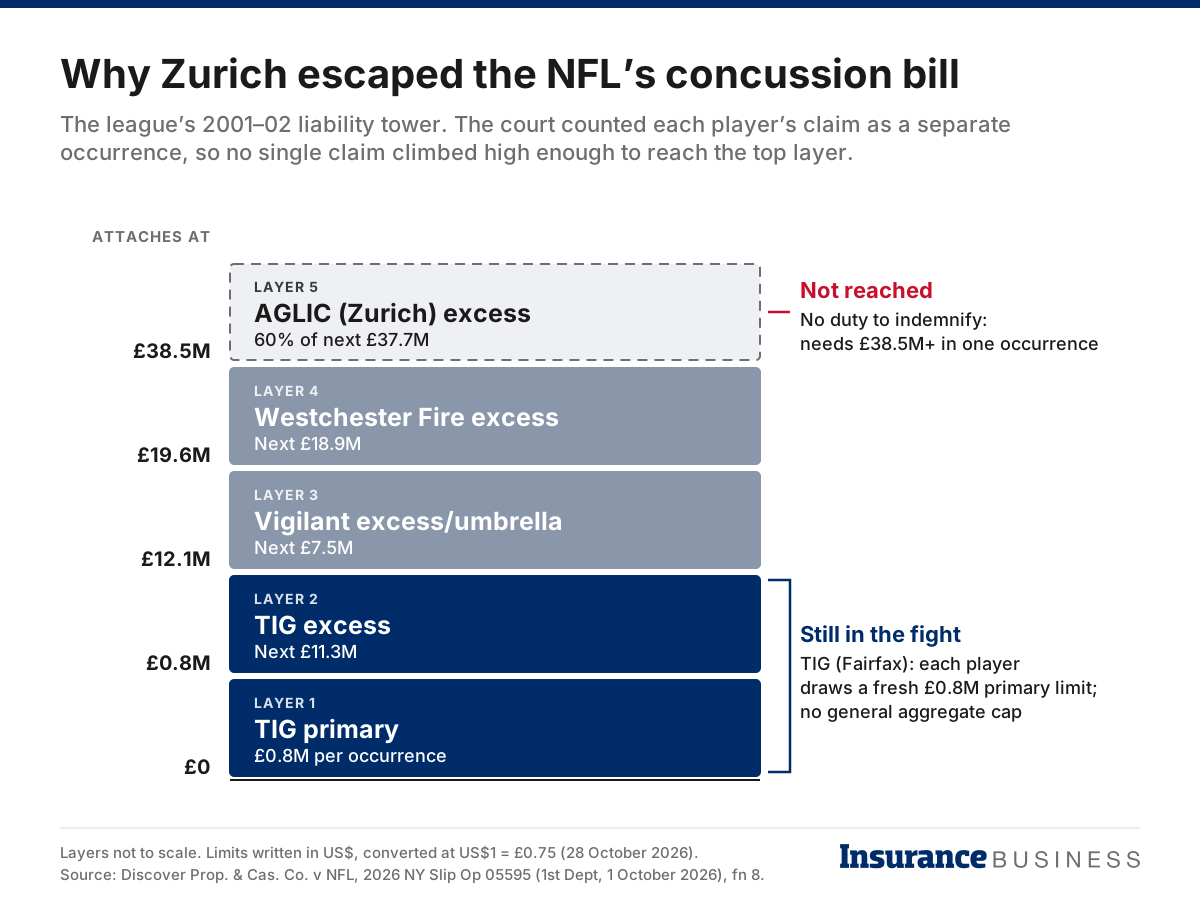
The US is also showing how these claims arrive on a liability tower. The NFL settled with thousands of former players over concussion injuries in 2015, in an uncapped deal that has since paid out more than a billion dollars, and has been fighting its liability insurers ever since over who funds it. On 1 October, a New York appeals court ruled in Discover Property & Casualty Co. v National Football League that each former player's claim is at least one separate occurrence, because the generic grouping language in the league's old policies did not name repeated head impacts as the triggering event.
That left Fairfax unit TIG's primary layer exposed player by player, while a Zurich excess layer that only kicked in above US$51 million (about £38.5 million) in underlying limits owed nothing.
English courts apply their own aggregation principles, built on decades of case law about "event" and "originating cause" wordings, so the ruling is not a precedent here. But the drafting point travels. With more than 1,000 rugby claimants in one action, whether those claims are treated as one loss, a handful, or one per player could decide which layers of the London market ever pay.
The bigger shift may come from the lab rather than the courtroom. CTE can currently only be confirmed after death, which keeps many claims years or decades away. Researchers are working on ways to diagnose it in living people, and if they succeed, claims that today surface late could arrive while claimants are still in middle age.
"We recognize these findings may cause concern for the community of living players and their families," the study's senior author, Boston University biostatistics professor Yorghos Tripodis, said in the university's statement. For UK insurers writing contact sport, from Premiership rugby down to Saturday-morning juniors, the question is no longer whether that exposure is real. It is how to price it.