Andy Burnham has spent his first weeks in Downing Street promising "breathing space" on the cost of living. On his first overseas trip as prime minister this week, he admitted there are limits to how much of that he can give away for free.
Speaking during a visit to Ukraine, Burnham said he "won't be unrealistic" about the state of the public finances. Any further help for households, he made clear, would have to be paid for. Asked directly whether tax rises were coming, he didn't deny it. Instead he leaned on his record running Greater Manchester's finances as proof he won't take risks with people's jobs or household budgets now he's in No.10. The big difference, of course, with his new role is that he doesn’t have a national Government to lobby for more funds – he now has to find that money himself.
For an insurance market already sitting on a record year for premium tax receipts, a live capital gains tax argument and rising employer costs, that's a worry. Chancellor John Healey delivers his first Budget on 28 October, and there are several places insurers, brokers and advisers should be watching closely.
The fiscal backdrop explains why Burnham is hedging. Government borrowing came in at £1.8 billion in July, according to the Office for National Statistics, roughly £2.3 billion above what the Office for Budget Responsibility had expected, and enough to keep the year-to-date deficit running above forecast despite a stronger tax take overall. Inflation ticked up to 2.9% in the year to July, its highest reading in four months, largely because of a fresh jump in the energy price cap.
Capital Economics has suggested the Treasury's fiscal headroom has shrunk from roughly £24 billion in the spring to closer to £17 billion now, leaving little room to simply borrow more. Something in the Budget is likely to move, and insurers have a stake in more than one area under discussion.
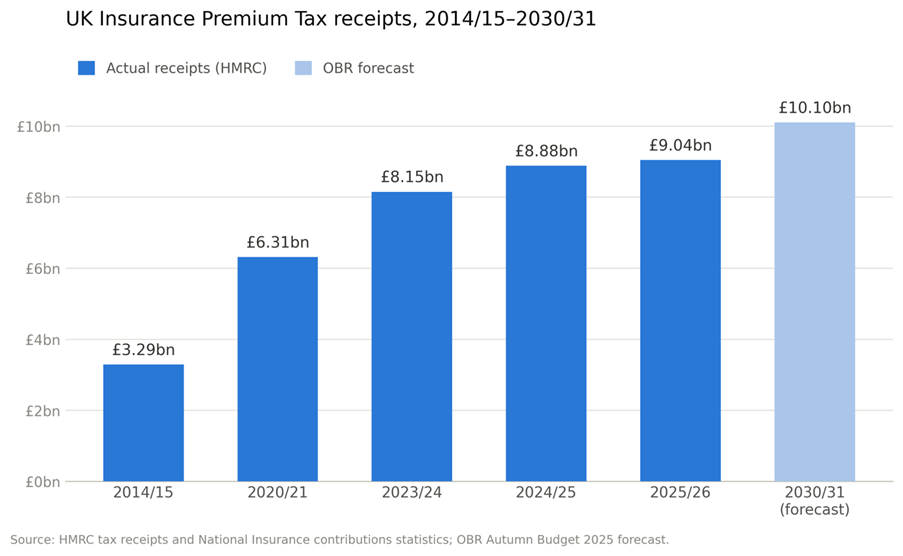
IPT wasn't touched in last November's Budget, staying at 12% for most policies and 20% for travel cover. Receipts have kept climbing anyway. The tax pushed past £6.7 billion in the first eight months of the 2025/26 financial year, putting the UK on course for another record haul. Consultancy Broadstone has argued repeatedly that cutting or scrapping IPT on health cover would pay for itself by easing pressure on NHS waiting lists and supporting workforce productivity, a case that hasn't landed with the Treasury under successive chancellors so far. Whether Healey, inheriting a tighter position than his predecessor, sees it differently is an open question.
IPT is one of the few levers that raises meaningful revenue without breaching Labour's manifesto pledges on income tax, National Insurance and VAT. That alone makes it hard to rule out being asked to do more. Ahead of a previous Budget, Ageas UK chief executive Ant Middle called IPT "a hidden tax on insurance customers" - a complaint that tends to resurface every time Budget speculation starts up again.
Before Burnham won the leadership, then-health secretary Wes Streeting floated aligning capital gains tax with income tax bands: 20%, 40% and 45% depending on earnings, which he billed as "a wealth tax that works." The idea didn't disappear when its author missed out on the top job.
The effect on insurers would run in two directions at once. Analysis commissioned from trading platform suggested the change could cost the Treasury close to £7.8 billion a year rather than raise the £12 billion Streeting's team claimed, because higher rates would discourage investors from selling assets and crystallising gains in the first place. That same reluctance to sell is what makes insurance products look more attractive by comparison.
Onshore and offshore investment bonds, whole-of-life wrappers and other tax-advantaged structures don't trigger the same disposal event, and providers in that space have already seen strong demand: new business in the high-net-worth international life insurance sector reportedly rose sharply in 2024 off the back of earlier tax changes. A CGT shake-up at the Budget, even a partial one, would likely push more money that way. Good for life insurers and platforms. Less good for a Treasury hoping investors simply pay up.
Insurers rarely come up in coverage of business costs, but they're employers too, exposed to the same rising National Insurance bills and wage pressure as any other company. The British Chambers of Commerce has been pushing for a "growth delivery test" on any new Budget measures, pointing out that overheads for smaller firms have risen by around 70% over the past decade. For brokers, the more interesting angle may be on the client side. Rising employer costs have a habit of feeding into claims costs over time, particularly across liability, motor and property lines, as businesses trim maintenance, staffing and risk management spend to absorb the hit elsewhere.
There's also a structural question hanging over the private medical insurance market. The sector has had a strong run: LaingBuisson research put the UK health cover market at £7.59 billion, up £825 million on the year, with 4.68 million people covered by PMI once dependants are counted in. That's its strongest position since the 2008 financial crisis, driven largely by employers and individuals turning to private cover as NHS waiting lists stretched.
That growth has mostly been built on NHS strain under Keir Starmer's government. Burnham's political career has been built on the opposite: fixing the NHS rather than living with its deficit, and his government's stated direction is toward shorter waiting lists over time. Insurance Business has already flagged that the industry's usual pitch for PMI may need remaking for a Burnham government rather than a Starmer one. Any change to employer NI thresholds or rates at the Budget would add cost pressure to group PMI schemes on top of that repositioning.
A land value tax to replace council tax and stamp duty has reportedly been ruled out for this Budget, at least for now, and a full wealth tax on assets over £10 million remains a backbench cause rather than government policy.
A windfall levy on banks, an extension of National Insurance to a wider range of income, and tighter rules on pension salary sacrifice have all been discussed by economists and Labour insiders as more realistic ways to raise revenue. The last of those has been tried once already: the Association of British Insurers pushed back hard on capping salary-sacrificed pension contributions in last year's Budget, warning it would undermine retirement saving.
Insurance touches household budgets, workplace benefits and long-term savings all at once, so it's hard to imagine the sector coming out of October 28 untouched. More tax on premiums, investment gains and employment costs looks a good deal more likely than less, whatever Burnham's careful phrasing in Kyiv suggested.
Don't tell clients IPT is likely to fall. Receipts are already at record levels, and there aren't many alternative revenue-raisers that avoid Labour's manifesto red lines, so a freeze looks more probable than a cut.
Raise the CGT debate with HNW and investment clients before the Budget, not after. If alignment with income tax bands comes back in any form, tax-wrapped products become more attractive relative to direct holdings, and advisers who get ahead of that conversation will be in a stronger position than those reacting to it.
Start modelling NI changes into group PMI and benefits renewals now rather than waiting for Budget day. Employer cost changes have fed through quickly in past cycles.
Keep an eye on pension salary sacrifice if you advise on workplace benefits. It's already been targeted once, and the ABI has made clear it will contest another attempt.