
Another week, another bank telling its people to dig out their season tickets.
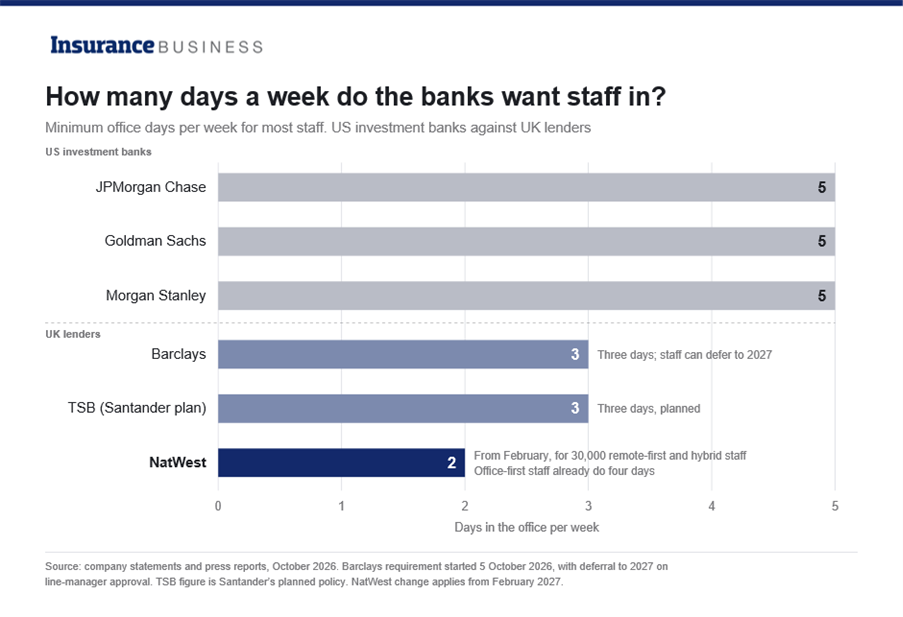
NatWest has told more than 30,000 employees who currently spend most of their working week at home that, from February, they will need to be in the office at least twice a week. The change catches two groups: roughly 13,500 “remote-first” staff who at present only need to show up twice a month, and around 17,000 hybrid workers whose current requirement is three days a fortnight.
The rest of the NatWest Group workforce of about 59,000 are classed as “office first”. They are already expected in four days a week and are unaffected.
The bank insists flexible working is still part of how it operates, but argues that time spent together helps teams collaborate, swap ideas, build relationships and learn from each other. It says staff are being given time to plan ahead and will be supported through the switch.
Unite is not buying it. General secretary Sharon Graham described the move as another blow to workers who have endured years of real-terms pay cuts. Caren Evans, the union’s national officer for finance, said that for many people, “homeworking is not a perk”. It is what lets them juggle caring responsibilities or manage a health condition, she said, and the current set-up has worked well for years.
The union also accuses NatWest of bypassing a consultation process on office attendance that it says was agreed with staff as part of a pay deal.
Read next: Talent attraction, retention now the top concerns for UK insurance – Gallagher Bassett
NatWest is hardly a trailblazer here. Barclays told its 45,000 or so UK staff over the summer that most would need to be in three days a week from 5 October, with more senior people expected in four. After thousands signed an open letter coordinated by Unite, the bank brought in transitional measures allowing staff, with their line manager’s sign-off, to defer the change until the start of 2027.
TSB staff, meanwhile, have threatened legal action over new owner Santander’s plans for a mandatory three-day week.
On Wall Street, the tone has been considerably blunter. JPMorgan ordered all staff back five days a week last year, and Goldman Sachs and Morgan Stanley were early adopters of full-time office attendance. British high street lenders have so far stopped well short of that.
Read next: ‘I don’t care how many people sign that f****** petition’
For insurance bosses watching from across the Square Mile, the timing is difficult. Talent has become the sector’s biggest headache. Gallagher Bassett’s 2026 Carrier Perspective report found that 72% of UK insurers surveyed were finding it harder to recruit qualified candidates, with retention now ranked as their top business challenge. On the broking side, a survey at this year’s BIBA conference found four in ten brokers put talent above AI, emerging risks and regulation as their leading concern.
Flexibility sits right at the heart of that fight. Insurance Business UK’s Top Insurance Employers data shows hybrid working has gone from a perk that set employers apart to something candidates simply expect. At specialty insurer LSM, for example, many teams have settled on two to three office days a week. Recruiters report that experienced insurance professionals have been tempted to move by fairly small tweaks to their hybrid pattern, and that plenty would rather do two days in the office than three.
Read next: Best Insurance Companies to Work for in the UK | Top Insurance Employers
The wider numbers point the in the same direction. According to the Office for National Statistics, more than a quarter of working adults in Great Britain were hybrid working in early 2025, and the share has crept up rather than down since 2022. Research from King’s College London found that only 42% of UK workers would comply with a full-time office mandate, down from 54% in 2022, while close to six in ten said they would either quit on the spot or start job-hunting. That research covered 2022 to 2024, so attitudes may have shifted since.
None of that means the office has lost the argument. A roundtable of insurance market figures convened by law firm Clyde & Co found broad agreement that brokers, underwriters and senior staff should be in more often, and that when leaders turn up, others tend to follow. The London market runs on relationships, and juniors have traditionally learned the trade by listening in on deals. That is hard to replicate over Teams.
Some insurers already ask for more than NatWest will. Aviva’s careers site says staff on its Smart Working policy must spend at least half their time in the office and come in every week.
But the Clyde & Co discussion also flagged a lack of hard evidence that more office days actually lift productivity, and noted that some employers in the market are already fielding grievances and claims from staff who do not want to go back, including allegations that attendance policies are discriminatory.
There is a statutory dimension too. Employees can ask for flexible working from their first day in a job, and employers have to handle those requests reasonably. A blanket mandate does not change that.
Read next: Talent shortage looms for UK brokers as young recruitment falters – report
Office policy has become a retention decision with a price tag attached. Banks can lean on scale and brand to absorb some attrition. A mid-sized broker or MGA, competing for the same handful of experienced account handlers and claims specialists, may find that one extra office day is all it takes for a rival to poach its best people.
For insurers, a more useful question than “should we order everyone back?” is “who actually gains from being in, and how often?” Client-facing teams, trainees and anyone learning the ropes probably need more time together. Others may be doing perfectly good work from the spare room. Getting that split right, and consulting properly before changing it, carries far less risk than finding out the hard way how strongly people feel. Barclays has just done exactly that.