Heat has never fitted neatly into the way UK insurers think about catastrophe. Windstorms get names and event dates. Floods have postcodes. A heatwave leaves cracked walls, overstretched hospitals and lost trading days, spread across a dozen policy lines and several months.
A Reuters investigation published this week argues that the biggest heatwaves should be treated more like storms. Working with about two dozen climate scientists, the agency analysed more than 65 years of hourly temperatures across roughly 1.04 million grid squares. It defines a heatwave as at least five consecutive days of abnormally high temperatures. Any heatwave that covers 1% or more of the Earth’s surface at its peak, an area about half the size of Canada, becomes a “heat storm” and gets a name.
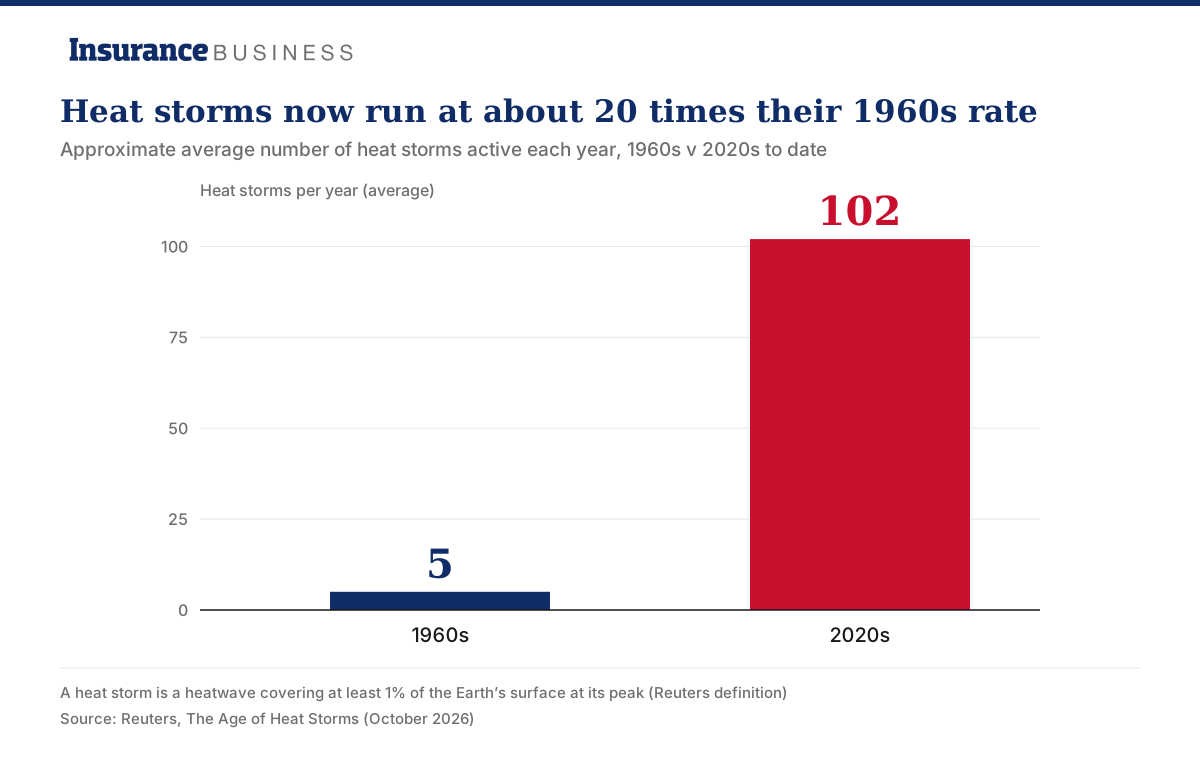
By that measure, the world averaged about five heat storms a year in the 1960s. This decade it is averaging about 102. Reuters also found that at least one has been active somewhere on the planet every day for more than 18 years.
The biggest so far, Heat Storm Vera, started on 29 July 2023 and lasted 367 days, reaching almost 85% of the globe at some point. Its successor, Heat Storm Raimundo, formed on 28 February this year and has not yet ended. Reuters links it to Europe’s summer heat and the large wildfires in Spain and France. On 28 August it covered 33.8% of the planet’s surface at once.
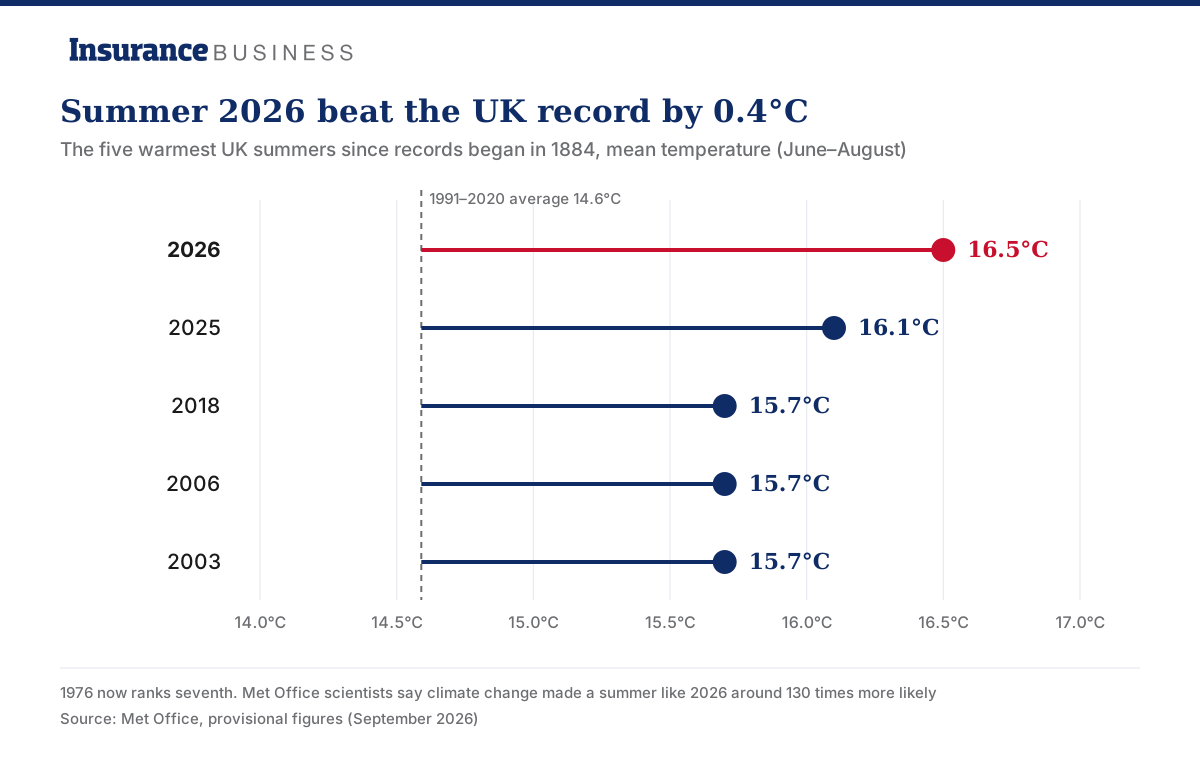
The UK numbers make the case without any new label. The Met Office says summer 2026 was provisionally the warmest since its series began in 1884, with a mean temperature of 16.5C. The previous record, 16.1C, was set only last year. The famously hot summer of 1976 now ranks seventh.
Lingwood in Norfolk set a June record of 38.0C, Hartpury College in Gloucestershire reached 38.2C on 13 August, and 54 Met Office stations recorded their highest temperature ever. By mid-August the UK had logged 35 days at 30C or above, beating the record of 34 set in 1995, Insurance Business reported.
Met Office attribution scientists estimate that climate change made a summer this hot about 130 times more likely. Without human emissions, they say, it would have been rarer than one in 1,000 years. In today’s climate they expect one roughly every nine years.
Read next: Third heatwave of 2026 renews subsidence and wildfire risk warnings for insurers
Most home insurers will feel it first in subsidence. The Association of British Insurers says members paid £72m on domestic subsidence claims between April and June, and the average claim reached a record £20,000, more than £2,000 higher than a year earlier. Payouts for the whole of 2025 reached a record £307m, Insurance Business has reported.
More claims are likely on the way. Clay soils shrink as they dry, and the damage often appears months later. After the 2022 heatwave, 18,000 of that year’s 23,000 subsidence claims arrived in the second half. Steven Coxon, head of subsidence at Claims Consortium Group, said in May that ground damaged in 2025 left “the potential for us to see yet another surge event this year”.
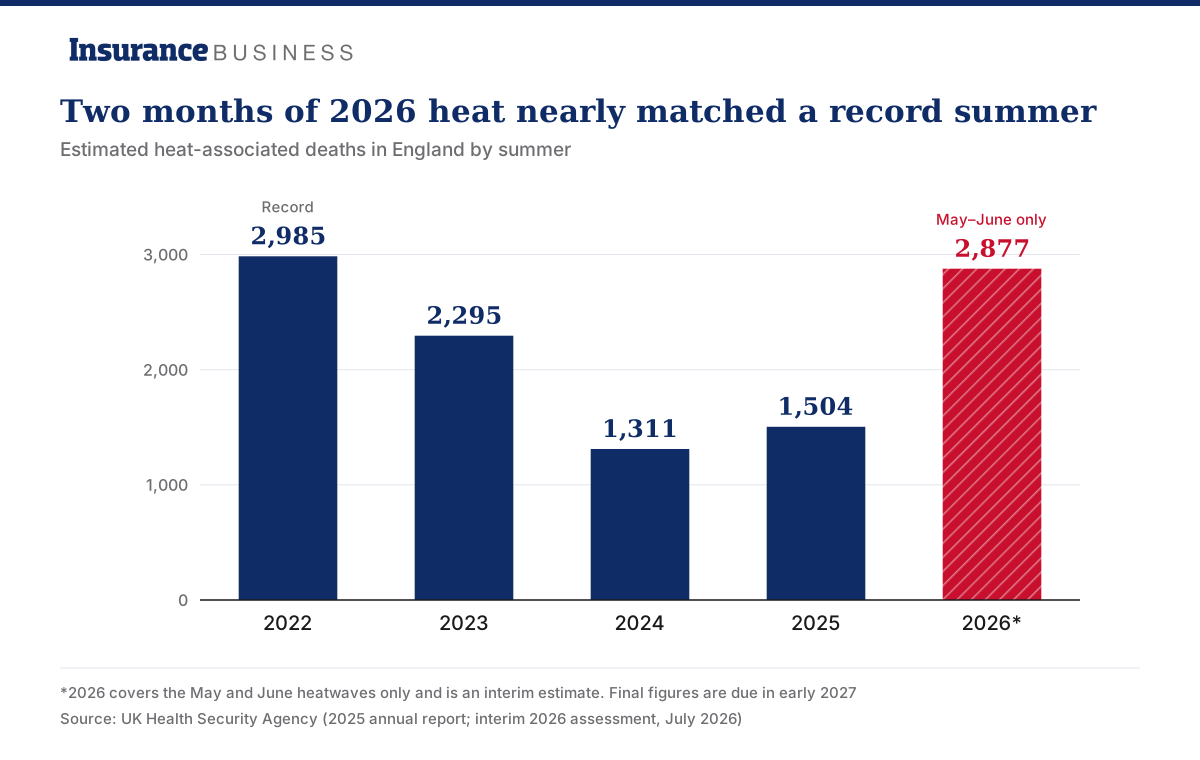
Heat deaths are rising as well. The UK Health Security Agency estimated 1,504 heat-associated deaths in England over summer 2025. Its interim estimate for this year’s May and June heatwaves alone is 2,877, close to the 2022 record of 2,985, and the agency expects 2026 to set a new high.
Those figures matter for life and health portfolios, and for liability claims against care homes, hospitals and employers. The UK has no legal maximum working temperature, so employers are expected to manage heat through their general risk assessments.
Business interruption is harder to pin down. Heat costs firms money when staff can’t work or customers stay away, but traditional BI cover usually needs physical damage before it responds. Insurance Business has reported that more large European companies now name heat as a risk on earnings calls, and that some insurers are looking at parametric products to cover the gap. Lloyd’s itself told around 1,200 staff to work from home during one heatwave this summer.
Read next: Fourth UK heatwave piles pressure on insurers facing record claims
Deloitte expects UK home insurers to post an underwriting loss in 2026, forecasting a net combined ratio of 102.1%. Wildfire is adding to the bill. The Environment Agency had recorded 110 wildfires on Sites of Special Scientific Interest by August, and IB has covered London’s emergence as Britain’s wildfire capital and a New Forest heathland fire that produced motor, property and BI claims at the same time.
The PRA’s first dynamic general insurance stress test, held over three weeks in May, put firms through an earthquake, a hurricane, a UK windstorm, European flooding and a cyber attack, IB reported. A long heat and drought season was not among the scenarios.
The exercise was built to test how firms respond to sudden shocks, so that is understandable. Heat losses build more slowly, through subsidence, health and liability claims that can take a year or more to settle, and they are hard to capture in a scenario that plays out over three weeks.
Read next: PRA stress test too demanding, insurers tell Bank of England
“Heat storm” is Reuters’ term, not an official peril, and it won’t change how any UK loss is classified. It does give brokers a reason to raise questions many clients haven’t been asked.
For homeowners and landlords on shrinkable clay, those questions are about subsidence excesses and whether clients know what early damage looks like. Rural and agricultural clients, and anyone near heathland, need to know whether their property cover names wildfire. With half of England in drought this summer, farm and crop policies deserve a separate look.
On the commercial side, brokers can check how BI wordings treat non-damage events, utility failure and denial of access, and whether stock spoilage and breakdown cover extend to refrigeration and cooling equipment. Employers with outdoor or physical work, and care home operators, should be able to produce a heat risk assessment that would hold up if a claim is made.
Read next: UK ‘underprepared’ for wildfire risk as losses hit record levels
Reuters says Raimundo hasn’t finished yet. For UK insurers, the claims from this summer haven’t either.