German chancellor Friedrich Merz has said that reports of Russia preparing to launch a nuclear-armed satellite were shocking, and that they showed how far Moscow appeared willing to escalate. He was speaking in Berlin alongside Nato secretary general Mark Rutte.
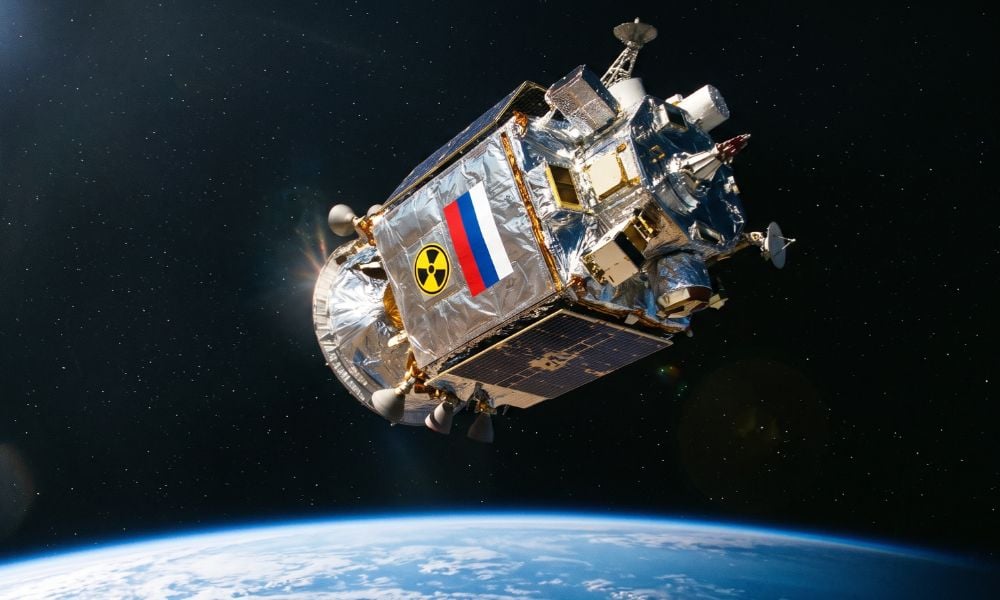
The reports come from broadcasters NDR and WDR and the Süddeutsche Zeitung. They say Germany's foreign intelligence service, the BND, and the Bundeswehr have shared intelligence with several Nato allies about a satellite called Sputnik-S. The satellite was reportedly built several years ago and has been stored in the Moscow region since then. Warnings circulated in early November said it could be launched within 60 days, which puts the window between now and early January. The Bundeswehr's space command reportedly thinks a December launch is possible.
The German government says it is taking the warning very seriously but that there is no immediate threat. Rutte did not comment on the intelligence directly. He said Nato would defend "every inch" of its territory, and that this included space.
The Kremlin dismissed the story. Spokesman Dmitry Peskov said reports based on unnamed sources were "hardly worth taking seriously". Russia's embassy in Berlin called them propaganda and said Russia's activities in space were peaceful.
No launch has been confirmed, and the intelligence behind the reports has not been made public.
Placing a nuclear weapon in orbit would breach Article IV of the Outer Space Treaty, which has been in force since 1967. Russia is a party to the treaty.
US concern has been building for some time. In October the Defense Intelligence Agency published its latest unclassified assessment of threats in space. It says Russia is developing a satellite designed to carry a nuclear weapon, and warns that such a weapon could cause the "rapid and sudden loss or degradation of thousands of satellites". The US Space Force's space threat fact sheet goes further, saying the capability could threaten every satellite and the services that depend on them.
Read next: Your client may already have a space risk without knowing it
There is a precedent, and Britain was on the receiving end of it. In July 1962 the US detonated a 1.4-megaton warhead about 400km above the Pacific in a test called Starfish Prime. The explosion created an artificial radiation belt, and over the following months satellites that passed through it stopped working.
Among them were Ariel 1, Britain's first satellite, and Telstar 1, which had relayed some of the first television pictures across the Atlantic. Telstar finally failed in February 1963.
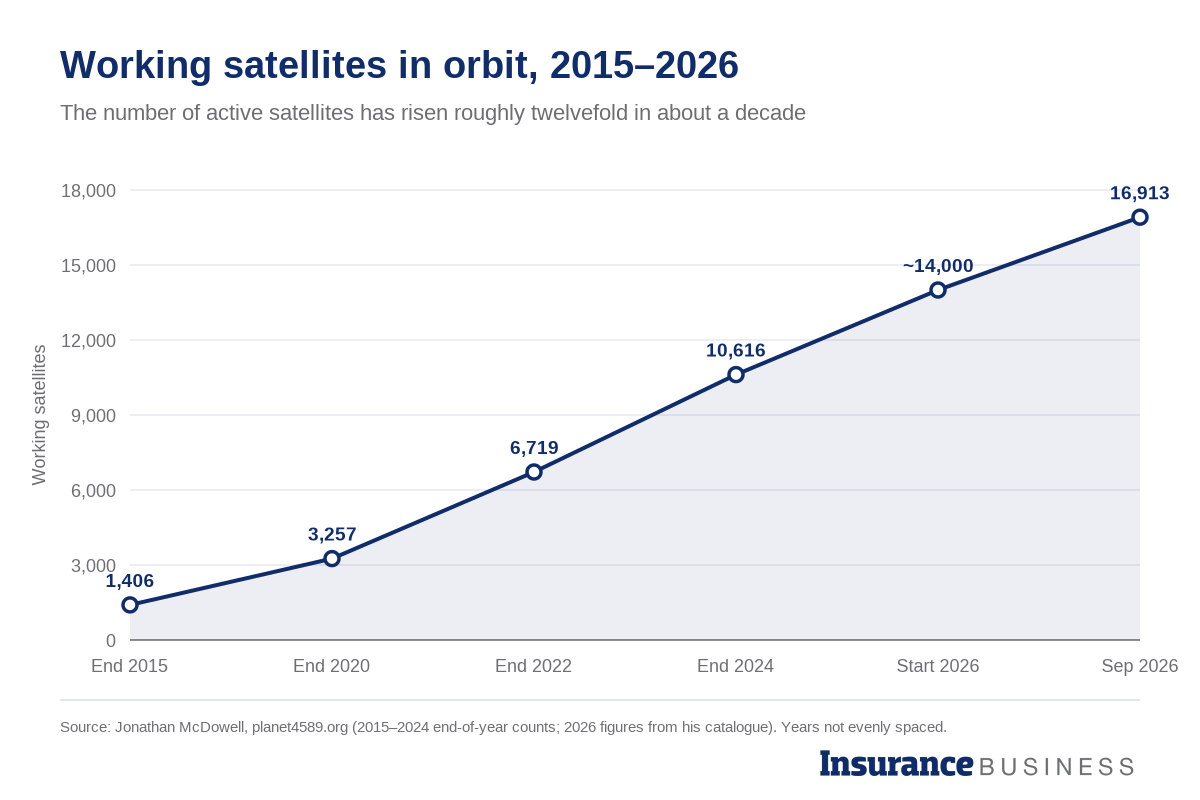
Space was almost empty then. It is now very crowded. Astronomer Jonathan McDowell, who keeps one of the most widely used catalogues of objects in orbit, counted about 1,400 working satellites at the end of 2015. By the end of 2024 there were more than 10,600, and the DIA now puts the number in low Earth orbit alone above 15,000.
A nuclear blast would not need to hit anything directly. Radiation trapped in the Earth's magnetic field would damage satellites gradually, including Russia's own.
Read next: Satellite insurance in freefall as space risks multiply – report
For space underwriters, a nuclear detonation in orbit falls outside cover. Satellite property policies are written on an all-risks basis, but they exclude war in its various forms, and cyber too.
Tim Rush, a senior partner at Gallagher Aerospace, told a US industry symposium last month: "Right now, those are not insurable risks. These are excluded events."
The International Union of Aerospace Insurers has discussed creating a war-risk market for space, similar to the ones that exist for aircraft and ships. Rush said any such cover would probably exclude conflicts involving the major nuclear powers, and Russia is one of them.
Most satellites carry no insurance in the first place. Andrew Bonwick, vice president of product development at Relm Insurance, estimates that only 3% to 4% of satellites in low Earth orbit are insured. The market is also small. Rush said premium has averaged about $500m a year recently, and Bonwick puts the most capacity available for a single spacecraft at roughly $500m to $600m.
Read next: Space insurance is moving beyond the single satellite model
Few UK brokers place satellite cover. Far more have clients who rely on satellite services without realising it, because positioning, navigation and timing signals sit underneath logistics, emergency response, shipping and a lot of everyday business.
Research commissioned by the government estimated that losing GNSS for 24 hours would cost the UK economy around £1.4bn. A seven-day outage would cost about £7.6bn, with emergency services, road transport and maritime taking most of the hit. The study looked at outages in general rather than a nuclear attack.
Many business interruption policies only respond to physical damage at the insured's premises or a supplier's. A satellite failing hundreds of kilometres up may not meet that test. If it does, a war exclusion is likely to apply.
"You're not insuring space businesses, you're just insuring objects in space," Bonwick told Insurance Business earlier this year.
There is no cover for a nuclear attack on satellites, but brokers can still help clients prepare. The first step is finding out which parts of a client's business depend on satellite navigation, timing or communications. Brokers can then check how the war, cyber and infrastructure exclusions in the client's BI wording interact. They can also ask whether continuity plans allow for GPS or satellite links being down for days rather than hours.
Willis has argued that political risk now lies in contested systems as much as in war zones. Orbit is one of those systems.
The Outer Space Treaty was signed so that nobody would ever have to plan for this. Underwriters may have to plan for it anyway.