Fraudsters are spending less time breaking into accounts and more time talking their way into them, if the banking industry's latest numbers are anything to go by.
Criminals took £659.5m through payment fraud in the first six months of 2026, according to UK Finance's Half Year Fraud Report. That is 8% more than the same period last year. Confirmed cases fell 14% to 1.78 million. Put simply, there were fewer frauds, but each one cost more.
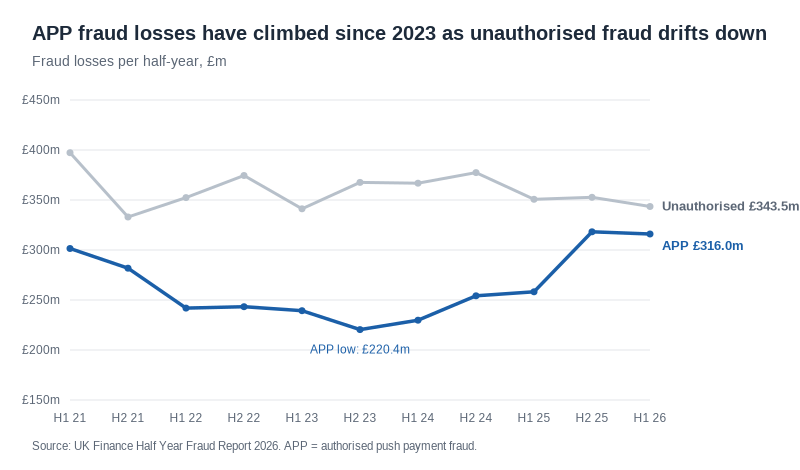
Unauthorised fraud losses slipped 2% to £343.5m, with cases dropping 17%. By contrast, authorised push payment (APP) fraud losses rose 22% to £316m, with cases up 25% to 138,345. Both APP figures are the highest the trade body has recorded for a first half. APP fraud now accounts for roughly 48p of every pound stolen.
"When one route becomes more difficult for criminals to exploit, they will look for another," Ruth Ray, UK Finance's managing director of economic crime, wrote in the report's foreword.
The half-year numbers follow a bruising full year. UK Finance's annual fraud report, published in June, showed payment fraud losses of £1.28bn for 2025, a 4% annual rise, with APP losses up 19% to £576.4m.
Read next: Phone scams cause 28% of APP fraud losses. A client's crime policy needs the right wording
Investment scams are still the costliest kind of APP fraud. Losses rose 29% to £126.3m, which is 40% of the APP total. The average investment scam case cost the victim more than £16,000, against £2,284 across all APP types. UK Finance notes these frauds can run for months before victims realise what has happened. Some of today's losses therefore reflect payments made a while ago.
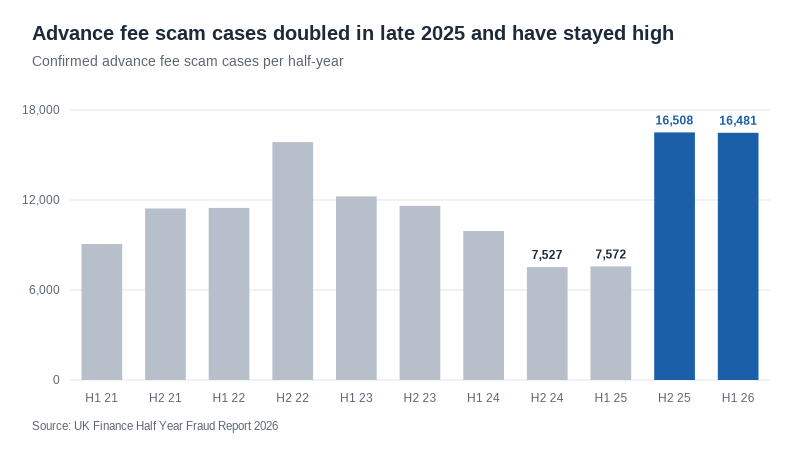
The sharpest jump came in advance fee fraud. Cases more than doubled to 16,481 and losses rose 73% to £34m. The report links part of this to a new style of deposit scam. Victims pay to "reserve" a car, boat, luxury watch or piece of construction equipment that never turns up. Fake recruitment schemes are also growing. These charge job seekers up front for training, kit, visas or background checks.
Purchase scams remain the high-volume problem. There were 95,830 cases, nearly seven in ten of all APP cases, and losses reached £66m. That is the highest figure since UK Finance began collecting this data in 2020.
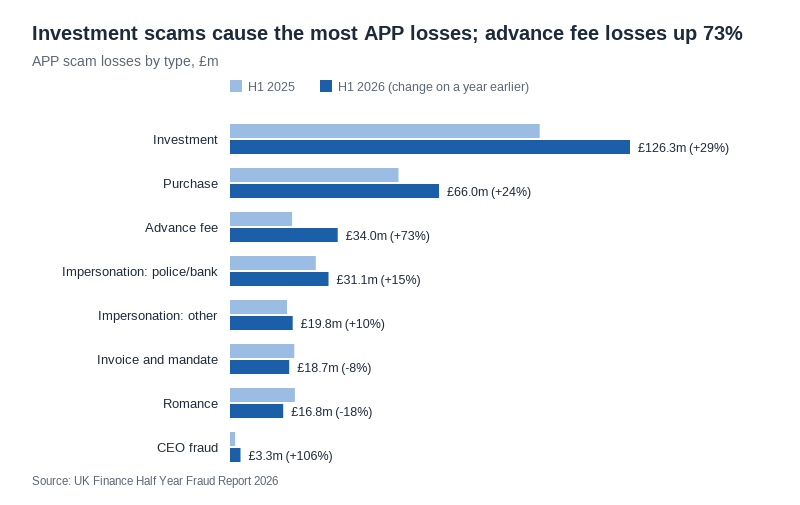
CEO fraud, where someone impersonates a senior executive to rush through a payment, rose from 78 cases to 171. Losses doubled to £3.3m. At just under £20,000 per case, it has the highest average loss of any scam type. Only 24% of the money lost was returned to victims.
Invoice and mandate fraud losses dipped 8% to £18.7m. However, three-quarters of those losses (£14m) fell on business accounts, and only 38% was recovered. UK Finance points out that businesses make large, genuine payments often, so a fake one is harder to spot.
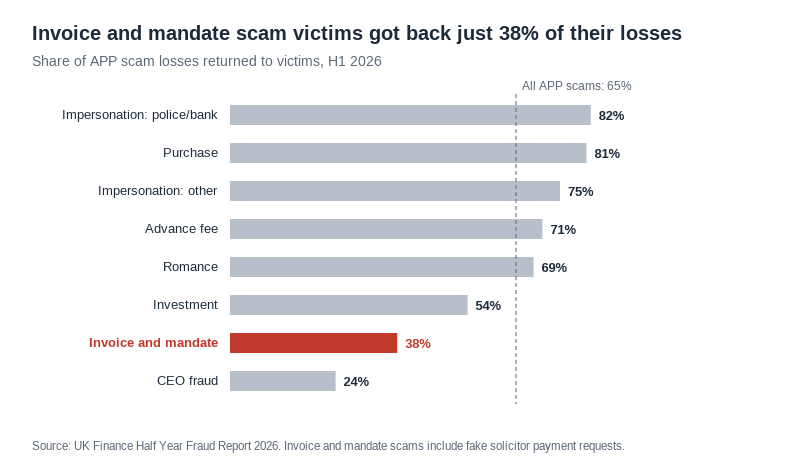
The reimbursement rules explain the low recovery rates. The Payment Systems Regulator's mandatory regime, in force since October 2024, protects personal, micro-enterprise and charity accounts. It only applies to UK Faster Payments and CHAPS transfers. Its cover runs to £85,000 per claim, and it does not extend to cash or card payments. Larger firms fall outside it altogether, so their safety net is their own controls and their crime or social engineering cover. The PSR's performance data shows how individual banks are doing under the regime.
Cross-border payments are also outside the scheme, and they are growing fast. APP losses sent internationally rose 32% to £39.2m. The number of those payments jumped 69%.
The figures are consistent with what insurers say they are seeing. Gallagher research published in April found half of UK businesses had been targeted by fraudsters posing as senior leaders in the previous year.
Read next: Half of UK firms hit by executive impersonation as AI-driven fraud surges - report
The better news is mostly about cards. Card fraud losses fell 4% to £286.4m. Remote purchase fraud, which covers online and phone transactions, dropped 10%. Banks and card firms blocked £810.5m of attempted unauthorised fraud in total, about 70p of every pound criminals went after.
UK Finance warns against reading too much into the fall. Some of the drop is likely because criminals now trick people into making card payments themselves. Those transactions don't show up in the unauthorised figures, and the APP data only counts bank transfers.
Mobile banking is moving the other way. Unauthorised mobile banking losses rose 18% to £25m and cases rose 61% to 15,873. Both are first-half records since 2015. Telephone banking losses jumped 57%, and cases more than doubled. Mobile apps were also the channel for £177.5m of APP losses, more than half the total and up 40%.
The report says criminals increasingly use AI tools, richer stolen personal data and automated messaging to dress up old tricks. Brokers will know this from the claims side. As the deepfake debate in cyber insurance shows, the trigger may look like a cyber event while the loss behaves like a crime.
Read next: How deepfakes are reshaping cyber insurance, and exposing policy blind spots
Most APP fraud still starts well outside the banking system. Online platforms were the source of 58% of cases, though mostly the lower-value ones. Phone calls and messaging services were the source of just 16% of cases but a third of all losses. That pattern fits the larger impersonation and investment scams.
The biggest change is in the "unknown" category. Banks could not say where 21% of cases, and 23% of losses, began. Two years ago the figure was 10% of cases. UK Finance puts this down to scams that move across several channels before the money moves.
That is the gap the government's Fraud Strategy 2026 to 2029 is meant to close. The strategy commits more than £250m over three years and includes a public-private Online Crime Centre designed to share data and disrupt online fraud at scale. UK Finance wants tech platforms and telecoms firms to share more responsibility for stopping fraud before it reaches a bank account.
Insurers are dealing with the same criminal methods on their own books. Aviva detected a record £233m of claims fraud in 2025, across more than 18,400 suspect claims.
Read next: Aviva detects record £233 million in fraud as AI tools and ghost broking accelerate
Firms returned £205.7m to APP victims in the first half, about 65% of what was stolen. That is up from roughly 62% a year earlier. Ray was blunt that this is no win: reimbursement, she wrote, "should not be mistaken for success in tackling fraud."
For brokers, the takeaway is simple. Consumer refunds are improving, but the fastest-growing losses are landing on businesses, which mostly sit outside the refund regime. The questions to ask a commercial client are about their payment verification process and how their crime wording treats a voluntary transfer. Those questions are better asked now than after a fraud.
Read next: UK brokers are not prepared for an AI fraud crisis