There's a national stereotype and then there's the insurance office version of it. British workers are famously the sort who apologise when someone else steps on their foot, who say "no rush at all!" while quietly recalculating their entire afternoon, and who will sit through a 45-minute meeting nodding along to a plan they think is mad rather than say so out loud. Insurance which is an industry built on committees, sign-offs and keeping brokers and clients sweet arguably does all of this a little harder than most.
We don't just avoid conflict. We schedule a follow-up call to avoid it more thoroughly.
New workplace data suggests this habit has a price tag. Acas, the UK's workplace conflict body, found in its largest-ever study of conflict at work in Great Britain that financial and insurance firms report less day-to-day conflict than almost any other sector. That’s 36%, against a national average of 44%. Given the average British worker is already, according to that same survey, more inclined to say nothing than to raise something, an industry coming in even quieter than that isn't a badge of honour.
It might just mean insurance has perfected the art of disagreeing entirely through facial expressions.
Read next: Why responsible leadership is the insurance industry's untapped advantage
The world thinks we're marvellously polite. We're not so sure.
Here's where it gets properly, gloriously British. A 2026 global survey by financial services firm Remitly asked more than 4,600 people across 26 countries who they thought the politest people in the world were and then, separately, asked people to rate their own country's manners.
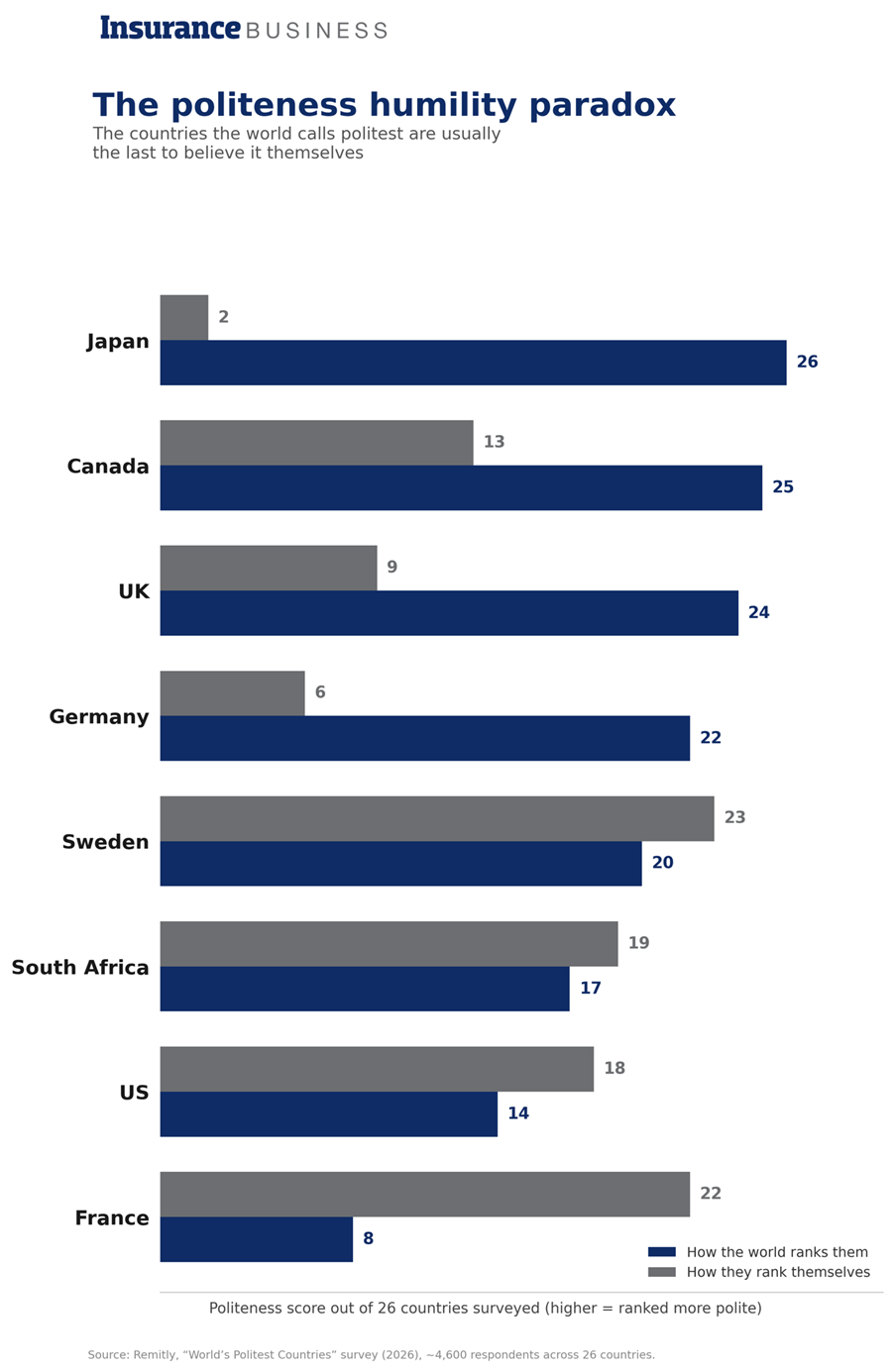
The UK came third in the world for external perceptions of politeness, behind only Japan and Canada, largely on the strength of our queuing, our relentless "please"s and "thank you"s, and our god-given talent for deadpan understatement.
And then British respondents were asked to rate their own country's politeness. We ranked ourselves 18th out of 26. Practically bottom of the class, by our own reckoning, at the one thing the entire planet agrees we're good at.
Japan first place globally, by a landslide, rated itself 25th out of 26, second only to being embarrassed about being first. It's less a politeness ranking, more a humility Olympics, and everyone's trying to lose.
Ah yes, what about the French? The politeness humility paradox
The pattern holds almost everywhere: the countries the world considers most polite — Japan, the UK, Germany — are precisely the ones that refuse to believe it about themselves. France, amusingly, does the opposite: ranked a fairly average 19th by everyone else, but 5th by its own citizens. Make of that what you will.
It's a fun bit of trivia. It's also, arguably, a national personality trait wearing a lanyard and turning up to work every day. If a whole culture has trained itself not to accept a compliment about being nice, it's not exactly a leap to imagine that same culture struggling to accept or deliver an uncomfortable truth about a renewal, a claim, or a colleague's performance.
Read next: The new edge in insurance retention
This isn't a new observation about British working life, either. Back in 2015, expense-management firm Webexpenses surveyed 1,000 UK managers and found that 78% believed being too polite was costing their business money, and nearly two-thirds admitted they were too well-mannered when handling difficult situations, quietly letting things slide from persistent lateness to suspected fraudulent expense claims, simply because confronting it felt rude.
Its chief executive at the time, Adam Reynolds, called it plainly: "stereotypical British politeness" was hurting the bottom line. A decade on, with the Acas figures above sitting right next to it, this looks less like a one-off finding and more like a national personality trait with a spreadsheet attached.
There's solid academic backing for why this actually matters, beyond making for a good dinner-party fact. Harvard Business School's Amy Edmondson coined the term psychological safety after a 1999 study of hospital teams found something delightfully counterintuitive: the best-performing teams reported more errors, not fewer because they felt safe enough to admit when something had gone wrong, rather than quietly hoping nobody would notice.
Economist Albert Hirschman made a related point back in 1970's Exit, Voice, and Loyalty: faced with something going wrong, people either leave, stay and go quiet, or speak up — and organisations only survive long-term if they make room for that third, distinctly un-British option.
Acas found that when managers had a live disagreement with someone reporting to them, 35% took no action at all to resolve it. That’s the highest rate of inaction recorded for any working relationship in the study. In other words: over a third of UK managers, faced with a direct report they had an actual problem with, chose the meeting-room equivalent of staring out of the window and hoping it would sort itself out.
For an industry built on underwriting panels, claims escalation and broker-insurer negotiation, that avoidance isn't just a soft HR footnote, it shows up as risk appetite that never gets properly stress-tested because nobody fancied being the one to challenge the room, and as underperformance that limps along for months because a manager kept dressing feedback up in so much diplomatic padding that the actual message never survived the trip.
Capability and performance issues were, in fact, the single most common source of workplace conflict overall in the Acas research, cited by 38% of everyone who reported a dispute.
The bill for all that unspoken tension adds up. Acas puts the annual cost of unresolved workplace conflict in Great Britain at £28.5 billion, and the CIPD's Good Work Index 2024 found fewer than half of workers who experience conflict feel it was ever properly resolved.
Many, naturally, just "let it go" which is about as British a coping mechanism as exists, somewhere between a stiff upper lip and quietly rewriting your CV.
Read next: Insurance leaders rethink talent, resilience and leadership
Priya Parker, a New York-based conflict resolution facilitator with 25 years' experience inside organisations, has a term for what's often happening beneath all that calm: toxic politeness. Speaking recently to sister HR title Human Resources Director, she said the tell isn't how much conflict a workplace has, but what's underneath the quiet.
"My clients will be the first ones to tell me that they suffer from unhealthy peace… and that they're unpracticed at even small disagreements," she said. The pattern, in her experience, is an oscillation between saying nothing at all and sudden blow-ups: "quiet, quiet, quiet, and then there's an explosion", which will sound uncomfortably familiar to anyone who's sat through a "no issues from me, all good" team meeting, only for someone to hand in their notice three weeks later.
None of this is a case for turning insurance offices into shouting matches and nobody's suggesting underwriters start slamming laptops shut for dramatic effect.
Parker is clear that the goal isn't conflict for its own sake, but what she calls "healthy heat": disagreeing with real care, rather than not disagreeing at all. Her framework comes down to three shifts. Treat constructive disagreement as a core team skill rather than one manager's personality quirk, train the whole team in it rather than just whoever happens to run the meeting, and deliberately build small rituals that make disagreement normal before a crisis (or a resignation letter) forces the issue.
For an industry that has spent decades quietly, politely, proudly being unflappable, that might take some getting used to. But as Parker put it, conflict handled well isn't a sign something has broken, it's usually what stops something from breaking later.
Sorry to be so direct about it. We'll see ourselves out.