For several series, viewers watched Richard Hammond put science to the test on Brainiac, from which foods made the worst smell after eating to which office equipment you should cling to in a flood. In an experiment that may well have been inspired by that entertaining lunacy, Flood Re has enlisted researchers at the University of Hull on what sounds, at first, like a rather high-jinks caper.
For decades, the sandbag has been the nation’s go-to emblem of flood defence, piled on doorsteps in every news bulletin whenever the rivers start misbehaving. Flood Re has questioned that assumption, and it turns out sandbags may have been coasting on reputation.
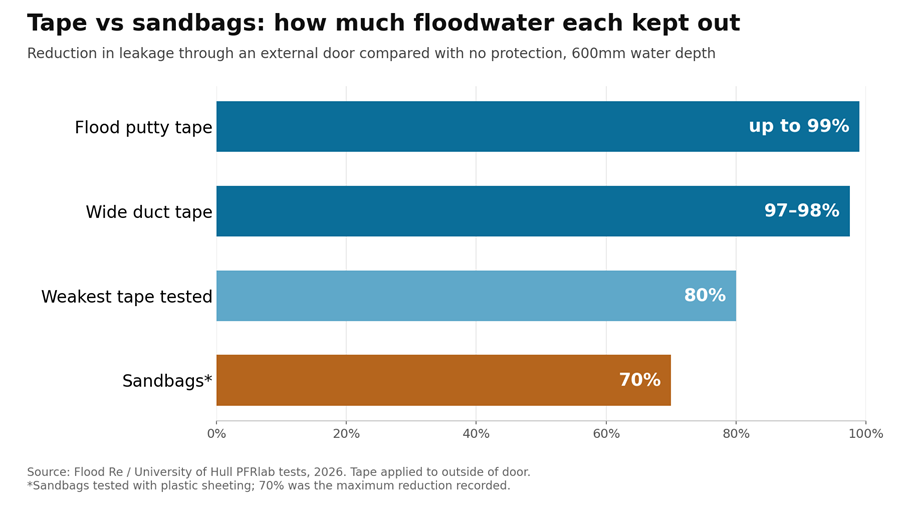
Laboratory tests carried out for Flood Re by researchers at the University of Hull found that every tape they tried, from specialist flood putty tape to humble yellow plastic tape, kept more water out of a doorway than sandbags did when stuck to the outside of the door.
The star turn was flood putty tape, a butyl-style product, which cut leakage by up to 99% and proved as much as ten times more effective than sandbags under test conditions. Good-quality wide duct tape, the DIY enthusiast’s answer to everything, reduced leakage by 97% to 98% compared with an unprotected door. It also took the overall crown, striking the best balance of performance, price, durability and how easily it can be slapped on in a hurry.
Even the runt of the tape litter cut leakage by 80%. Sandbags managed around 70%.
Read next: Aviva: Flood resilience in new builds could save £60 million
Because this was proper science, the experiments took place at PFRlab, Hull’s purpose-built property flood resilience testing facility, developed with backing from Flood Re and the Environment Agency. Six common door types faced water depths of up to 600mm, roughly two feet, mimicking the shallow but ruinous flooding that hit the city in June 2007, when more than 8,600 homes and 1,300 businesses flooded.
Not everything in the kit covered itself in glory. Temporary demountable barriers turned out to be the divas of the bunch. Fitted properly, they could keep water out completely, but like a piece of flat-pack furniture, getting them right without specialist know-how proved tricky, so results swung from total protection to outright failure.
The doors had effects of their own. Before any protection went on, a standard outward-opening door let in 74% less water than an inward-opening one. And tape on the outside of the door comfortably beat tape on the inside, so taping yourself in from the hallway is off the table.
“Sandbags remain a symbol of flood protection, but these tests turn that assumption on its head,” said Jonathan Kassian, head of flood resilience at Flood Re. Floods minister Emma Hardy also welcomed the work, saying simple, affordable products could make a real difference to at-risk communities.
Read next: Flood maps may no longer tell the whole story
The research takes aim at the type of flooding that has climbed fastest up insurers’ worry lists. The Environment Agency’s national assessment of flood and coastal erosion risk puts around 4.6 million properties in England in areas at risk of surface water flooding, 43% more than its previous estimate, although the agency puts most of that jump down to better data and modelling. About 1.1 million of those are at high risk, triple the earlier figure. Surface water floods also tend to be shallower than river or coastal flooding, which is exactly the sort of water a well-taped door has a fighting chance against.
Before anyone swaps their flood plan for a trip to the hardware shop, Flood Re is keen to keep expectations in check. Temporary measures such as tape, it stresses, are no substitute for permanent, professionally specified property flood resilience where it is needed. The research feeds into its work on Flood Performance Certificates, designed to help homeowners understand their flood risk and what they can do about it.
Read next: Flood resilience gap in new builds leaves insurers blind
The findings round off a Flood Action Week heavy on resilience. Aviva estimated that building basic flood resilience into new homes could save around £60 million over a decade, while Flood Re named its senior independent director, Simon Green, as chair, subject to regulatory approval, as the scheme counts down to its planned exit in 2039.
Read next: Insurance moves: Flood Re, HDI Global and Howden
For home insurance brokers with clients in flood-prone postcodes, this is advice that will not break the bank: keep a roll of flood putty tape or decent wide duct tape in the house, and know how to apply it to the outside of external doors before the water is lapping at the step. Clients can check their own exposure using the government’s long-term flood risk service.
The bigger picture is less jolly. As Flood Re’s 2039 sunset creeps closer and pricing drifts towards risk-reflective rates, evidence of resilience, whether a roll of tape in the cupboard or a fully fitted flood door, is likely to count for more when it comes to getting cover and keeping it affordable. And for clients with inward-opening front doors, which way the replacement swings could be a conversation worth having.
Read next: UK flood risk is rising and Flood Re was not designed for this climate